The Continental Opening Algerian Merchants Have Been Waiting For
Algeria’s online economy is no longer a niche. According to ECDB’s market data, the country generated roughly US$1.7 billion in e-commerce revenue in 2025, served by nearly 200,000 registered online merchants. The number of registered e-commerce businesses has been expanding at an average of about 92% a year since 2020 — one of the fastest formalization curves on the continent. Internet penetration has moved past 77%, and the government has set a target of lifting the digital economy to 20% of GDP by 2030.
Until recently, that energy was almost entirely domestic. An Algerian merchant selling cosmetics, electronics accessories, or handmade goods could reach customers in Algiers, Oran, or Constantine — but selling to a buyer in Accra, Nairobi, or Kigali meant navigating a patchwork of customs rules, incompatible payment systems, and no common legal recognition of an electronic contract or invoice.
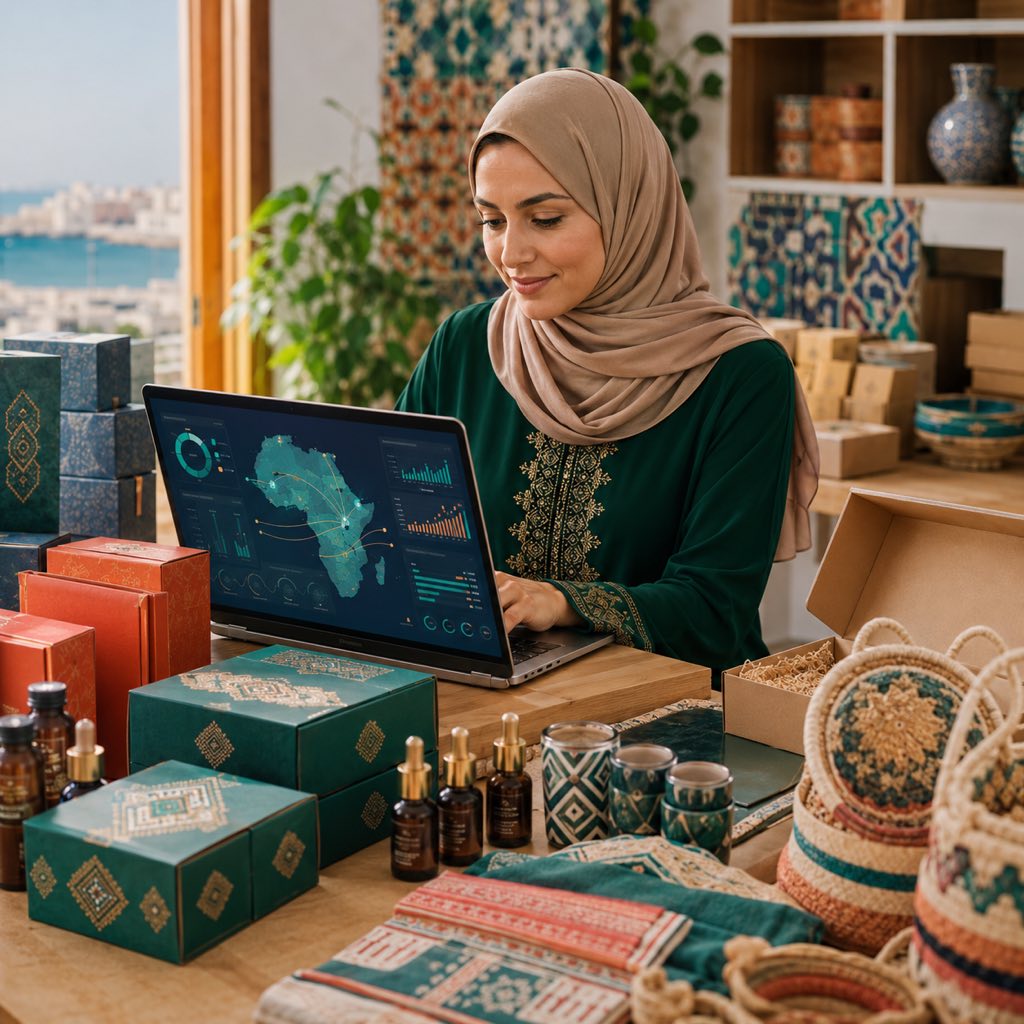
That is exactly the friction the AfCFTA Digital Trade Protocol is designed to remove. Adopted at the 37th African Union Heads of State Summit in Addis Ababa on 17–18 February 2024, the protocol is the digital chapter of the African Continental Free Trade Area — the world’s largest free-trade area by membership, spanning 54 African states. For Algerian merchants, it represents the clearest path yet from a single national market to a continental one.
The AfCFTA Digital Trade Protocol: What It Opens Up
The protocol consolidates the rules that govern how digital trade moves across African borders. It sets common ground on data governance, cross-border data flows, online consumer protection, cybersecurity, digital payments, and emerging technologies including artificial intelligence. In practical terms, it is the legal scaffolding that makes a cross-border online sale recognizable and enforceable in another member state.
It is not yet fully in force. Per tralac’s analysis of the legal text, the protocol requires ratification by 22 State Parties before it enters into force, 30 days after the 22nd instrument is deposited. Once in force, member states have a five-year window to align their national laws with its provisions. Eight technical annexes — covering rules of origin, cross-border digital payments, cross-border data transfers, digital identities, financial technology, and online safety — are still being negotiated, and an inaugural AfCFTA Digital Trade Forum in Lusaka, Zambia, on 7 May 2025 launched a 13-point implementation plan to move that work forward.
For a merchant, the takeaway is timing. The framework is being built now, which means the next two to three years are the moment to get the operational pieces — payments, fulfillment, and compliance documentation — ready, so that the day the rails open commercially, Algerian sellers are already positioned to move first rather than scrambling to catch up.
Payment Rails for Cross-Border Sales
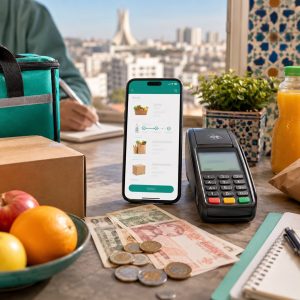
A continental sale is only as good as the merchant’s ability to get paid. Here, Algeria’s payment landscape has matured quickly. Electronic payment transactions rose 46% year-on-year in 2025 to 939 billion dinars (around $7 billion), and the volume of e-commerce transactions has climbed roughly 340% over three years. By the end of March 2026, Algeria counted more than 22 million payment cards in circulation, including nearly 18 million Edahabia cards issued by Algérie Poste, alongside the bank-issued CIB card.
The newest building block is BaridiPay, the QR-code mobile payment service Algérie Poste launched on 14 June 2025. Accessible through the BaridiMob app, it lets customers pay without a physical card or cash — a meaningful step for merchants who want digital settlement rather than cash on delivery, which still accounts for over 85% of transactions today.
For cross-border specifically, two rails matter. The first is the Pan-African Payment and Settlement System (PAPSS), which Algeria joined on 15 August 2025 as its 18th member, connecting the Bank of Algeria to a settlement network spanning African commercial banks and letting merchants invoice in local currencies rather than converting through the US dollar. The second is the domestic fintech rulebook: Bank of Algeria Instruction 06-2025 established the country’s first framework for licensed payment service providers, with three-tier digital wallets and clear capital requirements. Together these give Algerian merchants a legal, traceable way to receive payment from an African buyer — the single most important precondition for digital export.
Advertisement
Logistics: The Last Mile to Africa
The harder building block is moving the goods. Domestic last-mile delivery in Algeria has grown alongside the merchant base, but a parcel destined for Lagos or Dar es Salaam crosses customs, currency, and carrier boundaries that a domestic order never touches. This is where the AfCFTA’s broader trade machinery — rules of origin, simplified customs documentation, and the digital paperless-trade provisions inside the protocol — becomes the merchant’s ally rather than an obstacle.
The pragmatic near-term answer for most Algerian merchants is not to build their own continental logistics network but to plug into one. Cross-border fulfillment partners, freight consolidators, and African e-logistics platforms already move parcels between member states; the merchant’s job is to make their catalogue, customs paperwork, and returns policy compatible with those partners. Digital products and services — software, design, digital content, online courses, SaaS — sidestep the physical last mile entirely and are the fastest-moving category an Algerian seller can export today under the digital-trade framework.
What Algerian E-Commerce Merchants Should Do Now
The continental window is opening over the 2026–2028 period. Merchants who prepare the operational layer now will be the ones who capture it. Three concrete moves matter most.
1. Get a traceable digital payment stack in place before chasing the first African order
Cash on delivery does not cross borders. Before targeting a buyer in another member state, integrate at least one digital rail — a CIB or Edahabia gateway for domestic settlement and a PAPSS-connected bank relationship for cross-border invoicing. Add BaridiPay as a low-friction option for mobile-first customers. The goal is a payment trail that a foreign buyer, a bank, and a tax authority can all recognize. Merchants still running 100% on cash on delivery should treat digital payment integration as the first project of 2026, not a later optimization.
2. Build your compliance and documentation file so a continental order is a copy-paste, not a research project
Cross-border digital trade rewards merchants who have their paperwork standardized: business registration, a clear product origin declaration, harmonized product descriptions, a written returns and dispute policy, and data-handling practices that match consumer-protection norms. Assemble this once as a reusable export file. When the AfCFTA annexes on rules of origin and cross-border data transfers finalize, a prepared merchant simply slots into the new rules; an unprepared one starts from zero. Treat the documentation as a product asset, not bureaucracy.
3. Start with a digital-first or low-weight catalogue to test the corridor
The fastest, lowest-risk export is the one with no physical last mile. Algerian merchants offering software, digital design, online courses, or SaaS can sell into African markets today with little more than a payment rail and a localized landing page. For physical goods, start with high-value, low-weight items that absorb cross-border shipping economics — accessories, cosmetics, artisanal products — and pilot a single corridor through a fulfillment partner before scaling. A small, real cross-border pilot teaches more than a year of planning.
The 2026–2028 Window for Algerian Digital Exporters
The pieces are arriving in sequence. The AfCFTA Digital Trade Protocol gives Algerian merchants a continental legal framework. PAPSS gives them a settlement rail. Instruction 06-2025 and BaridiPay give them a domestic fintech foundation that can plug into it. And a home market growing at roughly 92% a year is producing exactly the kind of confident, digitally-native merchants who can scale beyond a single country.
What ties it together is sequencing. The merchants who win the continental opportunity will not be the ones who wait for every annex to be ratified before acting — they will be the ones who use the next two to three years to get payments traceable, documentation standardized, and one real cross-border corridor tested. The framework is being built now; the merchants who build alongside it will be the ones with orders flowing the day the rails open commercially. For Algeria’s nearly 200,000 online merchants, the question is no longer whether the continental market is reachable — it is which of them will be ready first.
Frequently Asked Questions
What is the AfCFTA Digital Trade Protocol and does it apply to Algeria?
The AfCFTA Digital Trade Protocol is the digital chapter of the African Continental Free Trade Area, adopted at the African Union Summit on 17–18 February 2024. It sets common rules for cross-border data flows, digital payments, online consumer protection, and emerging technologies across the AfCFTA’s 54 member states, including Algeria. It requires ratification by 22 State Parties before entering into force, after which members have five years to align national laws — so the framework is in an active build-out phase that Algerian merchants can prepare for now.
How can an Algerian merchant actually get paid by a customer in another African country?
The most direct route is a bank relationship connected to the Pan-African Payment and Settlement System (PAPSS), which Algeria joined in August 2025 as its 18th member. PAPSS lets merchants invoice and settle in local currencies across participating African countries rather than routing through the US dollar. Domestically, integrating CIB or Edahabia gateways and BaridiPay gives merchants a traceable digital payment trail that foreign buyers and banks can recognize.
What can Algerian merchants export digitally today, before all the annexes are finalized?
Digital products and services — software, SaaS, online courses, digital design, and digital content — can be exported today, because they avoid the physical last-mile and customs friction entirely. For physical goods, high-value, low-weight items such as cosmetics, accessories, and artisanal products are the most practical starting point, ideally piloted through a cross-border fulfillment partner on a single corridor before scaling.
Sources & Further Reading
- Further Reading
- E-Commerce Industry in Algeria 2018-2030 — ECDB
- The AfCFTA Digital Protocol — International Institute for Sustainable Development (IISD)
- The AfCFTA Digital Trade Protocol: Clarification of Key Issues — tralac
- Algérie Poste Launches “Baridi Pay” Mobile Payment Service — DzairTube
- Algeria: eTrade Readiness Assessment — UNCTAD
🔗 Related Intelligence

Algeria’s E-Commerce Platform Ecosystem: Tools for Online Merchants in 2026
Algeria’s E-Commerce Pivot: From COD Dominance to Digital Payment Adoption

Algeria E-Commerce Fulfillment: The Warehouse Gap Holding Back a $7 Billion Market

Algeria’s E-Commerce Boom: 92% Annual Growth and What Comes Next for Digital Merchants