The Physics Problem at the Heart of Every AI Rack
The data center industry is confronting a thermal crisis that air conditioning simply cannot solve. Traditional air-cooled racks reach their thermal limits at 15–25kW per rack. Yet today’s GPU clusters routinely consume around 85kW per cabinet, and next-generation AI workloads are projected to push rack power to 200–250kW — a tenfold increase over what conventional air-cooling infrastructure was ever designed to handle.
The numbers tell the scale of the problem. According to projections cited by Lombard Odier, global data center electricity consumption is set to reach 945 terawatt-hours by 2030, surpassing Japan’s total annual electricity use. AI-optimized facilities are expected to see their power usage quadruple within five years. Meanwhile, the power supply chain is already straining: only four suppliers are currently certified by Nvidia for next-generation power supply units, and critical quick-disconnect couplings for liquid cooling loops are concentrated among a handful of Western suppliers — Staubli, Eaton, CPC, and Parker-Hannifin.
The thermal challenge is not just about raw wattage. Modern AI accelerators — including Nvidia’s upcoming Rubin architecture — are expected to push single-chip power consumption toward 2,000W. At that level, moving enough coolant to extract heat through conventional water-based single-phase systems becomes mechanically impractical. The volume of liquid required, and the pumping power to move it, begins to compete with the compute energy itself.
This is the physics wall that is forcing data center operators, hyperscalers, and colocation providers worldwide to move decisively toward liquid cooling — and specifically toward a more advanced variant: two-phase direct-to-chip cooling.
From Cold Plates to Two-Phase: The Technology Stack
Not all liquid cooling is equal. Understanding the hierarchy matters for anyone making infrastructure investment decisions in 2026.
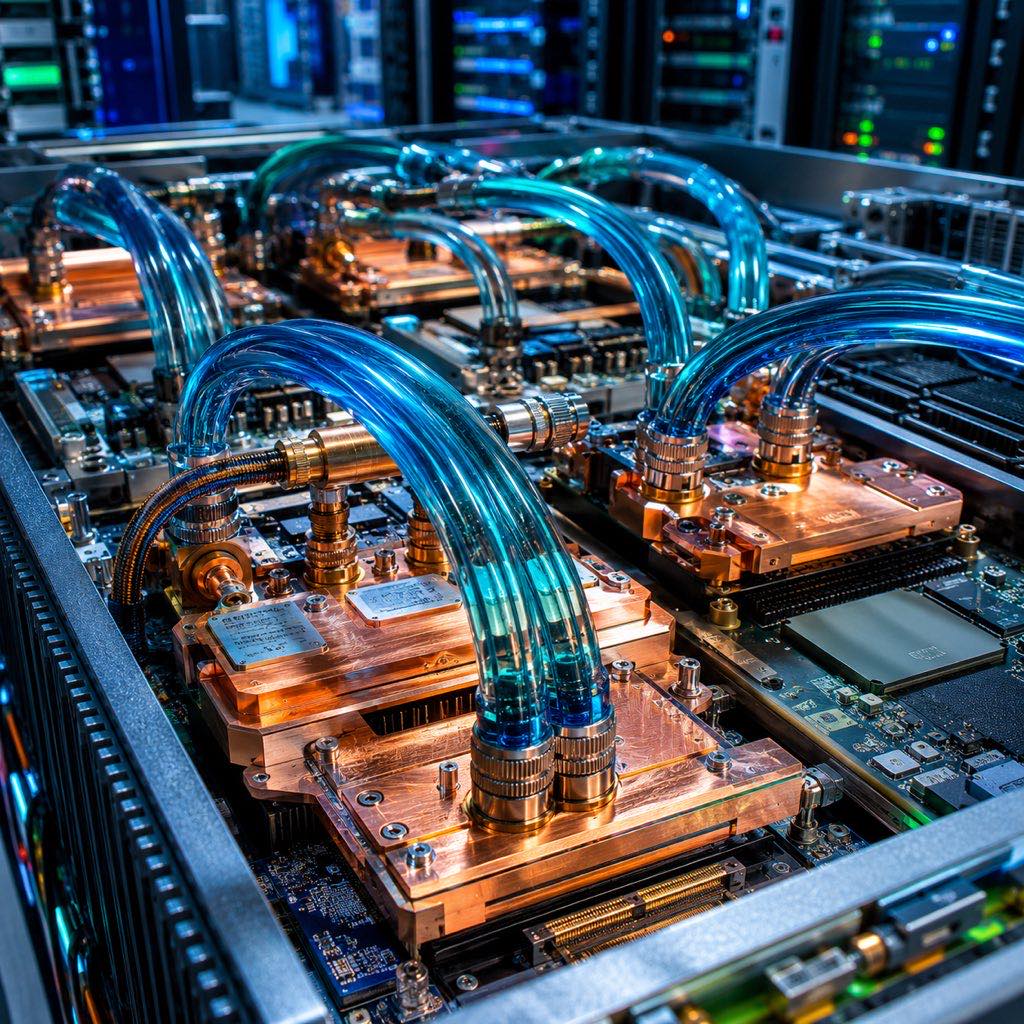
Single-phase direct-to-chip (1P D2C) is currently the most widely deployed liquid cooling approach. A coolant — typically water or a water-glycol mixture — flows through cold plates mounted directly on CPUs and GPUs. The coolant absorbs heat and returns at 35–50°C, which is warm enough to enable waste-heat reuse or free cooling for much of the year. Single-phase D2C is compatible with existing server platforms and requires minimal rack redesign. Schneider Electric and Motivair have both built full product suites around this approach, positioning it as the fastest route to liquid cooling deployment.
Two-phase direct-to-chip (2P D2C) represents the next tier. Instead of simply warming the coolant, the system allows the liquid to vaporize at the chip surface, exploiting latent heat — the energy absorbed during a phase transition from liquid to gas. This dramatically increases heat extraction efficiency. At a flow rate of approximately 0.3 liters per minute, a two-phase system can manage a 1,000W chip load that would require substantially higher flow rates in a single-phase configuration. The reduced flow volume cuts pumping power and mechanical stress on the system.
Immersion cooling submerges entire servers in non-conductive dielectric fluid. It eliminates hotspots entirely and achieves extremely low Power Usage Effectiveness (PUE) values, but it requires purpose-built tanks and complete rack redesign — a barrier that has kept it confined to specialist high-performance computing deployments.
The transition from single-phase to two-phase is now being formalized in products. Accelsius introduced the NeuCool MR250 in October 2025 — the first row-based Coolant Distribution Unit (CDU) delivering up to 250kW of two-phase liquid cooling capacity per rack in flexible configurations (1 × 250kW or 2 × 125kW per rack). At Data Center World 2026 in April, the company announced general availability of the NeuCool IR150, the industry’s first fully integrated rack-level cooling solution combining a two-phase CDU, 42U of IT rack space, and built-in liquid and vapor manifolds in a single 800mm-wide enclosure capable of handling up to 150kW. Higher-capacity systems in the NeuCool series are already scheduled for release through 2026.
The broader market is reading the same signals. IDTechEx forecast that two-phase cold-plate cooling will take off as early as 2026–2027, driven by AI chip TDPs that will exceed what single-phase systems can handle. Two-phase D2C becomes the preferred option when operators foresee loads exceeding approximately 200kW per rack, when they need to accommodate warmer facility supply water, or when per-socket heat flux constraints make high coolant flow rates impractical.
Advertisement
Why 2026 Is the Inflection Year
Three converging forces are making 2026 the year liquid cooling shifts from specialty solution to default build standard.
The density threshold has been crossed. According to Gottogpower’s analysis, liquid cooling penetration in data centers grew from approximately 3% of deployments in 2021 to a projected 37% in 2026. Goldman Sachs is more aggressive: it forecasts that liquid-cooled AI servers will increase from 15% of all AI deployments in 2024 to 54% in 2025, rising to 76% by the end of 2026. For rack densities above 100kW, liquid cooling is no longer an option — it is the only practical solution.
The economic case has flipped. Liquid cooling costs 30–50% more than air systems in Chinese markets and 100–150% more in Western markets. Yet for racks above 40kW, liquid cooling’s energy efficiency gains begin to pay back that premium. A 40kW liquid-cooled rack allocates 21% of capital expenditure to cooling, compared to 10% for a 10kW air-cooled rack — but the PUE improvement from 1.5–2.0 (air) to 1.03–1.20 (liquid D2C) generates 20–30% overall facility energy savings that compound over the infrastructure lifetime.
Modular liquid-cooled builds are arriving at scale. The CoreSite 2026 data center outlook notes that new modular liquid cooling units starting at 2MW capacity are entering the market in 2026, with two-phase direct-to-chip solutions positioned to succeed today’s one-phase systems as rack densities climb toward and beyond one megawatt. This modular approach allows operators to stage liquid cooling capacity alongside compute buildouts rather than betting on a single massive infrastructure transformation.
The energy math also has a 2026-specific dimension: cooling systems currently account for more than 35% of data center electricity consumption, and the power demand of global data centers is projected to exceed 1,000 TWh in 2026. Cutting cooling’s share of that load is now a strategic imperative, not a sustainability aspiration.
What Infrastructure Teams Should Do Now
The window for gradual adoption is narrowing. Operators who defer liquid cooling planning until their next major refresh cycle risk being stranded on air-cooled infrastructure at a moment when GPU TDPs are jumping discontinuously with each new chip generation. Here is a structured approach for teams making decisions in the next 12 months.
1. Audit your existing rack density and establish a 3-year TDP roadmap
Most data center operators have a heterogeneous estate: older air-cooled racks running at 5–15kW alongside newer GPU deployments at 50–85kW. Start by tagging every row with its current power density and mapping it against the GPU roadmap your procurement team is tracking. If any cluster is scheduled to receive next-generation Nvidia or AMD accelerators in 2025–2027, model the thermal load based on current chip specifications. Anything projected above 80–100kW per rack should be flagged for liquid cooling. Anything above 150kW should be in scope for two-phase evaluation now, not at refresh.
2. Pilot single-phase D2C first for the 50–100kW tier — then build toward two-phase
The practical advice from the industry in 2026 is to not skip steps. Single-phase direct-to-chip is deployable today at scale, is compatible with existing server platforms, and produces coolant return temperatures warm enough (35–50°C) to enable waste-heat recovery. Run a controlled pilot on your highest-density current cluster. Use it to train facilities and operations teams, build familiarity with coolant loop management, and collect real PUE data. This positions the organization for two-phase adoption — which requires more specialized manifolds, vapor management, and potentially dedicated CDUs — without betting the entire infrastructure transformation on an emerging technology in a single step.
3. Evaluate CDU vendors against the 250kW density horizon, not today’s spec
The vendor landscape for two-phase D2C is active and consolidating quickly. Accelsius, LiquidStack, and Vertiv are among the players publishing specifications at the 150–250kW per rack tier. When issuing RFPs or running vendor evaluations, benchmark against the 250kW threshold even if your current deployment is at 85kW — because a cooling infrastructure decision made today will still be operating in 2030 when rack densities may exceed 500kW for the most demanding AI training configurations. Negotiate modular expansion paths, compatibility with future chip generations, and flexibility on coolant distribution unit placement (in-row vs. rear-door vs. facility-level). Certify that the CDUs you evaluate are compatible with your facility’s water supply temperature and pressure specifications to avoid costly retrofits at scale.
The Road Ahead: Beyond 250kW
Two-phase direct-to-chip cooling solves the immediate problem — getting from 85kW to 250kW per rack without rebuilding the entire facility. But the physics of AI compute suggests the runway is shorter than the industry expects.
Nvidia’s Rubin GPU architecture, expected to push single-chip TDPs toward 2,000W, will force rack densities beyond 250kW at full configuration. At that point, two-phase D2C faces the same pumping-power constraints that make single-phase D2C impractical at 200kW today. Research groups and vendors are already examining hybrid approaches: two-phase D2C for the CPU and GPU tier combined with facility-level heat rejection strategies that extract high-quality waste heat at 55–70°C for district heating or industrial processes. The Energy Reuse Factor (ERF) — a metric that accounts for heat recovered and reused outside the data center — is emerging alongside PUE as a key performance indicator for next-generation facilities.
The modular 2MW liquid cooling unit that CoreSite identified as a 2026 entrant is emblematic of where the market is heading: infrastructure that treats AI compute heat not as waste to be expelled, but as a byproduct with economic value. Data centers in Scandinavia have already demonstrated district heating integration at scale. The question for operators everywhere else is whether they build that capability in from the start, or retrofit it at far greater cost when the regulatory and economic pressure to do so becomes unavoidable.
For now, the immediate imperative is clear: if your organization is deploying AI racks above 85kW today, you are already in liquid cooling territory. If you are planning deployments above 150kW in the next 18 months, two-phase direct-to-chip cooling deserves a place in your infrastructure roadmap — not as a future option, but as a design baseline.
Frequently Asked Questions
What is the difference between single-phase and two-phase direct-to-chip cooling?
Single-phase direct-to-chip cooling circulates liquid coolant through cold plates mounted on CPUs and GPUs, absorbing heat as the coolant warms but stays in liquid form throughout. Two-phase direct-to-chip cooling allows the coolant to vaporize at the chip surface, exploiting latent heat — the energy absorbed during phase transition — to extract dramatically more heat at lower flow rates. Two-phase systems can handle approximately 0.3 liters per minute per 1,000W chip load, reducing pumping power and mechanical stress. Single-phase is currently the dominant deployed approach and is compatible with existing server platforms; two-phase is preferred when rack loads exceed roughly 150–200kW, where single-phase flow rates become impractical.
At what rack power density does liquid cooling become necessary?
Liquid cooling typically becomes necessary when rack densities exceed 30–50kW — a threshold that modern GPU-intensive AI training and inference clusters routinely surpass. For deployments above 100kW per rack, liquid cooling is generally the only practical solution: air cooling infrastructure at those densities would require mechanical systems so large and loud that they would consume a disproportionate share of the facility’s power and floor space. With Goldman Sachs forecasting that 76% of AI server deployments will be liquid-cooled by end of 2026, the industry has effectively established liquid cooling as the baseline for new AI infrastructure rather than an optional premium.
How much more expensive is liquid cooling compared to air cooling?
The cost premium varies significantly by market and configuration. In China, liquid cooling costs approximately 30–50% more than air-cooled systems. In Western markets, the premium rises to 100–150%. However, the economic calculus changes significantly at higher rack densities: a 40kW liquid-cooled rack allocates 21% of capital expenditure to cooling versus 10% for a 10kW air-cooled equivalent, but the operational energy savings from PUE improvements of 1.03–1.20 versus 1.5–2.0 for air cooling produce 20–30% overall facility energy savings that typically recover the capital premium within three to five years at commercial electricity prices.
Sources & Further Reading
- Further Reading
- Why liquid cooling will dominate AI data centres in 2026 — Lombard Odier
- Liquid Cooling in Data Centers Explodes in 2026: Cold Plate vs. Immersion — Gottogpower
- Data Center Outlook 2026: Power and Cooling Challenges — CoreSite
- Accelsius Introduces NeuCool MR250 for At-Scale Two-Phase Direct-to-Chip Cooling — Accelsius
- Two-Phase Cold Plate Cooling Will Take Off as Early as 2026–2027 — IDTechEx
- Performance Evaluation of Two-Phase Direct-to-Chip Liquid Cooling for Data Centers — ScienceDirect
- AI to Drive 165% Increase in Data Center Power Demand by 2030 — Goldman Sachs
🔗 Related Intelligence
Liquid Cooling in AI Data Centers: Why Direct-to-Chip Is the New Default

200 kW Racks: Why Liquid Cooling Is No Longer Optional for AI Infrastructure in 2026
The Cooling Tipping Point: Liquid Cooling Now Powers 57% of AI Servers in 2026

The $700B Hyperscaler Bet: Why Power and Cooling Are Now the AI Infrastructure Ceiling