The Tipping Point: Why 2026 Is the Year Liquid Cooling Became Majority Practice
The shift from air cooling to liquid cooling in data centers has been discussed as a future inevitability for over a decade. In 2026, it stopped being future and became present: liquid cooling now accounts for 57% of AI server deployments, up from 23% the prior year. The doubling in a single year is not a gradual trend — it is an inflection driven by a hardware generation transition that made air cooling architecturally impossible at AI server rack densities.
The thermal physics are unambiguous. AI training clusters regularly exceed 30 to 50 kW per rack, and GPU thermal design power has exceeded 700W for current-generation NVIDIA and AMD processors. A fully loaded rack of NVIDIA Blackwell GB200 NVL72 systems — the current flagship for AI training — generates heat loads that air-cooling infrastructure cannot exhaust fast enough to prevent thermal throttling. When GPUs throttle, training throughput drops, directly increasing the cost per AI model training run. Liquid cooling is not an environmental preference; for high-density AI compute, it is a functional requirement.
The data center liquid cooling market reflects this transition: valued at $6.6 billion in 2026, it is projected to reach $38.4 billion by 2033 — a compound annual growth rate of 28.7%. For comparison, the broader hyperscaler infrastructure market is growing at roughly 12-15% annually. Liquid cooling is growing at roughly twice that rate because it is being adopted not just in new AI-native facilities but as retrofits to existing data centers that need to support next-generation AI hardware without building new facilities.
Three Cooling Architectures Now in Play
The liquid cooling market is not monolithic. Three distinct architectures are competing for adoption, each with different facility requirements, retrofit complexity, and performance profiles.
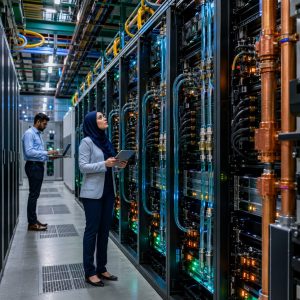
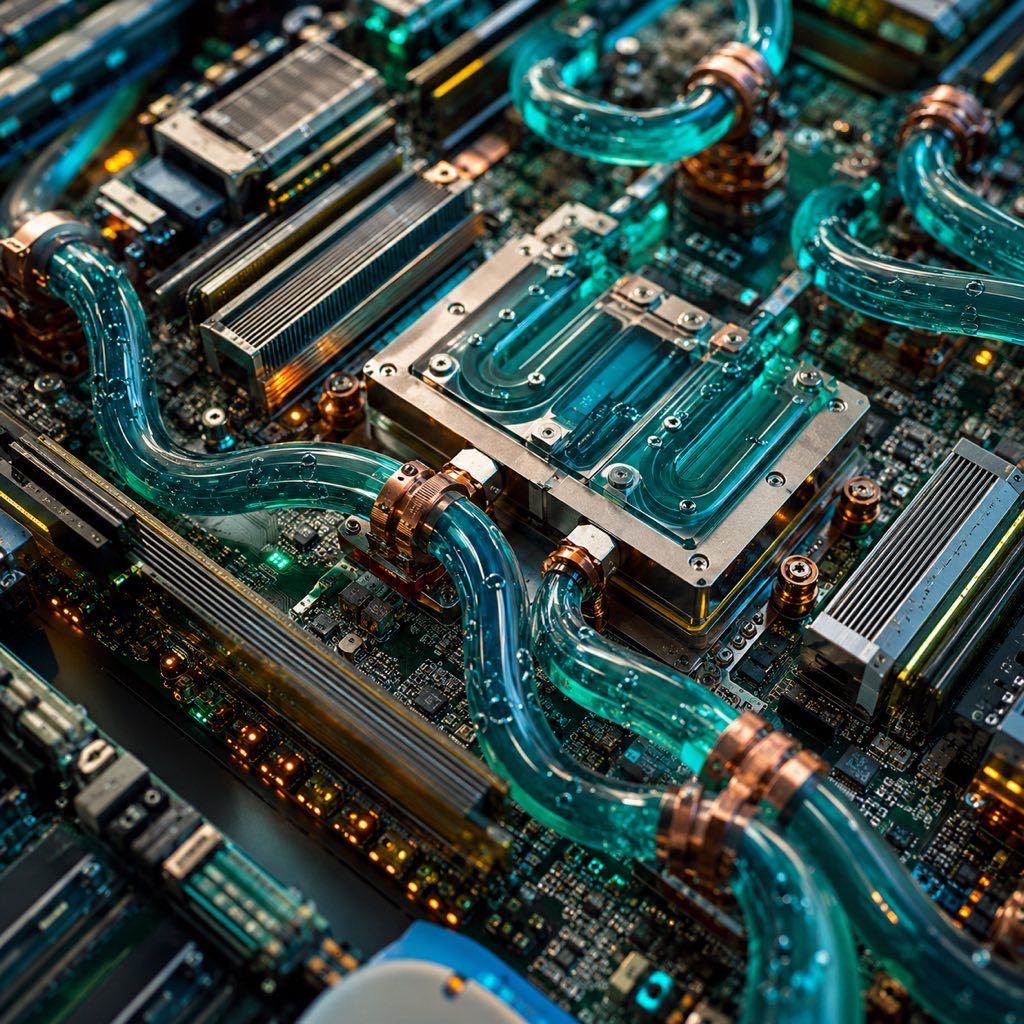
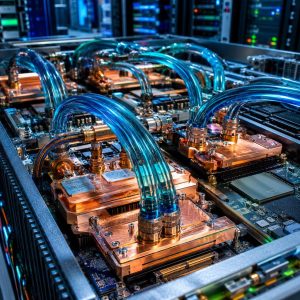
Direct-to-chip (DLC) cooling circulates coolant through cold plates mounted directly on CPUs, GPUs, and memory modules. It is the current primary adoption method because it requires the least facility modification — existing air cooling handles the remaining heat from peripheral components, while the primary heat load is captured at the chip level. DLC reduces data center cooling energy consumption by 20-30% compared to full air cooling and can handle rack densities up to approximately 100 kW per rack.
Immersion cooling submerges server hardware entirely in non-conductive dielectric fluid. The liquid absorbs heat directly from all server components — not just the CPUs and GPUs — achieving temperature reductions of 30-40°C at the server level compared to air cooling. Immersion is the fastest-growing segment in the liquid cooling market: two-phase immersion cooling holds 66.2% market share within the immersion segment. It supports rack densities exceeding 150 kW per rack — well beyond the current ceiling of direct-to-chip — making it the architecture of choice for next-generation AI training clusters.
Rear-door heat exchangers (RDHx) attach to the back of standard server racks and use water coils to capture heat from hot exhaust air before it enters the facility cooling loop. RDHx is the simplest retrofit option and requires no modification to the servers themselves, but it handles a narrower density range than DLC or immersion and is primarily used as a bridge technology for facilities transitioning from legacy air-cooled infrastructure.
The coexistence of these three architectures means that facility operators and enterprise IT teams face a technology selection decision with 10-15 year infrastructure implications. Choosing the wrong architecture for a given rack density profile either wastes facility investment (over-specifying immersion for 30 kW racks) or creates a capacity ceiling (under-specifying air or RDHx for 80 kW AI racks).
Advertisement
What Enterprise IT Leaders Must Do Now
The cooling transition is not optional for any organization planning AI infrastructure investment in 2026 or beyond. But the urgency and specific actions vary significantly depending on whether an organization is operating its own data center, colocating, or procuring AI cloud capacity from a hyperscaler.
1. Audit Your Facility’s Liquid Cooling Readiness Before the Next GPU Procurement Cycle
Any organization planning to procure AI servers — NVIDIA Blackwell, AMD Instinct MI400, or equivalent — should complete a facility thermal audit before placing hardware orders. The audit must determine: current power density per rack in the target AI zone, available chilled water capacity and distribution infrastructure, floor loading for immersion tank or cold plate coolant distribution units (CDUs), and the facility operator’s liquid cooling roadmap. Major developments in 2024-2025 — including Blackstone’s $16 billion AirTrunk acquisition in 2024 — are accelerating the liquid-cooling retrofit market; many colocation operators are now actively upgrading. Verify your colocation provider’s timeline and contractual cooling delivery before finalizing AI server rack space agreements.
2. Select Your Liquid Cooling Architecture Against a 5-Year Rack Density Projection, Not Today’s Workload
The most common planning error is selecting a liquid cooling architecture based on current GPU generation requirements, then discovering that the next GPU generation exceeds that architecture’s capacity within 2-3 years. Direct-to-chip is the right choice for rack densities up to 80-100 kW. If your 5-year AI compute projection involves training runs on multi-node GPU clusters at full Blackwell or post-Blackwell hardware density, begin evaluating immersion cooling now — the facility modifications required (sealed tanks, dielectric fluid supply, modified power distribution) take 12-18 months to design and implement. Making the architecture selection after the GPU order arrives means operating below hardware performance potential for the entire retrofit period.
3. Factor Liquid Cooling Into Your AI Infrastructure TCO Model
Liquid cooling carries higher upfront capital costs — CDUs, cold plates, piping — but delivers measurable operating cost savings that most enterprise TCO models currently ignore. Immersion cooling reduces overall data center energy consumption by 20-30%. At current electricity prices, a 25% reduction in cooling energy for a 200-rack AI zone represents material annual savings — on the order of hundreds of thousands of dollars annually at commercial electricity rates, more in markets with higher industrial power pricing. AI infrastructure leaders should build liquid cooling TCO models that include: upfront capital cost delta versus air, annual energy savings, GPU performance improvement (elimination of thermal throttling adds 5-15% effective throughput), and facility space efficiency gains from higher density per square meter.
4. Establish Vendor Relationships With Liquid Cooling Specialists Before Demand Peaks
The liquid cooling supply chain is constrained. Key vendors — Vertiv, Schneider Electric, CoolIT Systems, nVent, Asetek, Submer, Green Revolution Cooling — are working through multi-month order backlogs as data center operators globally rush to retrofit. Daikin’s acquisition of Chilldyne in November 2025 and CoolIT Systems’ manufacturing expansion signal that the industry is scrambling to meet demand — but supply will lag for 12-24 months. Organizations that have not established preferred vendor relationships and begun qualification testing will face extended lead times that delay AI hardware deployments. Initiate vendor qualification processes now, before hardware procurement timelines force rushed decisions.
The Structural Shift: Why This Changes How Data Centers Are Built
The liquid cooling tipping point is not just a technology upgrade cycle — it represents a structural reorganization of how data centers are designed, built, and operated. Air-cooled data center design has been essentially stable for 40 years: raise floor plenum for cold air distribution, hot-aisle/cold-aisle containment, computer room air handlers (CRAHs) or air conditioners delivering conditioned air at rack fronts, exhaust captured and returned. The physics of this design cap useful rack density at approximately 15-25 kW per rack for air cooling without significant efficiency penalties.
Liquid cooling breaks this physical constraint. A fully immersion-cooled facility can pack 150+ kW per rack, which means the same building footprint can house 6-10 times the AI compute capacity of an equivalent air-cooled facility. This is why hyperscalers are investing aggressively in liquid-cooled new builds — not just for energy efficiency, but for land use efficiency at a moment when data center land availability in major markets is the primary constraint on AI compute expansion.
For enterprise IT leaders, the structural lesson is that the data center specification decisions made in 2026 will determine AI compute capacity for the next 10-15 years. Facilities built or retrofitted today to air-cooling standards will reach their density ceiling at a hardware generation that is already in production. Those built or retrofitted to liquid-cooling standards will support the next 3-4 hardware generations without architectural rebuilds. The tipping point has been crossed. Planning for a world where air cooling is the default is now planning for the past.
Frequently Asked Questions
What is the difference between direct-to-chip cooling and immersion cooling?
Direct-to-chip (DLC) cooling uses liquid-filled cold plates mounted on specific components (CPUs, GPUs, memory) — the liquid absorbs heat from those components and carries it away, while air handles residual heat from the rest of the server. Immersion cooling submerges entire servers in non-conductive dielectric fluid, which absorbs heat from all components simultaneously. DLC is simpler to retrofit into existing facilities but caps at around 100 kW per rack. Immersion supports densities above 150 kW per rack and delivers greater energy efficiency, but requires sealed tanks, specialized fluid handling, and more extensive facility modifications. Most organizations are deploying DLC now as they plan immersion-ready facilities for the next hardware generation.
Why is liquid cooling growing so much faster than overall data center investment?
Liquid cooling is growing at 28.7% CAGR versus approximately 12-15% for overall data center market growth because it is being adopted both in new AI-native facilities and as a retrofit in existing facilities that would otherwise be unable to support current-generation GPU hardware. The driver is hardware physics: NVIDIA’s Blackwell GPUs and AMD’s latest AI accelerators exceed the thermal limits of air cooling at the rack densities required for economical AI training. This means every new AI compute deployment and a significant fraction of existing facility upgrades now require liquid cooling — a much larger total addressable market than cooling-as-option would represent.
How should organizations evaluate the total cost of ownership for liquid cooling versus air cooling?
Liquid cooling has higher upfront capital costs — cold distribution units, cold plates or immersion tanks, specialized piping — but lower operating costs due to energy efficiency gains of 20-30% versus air cooling. The TCO breakeven point depends on local electricity costs, workload density, and facility utilization, but most analyses find liquid cooling reaches cost parity with air cooling within 3-5 years for workloads above 50 kW per rack, and pays back within 1-2 years for high-density AI training clusters above 100 kW per rack where the alternative is significant GPU thermal throttling. Organizations should also factor in GPU throughput improvement — eliminating thermal throttling typically adds 5-15% effective compute capacity at no additional hardware cost.
Sources & Further Reading
- Data Center Liquid Cooling Market to Witness 28.7% CAGR — GlobeNewswire
- Liquid Immersion & Hybrid: The Cooling Architectures That Will Dominate AI Facilities — DataCenters.com
- Data Centre Trends 2026: Shifting Up a Gear — Accenture
- Data Center Liquid Immersion Cooling Market — Coherent Market Insights
🔗 Related Intelligence
Liquid Cooling in AI Data Centers: Why Direct-to-Chip Is the New Default

200 kW Racks: Why Liquid Cooling Is No Longer Optional for AI Infrastructure in 2026

Liquid Cooling Goes Mainstream: The Race to Cool AI’s Insatiable Heat
Two-Phase Direct-to-Chip Cooling: How Data Centers Tame 250kW AI Racks in 2026