Why India, Why Now: The Strategic Logic Behind $15 Billion
Google’s commitment to $15 billion in Indian data center infrastructure — with construction in Andhra Pradesh expected to begin in April 2026, according to Data Center Knowledge — is not simply a cloud market expansion play. It reflects a fundamental restructuring of how hyperscalers are thinking about the geography of AI infrastructure.
The traditional model of hyperscaler geography followed consumer internet traffic: build data centers close to large user populations in the United States, Western Europe, and East Asia, then extend to other regions as demand developed. AI infrastructure geography follows a different logic. AI training workloads generate massive inter-datacenter traffic — model weights, gradient updates, checkpoint files — that must traverse long distances between training clusters. The optimal location for an AI training hub is not simply close to the most users; it is close to high-capacity subsea cable terminations that can carry the data flows AI training demands at the speed and volume required.
India’s position is exceptional by this measure. The subcontinent sits at the intersection of subsea cable routes connecting Europe, the Middle East, East Africa, Southeast Asia, and the Pacific. Subsea cables including 2Africa, PEACE, SEA-ME-WE, and multiple Google-backed systems converge around the Indian Ocean. A major hyperscaler AI facility in India can reach Europe in approximately 70-80ms round-trip latency via subsea, Southeast Asia in 20-40ms, and East Africa in 50-60ms. That multi-continental connectivity profile — four continents reachable within 80ms — is what hyperscalers mean when they describe India as a global AI hub rather than a regional cloud market.
The Global Data Center Investment Context
Google’s India commitment arrives within a broader hyperscaler spending acceleration that is unprecedented in scale. JLL’s 2026 Global Data Center Outlook projects that nearly 100 gigawatts of new data center capacity will be added globally between 2026 and 2030 — effectively doubling total global capacity in five years. The total investment required is estimated at $3 trillion. Data center construction costs are forecast to increase 6% in 2026 alone, reaching approximately $11.3 million per megawatt — reflecting the liquid cooling, power infrastructure, and specialized civil engineering requirements of AI-grade facilities.
AI workloads are the primary demand driver. According to JLL’s analysis, AI workloads are projected to represent half of all data center traffic by 2030, up from a minority share today. The 14% compound annual growth rate in data center capacity through 2030 that JLL projects reflects this: even with dramatic efficiency improvements in AI hardware, the volume of AI inference and training compute required to support global AI application deployment exceeds what efficiency gains can offset.
The Americas lead this expansion at 17% CAGR, driven by US hyperscaler buildout. But Asia-Pacific, growing at 12% CAGR, is where strategic investment is concentrating because APAC combines large and growing user markets with the geographic position on subsea cable networks that makes it a natural AI infrastructure anchor. India’s role within APAC is now central, not peripheral.
Advertisement
The Subsea Cable Infrastructure That Makes India’s Position Durable
The AI hub designation would mean little if India lacked the subsea cable infrastructure to sustain it. The country benefits from multiple cable systems that are either operational, in deployment, or planned:
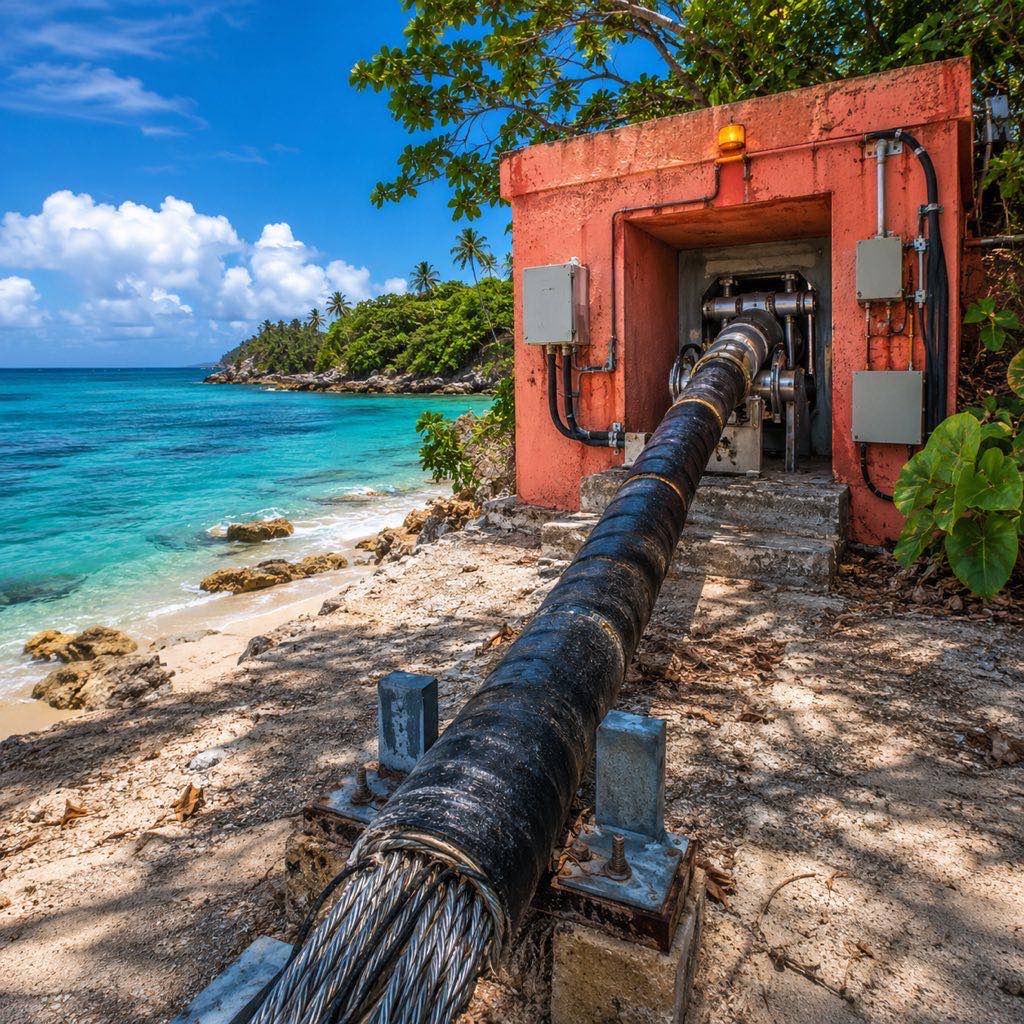
The 2Africa cable — the world’s longest subsea cable system at over 45,000 km — connects 33 countries across Europe, the Middle East, and Africa and has an India branch. Google’s Grace Hopper cable connects the United States, United Kingdom, and Spain. Google’s Equiano cable connects Europe to South Africa. Together, these cable systems create a multi-directional submarine network anchored significantly in Indian Ocean geography — and India, as a peninsula, sits at the center of that network.
This is the geographic foundation of the “four continents” hub positioning: North America (via trans-Pacific and Grace Hopper), Europe (via multiple systems), Africa (via 2Africa and Equiano), and Southeast Asia (via intra-APAC cables) are all reachable from Indian cable landing stations with latencies that are competitive for AI training data flows. No other country in the APAC region has equivalent multi-directional subsea connectivity at comparable scale.
What Enterprise Leaders and Infrastructure Teams Should Do
The scale and strategic logic of Google’s India investment has practical implications for technology leaders making multi-year infrastructure decisions.
1. Evaluate India-Based Cloud Regions for AI Inference Workloads Serving APAC
Enterprises with AI applications serving Southeast Asian, South Asian, and Middle Eastern users should evaluate Google Cloud’s India regions as a latency-optimized deployment target for inference infrastructure. With construction beginning in 2026, new cloud regions in Andhra Pradesh will begin offering capacity within 18-30 months of groundbreaking. Cloud architects should map user population distribution against planned region availability and begin workload placement planning now, rather than defaulting to Singapore or Tokyo for all APAC AI inference needs.
2. Monitor the Subsea Cable Investment Map When Making Multi-Year Cloud Vendor Decisions
The hyperscaler that controls the most subsea cable infrastructure in a given region has structural latency advantages that translate into AI training throughput benefits that are not reflected in standard cloud pricing comparisons. Google’s subsea cable portfolio — including proprietary systems like Grace Hopper, Equiano, and Firmina — gives it structural network advantages in specific routes that AWS and Microsoft Azure do not have. Organizations committing to multi-year enterprise agreements for AI infrastructure should factor subsea cable coverage maps into vendor selection, particularly for use cases where inter-region data transfer latency affects training or inference performance.
3. Model Your AI Infrastructure Geographic Strategy Against the 2026-2030 Capacity Buildout
JLL’s projection of $3 trillion in global data center investment through 2030 implies that cloud capacity, cloud pricing, and cloud region availability will all shift dramatically over the next five years. AI compute that costs a given amount per GPU-hour today will likely cost significantly less by 2028-2029 as new capacity comes online. Organizations locking into 3-year reserved instance commitments today may be over-paying for capacity that will be commoditized faster than the commitment term implies. Model AI infrastructure costs with price decline curves, not static pricing.
4. Treat India’s Emerging Hyperscaler Presence as a Risk Diversification Asset
The concentration of AI training capacity in US data centers — primarily Northern Virginia, Silicon Valley, and Texas — creates geographic and regulatory concentration risk. A major grid disruption, regulatory action, or natural disaster affecting US hyperscaler campuses would affect AI service availability globally. India’s emergence as a second major hyperscaler AI training hub provides a diversification option: enterprises with critical AI workloads should evaluate whether maintaining training capacity across US and India-based regions provides meaningful resilience improvement for their use cases.
The Bigger Picture: Infrastructure Investment Shapes AI Trade Routes
The subsea cable map is becoming the map of AI trade flows. Data — model weights, training datasets, inference requests, fine-tuning data — will flow along the same physical cables that carry web traffic, and the countries that control cable landings and hyperscaler data centers will intermediate that trade. Google’s $15 billion India commitment is a declaration of where one of those AI trade route hubs will be located.
This has geopolitical implications that go beyond cloud market share. Countries with dense subsea cable infrastructure and hyperscaler campuses will attract AI research institutions, AI-native companies, and the high-skilled engineering talent that follows compute infrastructure. Countries without that infrastructure will become net importers of AI capability — dependent on remote cloud connections for AI workloads that their domestic connectivity cannot efficiently support.
JLL’s forecast that global data center capacity will nearly double by 2030 is not merely a projection of how many servers will exist. It is a projection of where AI capability will be geographically concentrated. The $3 trillion investment mapping that capacity is, in effect, a map of where the AI economy will be headquartered for the next decade. Google’s India move — and the subsea cable infrastructure underpinning it — is a major coordinate on that map.
Frequently Asked Questions
What is Google’s America-India Connect and why does it matter for global cloud strategy?
Google’s America-India Connect initiative encompasses subsea cable infrastructure and data center investments — including a reported $15 billion data center commitment in Andhra Pradesh — that position India as a hub connecting North America, Europe, Africa, and Southeast Asia via submarine cable networks. It matters for cloud strategy because it signals that hyperscalers are now building AI training infrastructure in geographically strategic cable hub locations, not just in proximity to large user populations. Organizations choosing cloud regions for AI workloads should understand that India-based regions will increasingly have structural latency advantages for multi-continental AI inference and training use cases.
How does subsea cable ownership affect cloud provider performance?
Cloud providers that own or co-own subsea cables have direct control over the bandwidth, latency, and routing of data flowing between their data centers and their users. Proprietary cables can be optimized for the traffic patterns of AI training — prioritizing large data transfers, minimizing jitter — in ways that shared public cable capacity cannot be. Google’s subsea cable portfolio (Grace Hopper, Equiano, Firmina, and India-connected systems) gives it structural network advantages on specific routes that affect AI training throughput and inference latency for workloads crossing those routes. AWS and Microsoft Azure operate with different cable portfolios, creating meaningful performance differences that standard cloud benchmark comparisons do not fully capture.
How much is being invested globally in data center infrastructure through 2030?
According to JLL’s 2026 Global Data Center Market Outlook, approximately 100 gigawatts of new data center capacity will be added globally between 2026 and 2030 — effectively doubling global capacity — requiring approximately $3 trillion in total investment. Data center construction costs are increasing 6% in 2026 alone, reaching around $11.3 million per megawatt as AI-grade liquid cooling, specialized power infrastructure, and advanced civil engineering drive cost inflation. AI workloads are projected to represent half of all data center traffic by 2030, up from a minority share today.
Sources & Further Reading
🔗 Related Intelligence
Adani’s $100 Billion Bet: India’s Play for AI Data Center Supremacy
Amazon’s $48B India Bet: Why AWS Just Tripled Down on AI Infrastructure
Google’s $40B Anthropic Bet: Inside the Biggest AI Compute Alliance of 2026
Microsoft’s Hyderabad Bet: Inside Its Largest India Cloud Region Yet