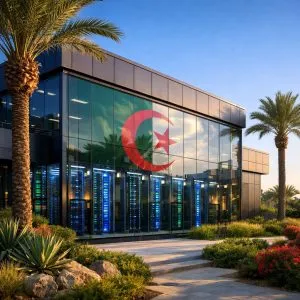
What the May 5 Agreement Actually Contains
The bilateral meeting took place during Omani Minister Al Maawali’s official visit to Algeria, which covered transport, ports, and digital transformation. The data center and digital cooperation component was negotiated by Minister Benmouloud at a working session focused on enhancing collaboration in “digital transformation and expanding partnerships.”
Per reporting by Data Center Dynamics, the agreement commits both governments to establishing data centers through a bilateral partnership model. Oman explicitly signaled readiness to “establish an effective partnership based on innovative approaches grounded in international standards.” From Oman’s Ministry of Transport, Communications and Information Technology, the framing was broader digital transformation cooperation rather than a single facility commitment.
What distinguishes this from a standard bilateral MOU is Oman’s position in the data center market: Oman hosts Oracle Cloud Infrastructure’s only Middle East and Africa region, and Muscat has attracted multiple hyperscaler-grade facilities. Oman’s Ministry brings direct operational experience with hyperscaler partnership negotiations — exactly the institutional knowledge Algeria can absorb through this partnership and build at home.
Why Oman as the Partner Country Makes Structural Sense
The Algeria–Oman pairing is not geographically obvious — the two countries share no border, no common language register beyond MSA, and no historical infrastructure ties. The logic is entirely strategic.
Oman’s digital infrastructure position is more advanced than most of its Gulf neighbors for a country its size. Its Oracle Cloud region gave Omani government ministries direct experience negotiating data residency, SLA standards, and cross-border data flow rules with a hyperscaler — exactly the institutional knowledge Algeria needs as it scales its own sovereign cloud framework under ARPCE.
Algeria, in turn, offers Oman an Atlantic-and-Mediterranean access point. Algeria’s North African geography — sitting between West Africa, the Sahel, Southern Europe, and the Middle East — makes it a candidate transit hub for subsea cable interconnection points. According to the New Lines Institute’s analysis of Algeria’s AI positioning, Algeria’s gas reserves, latent infrastructure, and digital sovereignty regulation pipeline position it as a plausible AI and cloud hub for the region by the late 2020s.
The Oman partnership is, structurally, an attempt to compress Algeria’s institutional learning curve by borrowing from a country that has already navigated the hyperscaler infrastructure deal process.
Advertisement
Why the Model Matters Beyond This Single Deal
The more important question is not what Oman and Algeria will build together — it is what the deal structure reveals about how Algeria should approach future infrastructure partnerships.
Algeria’s current data center inventory lists six facilities — a thin base for a country targeting 500+ digital transformation projects under SNTN-2030. Closing that gap purely through domestic investment would take a decade. The bilateral template offers a faster alternative: pair Algerian land, energy, and regulatory frameworks with Gulf operational expertise, financing structures, and standards pedigree.
Several elements of the Oman deal are worth extracting for replication:
State-level MOU as first-mover signal: The ministerial MOU establishes political commitment before commercial terms are negotiated. This sequencing matters — commercial parties on both sides can negotiate with confidence that the regulatory environment will be cooperative, not hostile. Algeria could pursue the same template with UAE (Abu Dhabi’s data center cluster), Saudi Arabia (NEOM’s cloud ambitions), or Qatar (Ooredoo’s regional infrastructure arm).
Standards alignment as the core deliverable: The Omani statement about “innovative approaches grounded in international standards” is significant. One of Algeria’s biggest data center barriers is the absence of Tier III certification for locally-operated facilities (the Blida national data center is pursuing Tier III Design certification; it is not yet operational). A standards-sharing bilateral arrangement — allowing Algerian operators access to Oman’s ISO/IEC 27001 and Uptime Institute audit frameworks — would accelerate certification at lower cost than building that institutional capacity from scratch.
Operational expertise transfer: AYRADE serves 10,000+ clients in regulated sectors but does not publicly disclose its technical operations teams or certifications. A bilateral agreement that includes an institutional secondment or advisory channel — Omani data center operators embedded with Algerian counterparts for 12-24 months — would transfer practical expertise that no MOU text alone can deliver.
What Algerian Cloud Operators and Policymakers Should Do
1. Convert the MOU into a Specific Capacity Commitment with a Named Operator
A bilateral MOU has diplomatic value but no operational value until a private operator on at least one side signs a commercial agreement underneath it. Algeria’s ARPCE and the Ministry of Digital should designate a lead implementing operator — AYRADE is the logical choice, given its regulated-sector focus and impending IPO — and assign a 90-day deadline for converting the MOU into a term sheet with a named Omani counterpart.
The risk of MOU fatigue is real: Algeria has signed numerous bilateral digital cooperation agreements that have produced no measurable infrastructure output. The Oman agreement is valuable only if this cycle does not repeat.
2. Use Standards Alignment as the First Deliverable
Rather than starting with the capital-intensive question of which facility to build, Algeria should negotiate a standards-sharing agreement as the first concrete output. This means: Omani counterparts reviewing Algeria’s draft Tier III certification framework for the Blida data center; Algerian ARPCE sending technical staff to Muscat for a 60-day audit skills program; and a joint working group publishing an Algeria-specific data center operational standard that references both ITU-T and Uptime Institute frameworks. This costs less than $500,000 to execute but compresses Algeria’s institutional learning curve by years.
3. Expand the Template to Three Additional Gulf Partners by End of 2026
The Oman deal creates precedent. Algeria should treat it as the first of a four-partner Gulf infrastructure cluster, not a one-off. The three additional partners that structurally make sense are UAE (Abu Dhabi’s Mubadala infrastructure arm), Saudi Arabia (government-to-government given Vision 2030 parallels with SNTN-2030), and Kuwait (Zain Group’s MENA infrastructure coverage). Each of these partners brings different capabilities: UAE brings hyperscaler co-location know-how; Saudi brings financing scale; Kuwait brings telecom infrastructure reach.
The Bigger Picture: Infrastructure as Diplomatic Currency
Algeria’s infrastructure deficit — six data center facilities for a 47-million-person economy — is simultaneously a risk and an opportunity. The risk is that without local cloud capacity, Algerian sovereign data requirements cannot be met at scale, driving regulated entities toward legal gray zones (EU hyperscaler hosting with data residency workarounds) or expensive on-premise alternatives.
The opportunity is that Gulf partners have strong incentives to help Algeria close this gap: North African infrastructure creates new traffic routes for Gulf-hosted hyperscaler regions, diversifies Gulf digital investment portfolios, and extends Gulf soft power through infrastructure partnership rather than capital grants.
The Algeria–Oman MOU is the first concrete expression of this logic. Its value will be measured not by the document signed on May 5, but by the operational partnerships, certified facilities, and skills transfer programs it initiates over the next 24 months.
Frequently Asked Questions
What specific data center projects came out of the Algeria–Oman agreement?
The May 5, 2026 agreement is a bilateral MOU establishing a framework for cooperation — it does not specify a named facility, investment amount, or construction timeline. Both governments committed to working through an “effective partnership based on innovative approaches grounded in international standards.” The concrete project commitments will emerge during the commercial negotiation phase that follows the MOU.
Why does Oman make sense as a data center partner for Algeria specifically?
Oman hosts Oracle Cloud Infrastructure’s Middle East and Africa region, giving its Ministry of ICT direct experience negotiating data residency, SLA standards, and cross-border flow rules with hyperscalers. This institutional knowledge is precisely what Algeria needs as it develops its own sovereign cloud certification framework under ARPCE. The partnership transfers that expertise at state-to-state level rather than requiring Algeria to develop it independently through trial and error.
How does this deal differ from Algeria’s other bilateral digital cooperation agreements?
The key structural difference is Oman’s specific data center operational experience. Many bilateral digital MOUs are too general to drive outcomes. The Algeria–Oman agreement has concrete leverage: Oman’s Oracle Cloud region provides a reference implementation for how a sovereign country negotiates a hyperscaler partnership while maintaining local regulatory control. If Algeria extracts that specific knowledge through secondment programs or working groups, the MOU produces real infrastructure capability rather than diplomatic language.
Sources & Further Reading
- Algeria and Oman Partner to Establish Data Centers — Data Center Dynamics
- Oman-Algeria Strengthen Cooperation in Digital Transformation — MTCIT Oman
- Why Algeria Is Positioned to Become North Africa’s AI Leader — New Lines Institute
- Algeria Data Centers Overview — Datacentermap
- Algeria Cloud Market — Cloudscene
- Algiers Data Centers — Datacentermap
🔗 Related Intelligence

Algeria-Oman Data Center Pact: Building Sovereign Infrastructure Through Gulf Partnership

Algeria as Africa’s Digital Transit Hub: The Cloud Corridor Strategy for 2026–2030

African Digital Summit: Algeria’s Infrastructure Bet
Algeria’s Infrastructure Window: Attracting Gulf AI Data Center Investment in 2026