The Scale of the Backlash
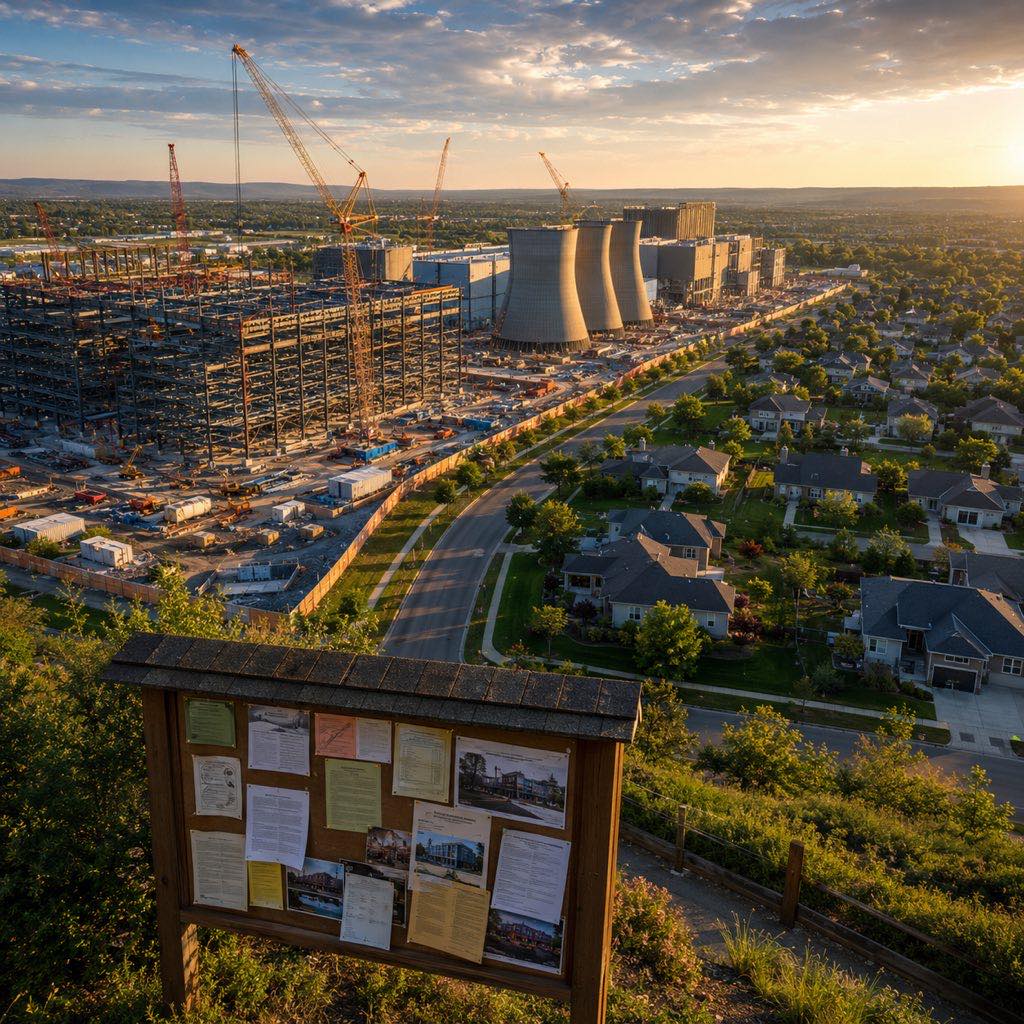
The moratorium wave did not emerge from a vacuum. It followed a measurable infrastructure impact. One analysis found that monthly electricity prices in areas hosting large data center clusters inflated by as much as 267% between 2020 and 2025. The North American Electric Reliability Corporation has predicted energy shortfalls for parts of the U.S. grid by 2028. Northern Virginia — home to “Data Center Alley,” roughly 400 operational and in-development campuses — has experienced repeated grid strain events. According to Built In’s tracker of state legislation, at least 63 local data center moratorium actions have been introduced, considered, or adopted across dozens of U.S. towns and counties.
The state-level bills are the legislative crystallization of that local backlash. What distinguishes 2026 from prior years of data center concern is the geographic spread: Maine, Vermont, New York, Oklahoma, Virginia, Maryland, and Georgia are not a regional bloc — they span the Northeast, Mid-Atlantic, South, and Plains. The drivers are not identical either: Vermont and Maine are concerned about environmental impacts on rural resource systems; Virginia and Maryland are responding to grid strain in a already data-center-saturated region; New York and Georgia are reacting to rapid influx of new proposals.
The State Bills: What They Actually Propose
The legislation varies in scope, threshold, and duration, but shares a common structural logic: impose a temporary halt while conducting a formal study of impacts.
Maine (LD 307): Passed both chambers — the closest any state came to enactment. Would have imposed a moratorium on projects requiring 20 MW or more until late 2027. Governor Janet Mills vetoed it in April 2026, preferring a study-council process over a construction halt. She signed LD 713 removing data centers from Maine’s tax incentives. Maine’s near-miss is analyzed as a template for future attempts with narrower carve-outs.
Vermont: Would freeze new data center construction until July 2030 while the Public Utility Commission investigates impacts on natural resources and the economy. No MW threshold — the bill applies broadly.
New York (S.9144): Three-year moratorium on permits for facilities capable of using 20 MW or more. Senator Liz Krueger: “Massive data centers are gunning for New York, and right now we are completely unprepared.” Food & Water Watch organized a statehouse rally in May 2026.
Oklahoma (SB 1488 / HB 2992): SB 1488 proposes a moratorium until 2029. HB 2992 (Data Center Consumer Ratepayer Protection Act) passed the Oklahoma Senate unanimously on April 28 with transparency requirements mandating water and electricity consumption disclosure before construction permits.
Virginia: Moratorium until July 2028 targeting Northern Virginia’s Data Center Alley, introduced by Delegate Irene Shin in response to grid stress in the world’s highest-concentration data center region.
At the federal level, Senator Bernie Sanders and Representative Alexandria Ocasio-Cortez introduced companion legislation to halt data center projects until Congress enacts comprehensive AI regulation.
Why Power Is the Primary Driver
A hyperscale campus running GPU clusters can draw 100 MW continuously — equivalent to the residential load of a mid-sized U.S. city. The 267% electricity price inflation figure cited in state records reflects peak exposure in specific grid zones where data center demand growth outpaced transmission investment, establishing a reference point legislators use to argue that expansion costs are externalized onto residential ratepayers without consent. The Federal Energy Regulatory Commission and the North American Electric Reliability Corporation both flagged grid adequacy risks in 2025 filings. Moratorium advocates’ core argument: if the grid cannot absorb projected demand without rate increases or reliability degradation, permitting should require grid impact assessment before construction — not after.
Advertisement
Why Water Is the Emerging Second Front
Water is gaining legislative momentum alongside electricity in 2026. A 100 MW facility can consume millions of gallons annually. In the American West and Great Plains — already managing multi-year drought — that consumption competes directly with agricultural and municipal demand. Oklahoma’s HB 2992 transparency provisions focus on water disclosure. Vermont’s study mandate covers natural resource impacts. New York’s S.9144 lists water consumption alongside energy and greenhouse gas concerns. The water argument assembles a broader political coalition than electricity: agricultural interests, municipal utilities, and environmental groups converge on water scarcity grounds even where they disagree on energy policy.
What Cloud Infrastructure Planners and Policymakers Should Do
1. Build Community Infrastructure Capacity Into Site Selection From Day One
The moratorium wave is fundamentally a symptom of site selection processes that treated community infrastructure as a constraint to navigate rather than an asset to co-invest in. The most effective industry response is demonstrating with quantified commitments that new data center projects add grid capacity and water resilience rather than consuming them: renewable energy contracts that bring new generation to the grid (additive, not just offset), closed-loop cooling systems that reduce net water consumption, and transparent pre-construction impact assessments published before permit applications are filed.
2. Engage With State Impact Study Processes Before Bills Become Law
Maine’s outcome — a veto creating a study council rather than a moratorium — is the best realistic result once a bill reaches legislative momentum. Vermont’s Public Utility Commission investigation, Maine’s study council, and Oklahoma’s Corporation Commission study are all active processes where data center operators can engage constructively. Companies that contribute actual consumption data and economic benefit analysis shape the regulatory outcome far more effectively than those who wait and lobby against the resulting regulations.
3. Differentiate Your Facility Category in Regulatory Advocacy
Not all data centers have the same impact profile. A 5 MW colocation facility has fundamentally different grid and water implications than a 500 MW hyperscale campus. Effective advocacy should push for tiered frameworks: baseline transparency for all new data centers, mandatory impact assessment for facilities above 20-50 MW, and separate environmental review for hyperscale campuses above 100 MW — allowing states to address large-scale concerns without restricting the colocation market serving local enterprise needs.
The Federal-State Collision
The moratorium wave sits against a federal backdrop that is explicitly pro-expansion. Trump’s AI Action Plan and the Stargate project prioritize rapid data center growth. A December 2025 executive order attempted to preempt state AI laws identified as barriers to innovation. However, energy regulation and land use permitting have historically been state authorities. The legal boundary between federal AI infrastructure mandates and state environmental authority has not been tested in court, and litigation is likely.
The Bigger Picture: Every Country’s Coming Infrastructure Conflict
The U.S. moratorium wave is a leading indicator, not an American exception. Every country accelerating national AI infrastructure investment will eventually encounter the same constraint: the gap between national strategy timelines and local infrastructure absorptive capacity. National AI strategies announce multi-year timelines; data center site selection proceeds faster than grid expansion; community resistance emerges when power bills rise; legislation follows. The countries and regions that avoid this cycle build grid and water infrastructure investment into AI strategy budgets from the beginning — treating infrastructure capacity as a prerequisite for AI capacity rather than a byproduct.
Frequently Asked Questions
Why did Maine’s moratorium bill get vetoed if both legislative chambers passed it?
Governor Janet Mills supported the concerns motivating the bill but concluded the legislation was too blunt — a blanket moratorium on all facilities above 20 MW would have halted small and large projects without discrimination. Her veto letter acknowledged a pause might be “appropriate given the impacts of massive data centers in other states,” but she preferred a study-council process and targeted tax incentive removal. The outcome reflects the political tension between community protection and economic development that all moratorium efforts face.
What is the 20 MW threshold that appears in multiple state bills?
Twenty megawatts became the reference threshold because it roughly corresponds to the scale at which data centers begin to have measurable impacts on local grid load and water systems. At 20 MW, a facility is large enough to affect a regional distribution grid during peak demand and requires substantial cooling water. Vermont’s bill has no threshold; Ohio’s ballot initiative uses 25 MW — but 20 MW has emerged as the de facto reference point in 2026 state legislation.
How does the federal government’s AI expansion push interact with state moratorium efforts?
There is a direct tension. The Trump administration’s AI Action Plan calls for accelerating data center construction as a national security priority. The December 2025 executive order attempted to preempt state laws identified as barriers to AI infrastructure deployment. However, energy regulation and land use permitting have historically been state authorities, and states have significant constitutional grounds for environmental and grid protection requirements. The legal boundary has not been tested in court, and litigation is likely as more states advance moratorium or impact assessment legislation.
Sources & Further Reading
- States Push Data Center Moratoriums as AI Growth Surges — Built In
- Maine’s Near-Miss on Data Center Moratorium Is Wake-Up Call to Industry — McGuireWoods
- Data Center Moratorium Bills Are Spreading in 2026 — Good Jobs First
- Lawmakers and Advocates Rally for AI Data Center Moratorium Bill in New York — Food & Water Watch
- More Than a Dozen U.S. States Consider Temporary Data Center Bans — Carrier Management
- State Data Center Laws vs. Federal AI Push: 2026 Tracker — MultiState
🔗 Related Intelligence
The AI Data Center Moratorium Act: Federal Bill Meets a $64 Billion Grassroots Revolt
Maine Data Center Ban: First US State Halts AI Infrastructure

The Hidden Bottleneck Halting the AI Data Center Boom: Transformer and Switchgear Shortages
US AI Regulation 2026: 25 State Laws in Q1 as Federal Preemption Stalls