Why Algerian Customs Is Still a Bottleneck Despite Going Digital
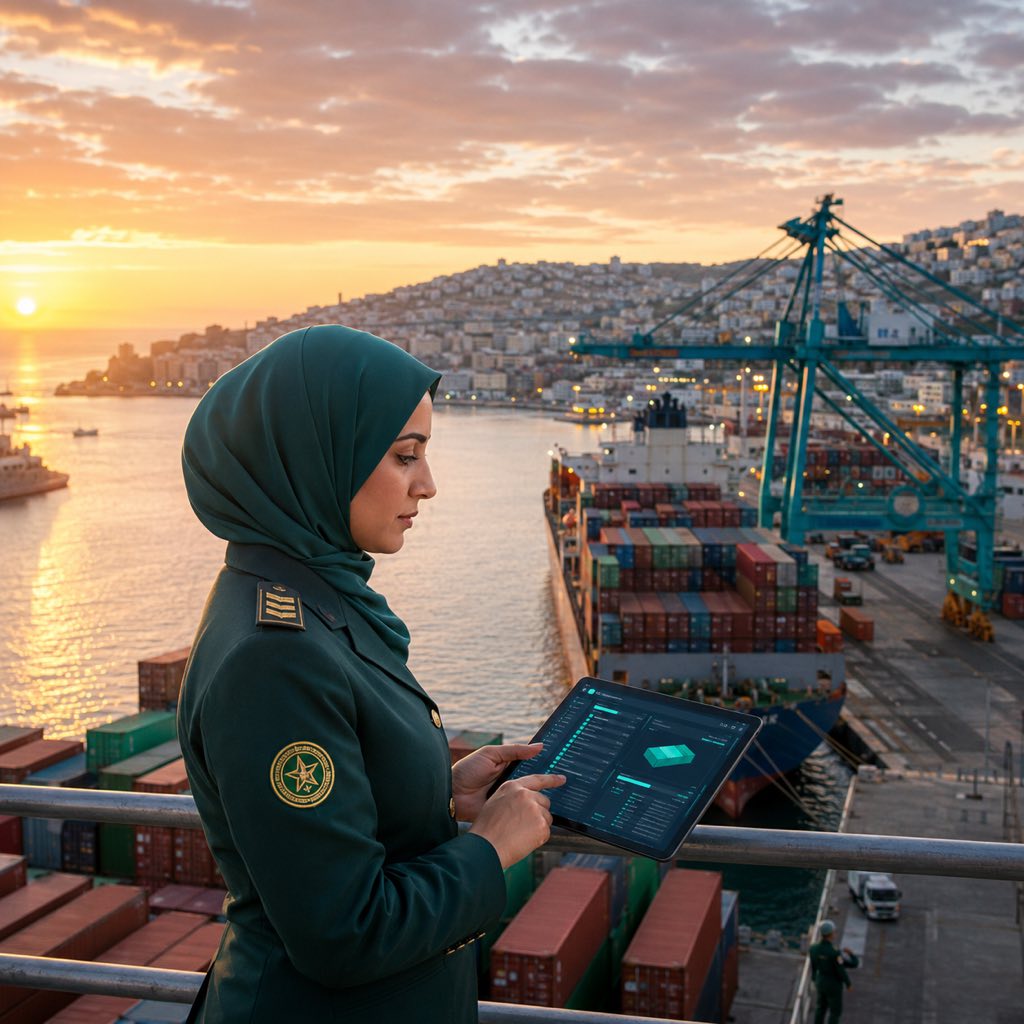
Algeria’s foreign trade has a well-documented friction point. According to the U.S. Commercial Service’s Algeria country guide, customs clearance is one of the most cited problems facing companies operating in Algeria, with delays routinely running from weeks to months. The consequences are not abstract: at peak congestion periods, as many as 15 vessels have been anchored offshore waiting for clearance, each accumulating demurrage charges estimated at $5,000 per day — costs that ultimately flow into the prices Algerian consumers and manufacturers pay.
The ALCES (Algerian Customs Electronic System) launched in July 2023 was a meaningful step. Developed in partnership with South Korea’s CUPIA and based on the UNI-PASS platform — the backbone of one of the world’s most efficient customs systems — ALCES brought paperless declarations, electronic risk management, and digital tracking to the Port of Algiers and Algiers International Airport. A companion Single Window project was targeted for completion by March 2024 to unify trade-related processes across agencies.
But digitization is not the same as automation, and automation is not the same as intelligence. ALCES replaced paper with digital forms. What it has not yet done is replace rule-based document review with AI-driven risk scoring that learns from transaction history, flags anomalies in real time, and allows low-risk shipments to clear in minutes rather than days. That is the gap — and global AI customs deployments in 2026 show it is a solvable one.
What AI-Driven Customs Automation Actually Does
The architecture of AI customs automation has stabilized into a recognizable stack. Pan African Visions’ 2026 analysis of agentic customs AI identifies five core functions that AI agents are now performing across leading customs administrations:
Document verification at ingestion. AI reads commercial invoices, bills of lading, certificates of origin, and import licenses using optical character recognition combined with language models trained on trade documentation. It cross-checks declarations against submitted documents in seconds, flagging discrepancies that human agents would need hours to identify. For Algeria’s port of Algiers, which processes hundreds of declarations daily, this alone could eliminate a significant share of the manual verification queue.
HS code classification. Harmonized System tariff classification — the assignment of a numeric code to every imported product for duty calculation — is one of the most error-prone and dispute-generating steps in customs. AI classification engines trained on millions of commodity descriptions achieve accuracy rates above 95% for standard goods categories, reducing misclassification disputes that currently force goods into secondary examination queues.
Dynamic risk scoring. Rather than applying static rules (flag all shipments from country X, inspect all consignments above value Y), AI risk engines build probabilistic profiles of importers and shipment types based on historical data. Clean traders with consistent compliance histories move to fast lanes; new entrants and statistical outliers receive targeted inspection. This is the model that Singapore’s TradeNet and South Korea’s own customs administration use to achieve average clearance times of under 30 minutes for pre-approved traders.
Automated duty calculation and pre-clearance. For standardized import categories with complete documentation, AI systems can calculate duties, issue clearance notices, and generate release orders without human intervention. In IOR Solutions’ 2026 analysis of AI customs clearance, this function alone reduces average clearance time by 60-70% for compliant, well-documented shipments.
Anomaly detection and fraud prevention. AI systems flag under-invoicing, mislabelling, and prohibited goods patterns that rule-based systems miss. This is particularly relevant for Algeria, where the Ministry of Foreign Trade launched an accelerated clearance initiative in August 2025 specifically to address the backlog of industrial inputs — a situation that would benefit from AI-assisted triage distinguishing genuine industrial goods from misclassified consumer imports.
Advertisement
What Algerian Customs Officials and Trade Ministry Teams Should Do
1. Layer AI Risk Scoring onto ALCES Within the Existing UNI-PASS Architecture
The strategic advantage Algeria holds is that ALCES is built on UNI-PASS — a platform that South Korea’s customs authority has already extended with AI risk management modules. The upgrade path is not a greenfield procurement; it is a module addition within an existing vendor relationship. The Ministry of Finance’s General Directorate of Customs should negotiate an AI risk scoring module directly with CUPIA, leveraging the existing partnership. Target use case: a pilot at the Port of Algiers covering containerized imports, with the AI engine pre-scoring 100% of declarations and routing the bottom 80% (by risk score) to an automated clearance queue. The remaining 20% go to human agents. This single change, implemented at one port, would visibly reduce vessel waiting times within 90 days.
2. Build an Importer Compliance Database as the Foundation for Trusted Trader Fast Lanes
AI risk scoring is only as good as the historical data it trains on. Algeria should accelerate the construction of a structured importer compliance database — capturing clearance history, inspection outcomes, duty dispute rates, and documentation quality scores for every registered importer. This database, fed into the AI risk engine, is what allows the system to differentiate a 10-year importer with a clean compliance record from a newly registered entity on its third shipment. Trusted traders who maintain compliance scores above a defined threshold should receive expedited lane access with AI-confirmed pre-clearance — a model that Singapore uses for its “Secure Trade Partnership” programme and that could be adapted for Algeria’s major industrial importers within 12 months.
3. Deploy AI Document Verification at the Algeria Ports Single Window
The Single Window — the unified interface for all trade documentation across customs, the port authority, the central bank, and phytosanitary agencies — is the ideal insertion point for AI document verification. When an importer submits documents to the Single Window, AI should perform instant cross-checking: does the declared value match the commercial invoice? Does the certificate of origin correspond to the declared HS code? Does the import authorization number exist in the ministry database? Catching these errors at ingestion — before the shipment arrives — eliminates the most common source of delays: goods held at port because documentation errors are discovered during physical inspection. The Algerian General Directorate of Customs has established an electronic portal for declarations; the next step is making that portal intelligent, not just digital.
4. Establish a Public Performance Dashboard for Port Clearance Times
AI systems improve iteratively — but only when their performance is measured and made visible. Algeria should publish a monthly public dashboard showing average clearance times by port (Algiers, Oran, Annaba, Skikda), by shipment category, and by risk lane. This serves two purposes: it creates accountability pressure that drives continuous improvement, and it gives importers the data they need to plan logistics around realistic timelines. Countries that publish granular port performance data — Singapore and UAE rank highly in global logistics performance indices — consistently attract higher-quality trade partners because the predictability premium is quantified and visible.
Where This Fits in Algeria’s 2026 Trade Strategy
The timing is significant. Algeria’s government has signaled an ambition to diversify exports beyond hydrocarbons and to position the country as a regional logistics hub — aspirations that require competitive port infrastructure measured in hours, not weeks. The August 2025 accelerated clearance initiative showed that political will exists to tackle the bottleneck; the ALCES platform shows that the digital foundation is in place. What converts these two assets into a genuine competitive advantage is the AI layer that makes clearance intelligent rather than merely paperless.
The comparison point is not aspirational. The World Customs Organization’s analysis of AI in customs positions Algeria’s ALCES launch as part of a global modernization wave — but the countries moving fastest are those that treat digital customs as a starting point, not a destination. For Algeria’s port-dependent importers — industrial firms in Oran, pharmaceutical distributors in Algiers, agricultural input buyers across the northeast — AI-enabled customs automation is not a future technology. It is an available tool with a clear deployment roadmap and a measurable return: fewer vessels at anchor, lower demurrage bills, and supply chains that can actually deliver on schedule.
Frequently Asked Questions
What is the ALCES system and how does it differ from an AI customs platform?
ALCES (Algerian Customs Electronic System) is a paperless customs platform launched in July 2023, based on South Korea’s UNI-PASS system. It digitizes customs declarations, tracking, and electronic clearance — replacing paper forms with digital ones. An AI customs platform goes further: it uses machine learning to score risk, classify goods automatically, verify documents against databases, and route low-risk shipments to automated clearance without human review. ALCES is the foundation; AI is the next layer.
How long do customs clearances typically take at Algerian ports today?
According to the U.S. Commercial Service, customs clearance is a common problem for companies in Algeria, with delays ranging from weeks to months for complex shipments. Even routine industrial imports can face multi-week processing times when documentation errors trigger secondary examination. Countries using AI-assisted customs — Singapore, South Korea, UAE — achieve average clearance times of under 30 minutes for pre-approved traders and under 24 hours for standard compliant shipments. The gap represents a direct competitive disadvantage for Algerian supply chains.
Would AI customs automation reduce fraud or create new risks?
AI risk scoring is specifically designed to improve fraud detection, not reduce it. Static rule-based systems (flag everything above $X value, inspect all shipments from country Y) are easy to game because the rules are public. AI dynamic risk engines build probabilistic fraud profiles from transaction history, making evasion strategies harder to predict and execute. The risk is on the implementation side: AI systems require high-quality historical data to train effectively. Algeria’s customs database, accumulated since ALCES launched in 2023, is already building that foundation — but the data governance and data quality investment must accompany any AI procurement to avoid garbage-in-garbage-out outcomes.
Sources & Further Reading
- Algeria – Customs Regulations — U.S. Commercial Service / Trade.gov
- CUPIA Officially Launched the ALCES System — CUPIA (2023)
- Why the Future of Customs Is Agentic AI — Pan African Visions (March 2026)
- AI Agents in Customs Clearance — Digiqt (2026)
- How AI and Automation Are Revolutionizing Customs Clearance — IOR Solutions
- Market Alert: Algeria — Customs and Payment Delays — Recovery Advisers
- Algeria Launches New Customs Information System — WCO News
🔗 Related Intelligence
AI at the Border: How Algeria’s Customs and Port Systems Are Going Digital

Imports Platform: Trade Digitization Gets Operational

US AI Policy Vacuum: What Algerian Tech Exporters Should Do Now

Algeria’s Emerging AI Regulation: Balancing Innovation with Accountability