The Numbers Behind the Survey: Algeria’s Fiber Reality in 2026
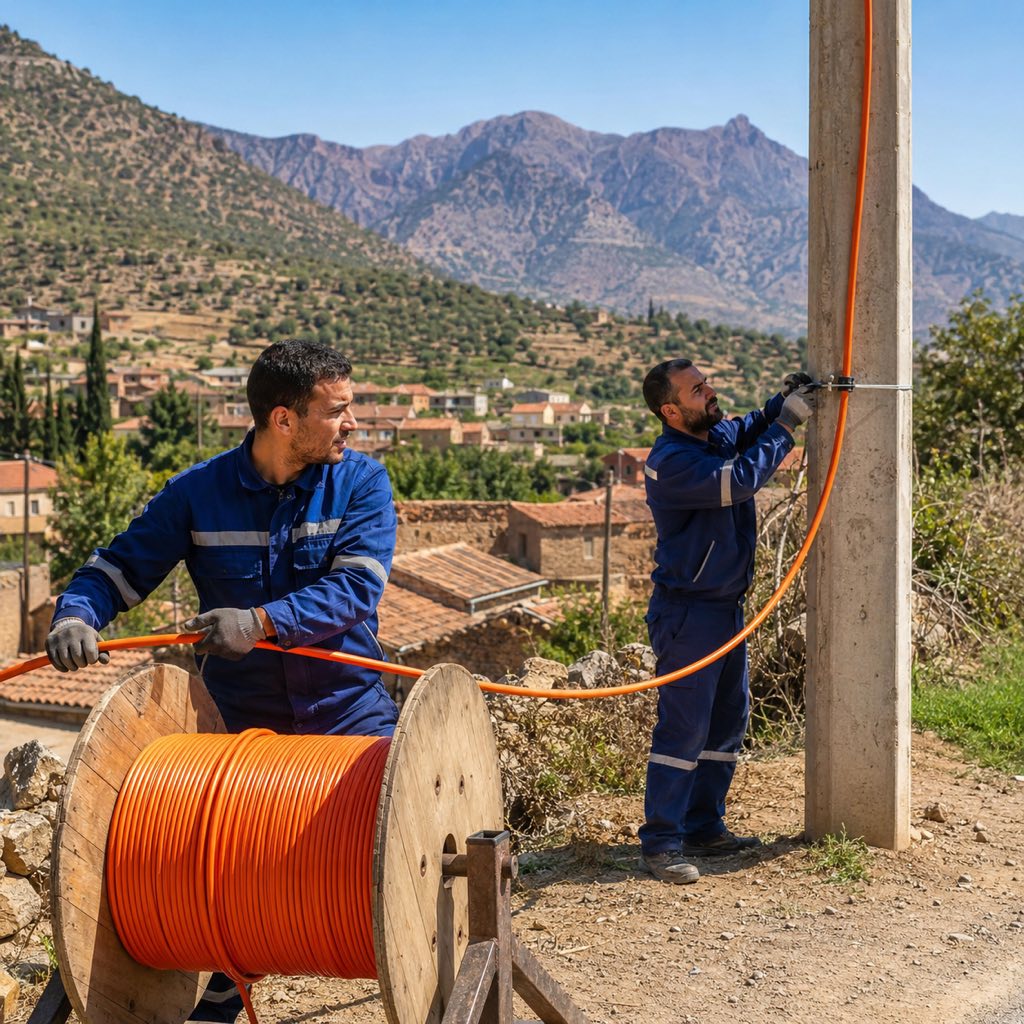
When Minister of Post and Telecommunications Sid Ali Zerrouki announced in February 2026 that Algeria had surpassed 3 million FTTH connections, the headline read as a milestone. And it is. From 53,000 FTTH subscribers in 2020 to 3 million in early 2026 is a roughly 56-fold increase in six years — one of the fastest fiber rollout rates in Africa.
But the milestone also exposes a structural gap. Algeria has approximately 7.4 million households. At 3 million FTTH connections, coverage sits at around 27% — meaning 73% of homes remain outside the fiber footprint. Internet penetration overall reached 76.9% at the start of 2025, but that figure is driven overwhelmingly by mobile broadband, which cannot sustain the sustained upload/download symmetry that cloud workloads — enterprise ERP, video collaboration, remote data pipelines — actually require.
The survey Algeria Télécom launched responds directly to this asymmetry. It asks neighborhood committees to submit their locality name, household count, and GPS coordinates. The submission deadline is July 31, 2025 (extended for 2026 follow-up planning). The results feed directly into Algeria Télécom’s 2026 extension projects: areas flagged by the survey are placed into a prioritization queue for FTTH rollout investment, in line with the government’s stated objective of deploying fiber across all neighbourhoods and regions of the country.
This matters not just for household internet access but for the country’s cloud-adoption trajectory. Enterprise cloud usage is bandwidth-constrained in ways that mobile-first connectivity cannot overcome. Until a locality has reliable symmetric fiber, it effectively cannot host a branch office on a cloud ERP, cannot participate in hybrid cloud architectures, and cannot attract the SME digital economy that the government’s Vision Algeria 2025 economic strategy presupposes.
Why the Coverage Gap Has a Geography Problem
Algeria’s fiber rollout has followed a predictable urban concentration pattern. The 3 million connected households are clustered in Algiers, Oran, Constantine, Sétif, and a handful of secondary cities where return on infrastructure investment is easiest to justify. Outer communes, mountain zones, and steppe towns — areas that collectively house a significant share of Algeria’s 47 million population — remain outside FTTH coverage with no mapped timeline.
The practical consequence is a two-speed cloud economy. Urban enterprises can already source hybrid multi-cloud services over stable fiber links. Rural and peri-urban businesses, government offices, and schools remain dependent on 4G LTE, which is adequate for consumer applications but unstable under simultaneous enterprise loads. A district hospital trying to run an electronic health records system on 4G will experience latency spikes and upload failures that make cloud adoption practically impossible, regardless of the application’s design.
The fiber survey is designed to make this geographic problem legible. Once Algeria Télécom has GPS coordinates mapped to household counts, it can calculate the cost-per-household for fiber extension in each unserved zone and sequence rollouts by density and strategic priority. That is meaningfully different from the previous approach of deploying fiber where it was easiest, then waiting for demand signals from underserved areas that had no formal channel to express need.
Advertisement
The Cloud Readiness Implication: What Fiber Penetration Actually Unlocks
Cloud adoption and fiber penetration are not merely correlated — they are causally linked at the infrastructure level. The reason matters for how Algerian policymakers and enterprise CIOs should think about the survey results.
Public cloud services offered by AWS, Google Cloud, and Microsoft Azure require sustained bandwidth for initial data migration (often terabytes), and then stable lower-bandwidth connections for ongoing operations. The threshold at which cloud ERP, collaboration suites, and data analytics become viable for an SME branch office is typically 100 Mbps symmetric with under 50ms latency — a profile that FTTH delivers and 4G frequently cannot, especially during peak usage hours.
The Medusa subsea cable, which lands in Algeria, provides the international bandwidth backbone. Algeria Télécom’s national backbone fiber network is the middle mile. The FTTH survey is about the last mile — and it is precisely the last mile that determines whether the bandwidth sitting in the backbone translates into usable cloud access for Algerian businesses outside the major cities.
What Algerian CIOs and IT Decision-Makers Should Do
The fiber survey is not a passive government mapping exercise. It is an infrastructure signal that directly informs cloud strategy timelines for every enterprise and public institution operating outside the five major cities. Decision-makers should treat it as a planning input.
1. Submit Locality Data Now — The Survey Is Both a Service Request and a Priority Vote
The Algeria Télécom survey closes July 31. Neighborhood committees, municipal offices, and business associations that want their area prioritized for FTTH must submit GPS coordinates and household counts before that date. An enterprise that operates a warehouse or production facility in an unserved commune should coordinate with local representatives to ensure the area is registered. The prioritization model rewards density — the more households in a submitted zone, the stronger the business case Algeria Télécom can build for investment. Passivity here is a missed vote.
2. Audit Your Remote Sites Against the FTTH Coverage Map Before Committing Cloud Contracts
Before signing a multi-year IaaS or SaaS contract that assumes cloud-grade connectivity, CIOs with sites outside major cities should audit each location’s current last-mile reality. If a site is on 4G LTE, the cloud contract will underperform — and the gap may not close for 12 to 24 months even after the survey results feed into Algeria Télécom’s 2026 rollout plan. The honest planning assumption for most rural sites is: SD-WAN with LTE bonding as a bridge for 2026-2027, FTTH-grade cloud contracts from 2028 onward for localities currently in the coverage gap. Plan contracts accordingly.
3. Model Your Cloud Adoption Timeline Against Algeria Télécom’s Expansion Phases
Algeria Télécom has committed to integrating survey results into its 2026 action plan. This means the fastest-moving localities flagged by the survey could see FTTH rollout commitments announced by late 2026 and physical installation during 2027. For CIOs at enterprises with a 3-to-5-year cloud migration plan, this timing is material: a site flagged in July 2026 may be fiber-ready by mid-2027, which changes the phasing of which workloads migrate first. Model cloud adoption as a phased rollout keyed to the fiber expansion schedule rather than as a single-date cutover.
4. Engage the Local Entrepreneurs Program as an Accelerant
Algeria Télécom has established a local entrepreneurs program to extend FTTH into underserved areas through co-investment arrangements. Enterprises and municipalities that want faster deployment in their zones can explore becoming implementation partners — providing right-of-way access, coordinating building entry agreements with property owners, or co-funding last-drop installation costs. This is not widely publicized, but it is the channel through which Algeria Télécom expects to accelerate deployment beyond what direct government investment alone can achieve.
Where This Fits in Algeria’s 2026 Digital Infrastructure Landscape
The fiber survey sits at the intersection of three converging pressures that will define Algeria’s digital infrastructure trajectory over the next three years. First, the government’s all-fiber strategy is explicit: the objective is national territory coverage, not just major-city coverage, and the survey is the first systematic instrument for identifying what “national coverage” actually requires. Second, enterprise cloud adoption is accelerating in the urban tier — and the competitive disadvantage of rural businesses and public services relative to Algiers-based counterparts will compound every year the gap persists. Third, Algeria’s ambition to participate in the Africa-wide data center economy — anchored by subsea cables such as Medusa — requires that domestic cloud consumption generate sufficient revenue and traffic to justify local infrastructure investment by regional operators.
The fiber survey is, in this sense, not only a connectivity project. It is the foundational data-collection exercise for a cloud economy that extends beyond Algeria’s five largest cities. Whether that economy materializes on a 2027 or 2030 timeline depends directly on how comprehensively the survey data is collected in July 2026 and how quickly Algeria Télécom converts that data into funded rollout commitments.
For CIOs, the implication is strategic, not operational: the decision to plan cloud adoption for rural and peri-urban sites should be made now, with realistic fiber timelines baked in, rather than deferred until the connectivity problem solves itself. The survey is the mechanism that connects that planning horizon to actual infrastructure reality.
Frequently Asked Questions
How many Algerian households currently have fiber-to-the-home?
As of February 2026, approximately 3 million Algerian households are connected to FTTH services, according to an announcement by Minister Sid Ali Zerrouki. This represents around 27% of Algeria’s 7.4 million total households, meaning roughly 5.4 million homes remain outside the fiber footprint. Growth has been rapid — from just 53,000 FTTH subscribers in 2020 — but the urban concentration of deployments has left peri-urban and rural areas with limited fiber access.
Why does fiber matter specifically for cloud adoption, not just general internet access?
Cloud workloads — ERP systems, video collaboration, data analytics pipelines — require sustained symmetric bandwidth with low latency. FTTH typically delivers 100 Mbps to 1 Gbps symmetric with under 20ms latency, while 4G LTE can provide 30-100 Mbps download but is asymmetric (slower upload), variable under load, and often exceeds 50ms latency during peak hours. The asymmetry and variability of 4G make it unsuitable for enterprise cloud operations, even where download speeds seem adequate for consumer use.
What should a business or local council do if their area is not covered by FTTH?
They should immediately submit their locality to Algeria Télécom’s online survey — providing the locality name, GPS coordinates, and estimated household count — before the July 31 deadline. This is the formal mechanism by which Algeria Télécom identifies priority zones for its 2026 extension plan. Businesses can also explore the local entrepreneurs program, which allows co-investment arrangements with Algeria Télécom to accelerate last-mile deployment in specific zones faster than the standard rollout schedule.
Sources & Further Reading
- Algeria Telecom Launches Survey to Map Fiber Network Gaps — Ecofinance Agency
- Algeria Telecom Launches Online Survey to Identify FTTH Gaps — Developing Telecoms
- Algeria Reaches Milestone as 3 Million Households Connect to Fibre Broadband — Tech Africa News
- Algeria Reaches 3 Million FTTH Milestone — MEA Tech Watch
🔗 Related Intelligence
Rural Connectivity: Algeria’s Push to Connect 4,500 Areas by 2027

Algeria as Africa’s Digital Transit Hub: The Cloud Corridor Strategy for 2026–2030

5G + 3M Fiber Homes: Algeria’s Connectivity Convergence Opens a New Cloud Layer

Medusa Subsea Cable: Algeria’s International Bandwidth Upgrade and What It Means for Cloud