Two Classification Societies Just Signed Off on a Data Center Ship
For the past two years, the AI industry’s bottleneck has quietly shifted from chips to sites — land, power interconnects, and water for cooling all ran out faster than GPUs could be delivered. Samsung Heavy Industries has now put a concrete answer on the table: build the data center as a ship, anchor it wherever grid queues and cooling water are actually available, and let a maritime classification society certify it the same way it would certify an LNG carrier.
That answer just cleared a real regulatory hurdle. Samsung Heavy Industries’ 50-megawatt floating AI data center design received Approval in Principle (AiP) from both the American Bureau of Shipping (ABS) and Lloyd’s Register, according to Construction Review Online and Eastern Herald. An Approval in Principle is not a construction permit — it is a classification society’s formal statement that a design’s engineering fundamentals meet safety and structural rules, the step that lets a shipyard start detailed design and financing conversations with confidence the concept will not later be rejected wholesale.
The announcements clustered around Posidonia 2026, the biennial international shipping exhibition held June 1–5, 2026 in Athens — the largest gathering on the global shipping calendar, which drew 2,038 exhibitors and 32,527 visitors from 138 countries at its most recent edition. That a data center concept was the headline story out of a shipbuilding trade fair, rather than a cloud conference, says something about who is actually positioned to build these things: not hyperscalers, but heavy industry.
Inside the Seawater-Cooled Design
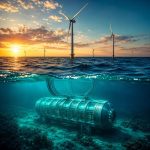
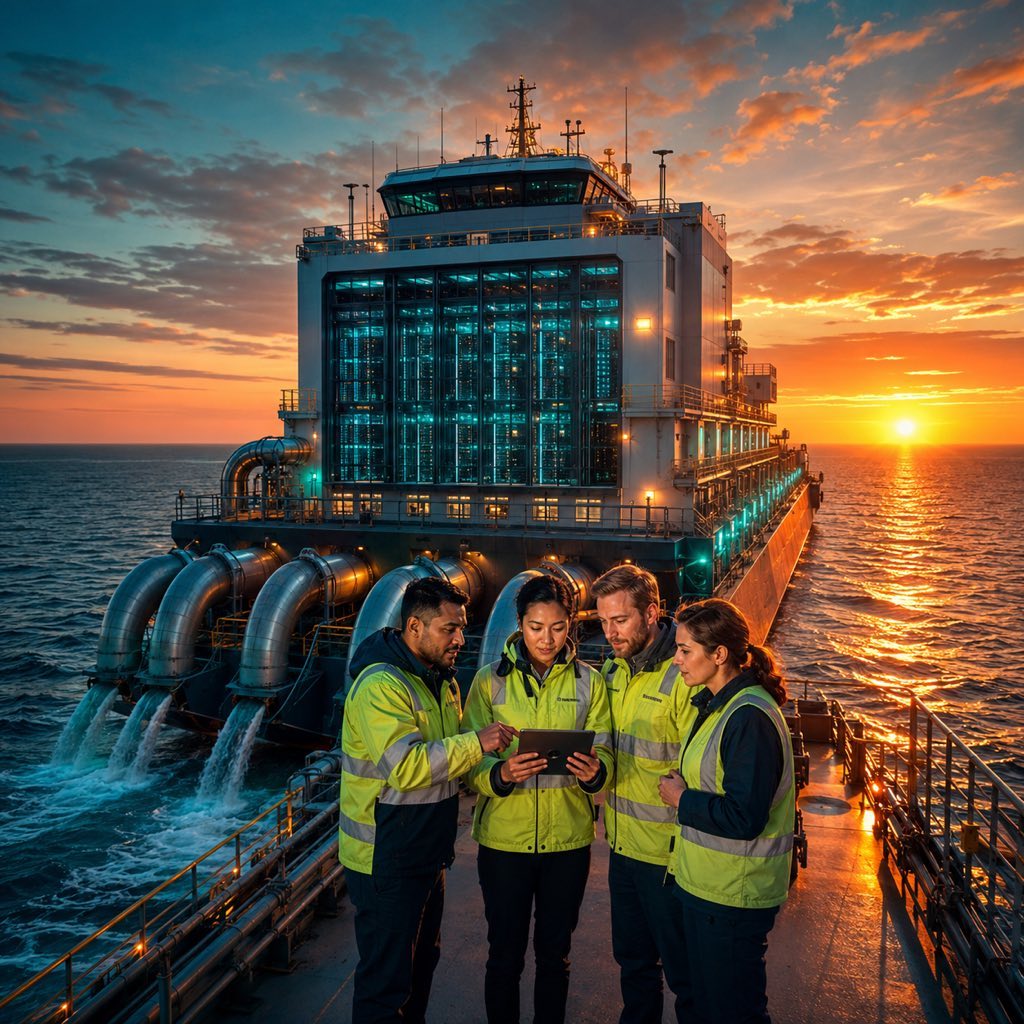
The core engineering bet is straightforward: instead of trucking in freshwater or building evaporative cooling towers on land, the vessel pumps seawater through a closed-loop heat exchanger that never lets ocean water touch the IT equipment directly, according to Construction Review Online and newsbytesapp.com. The warmed water is returned to the ocean, eliminating the freshwater draw that has made data centers politically toxic in drought-prone regions onshore.
Power is the second half of the pitch, and Samsung built in optionality: when the vessel is anchored close to shore, it can tie into the mainland grid via subsea cable; when it needs to operate independently — further offshore, or wherever grid interconnection queues are the real constraint — it runs on onboard liquefied natural gas (LNG) fuel cells, per Eastern Herald and a Tom’s Hardware report describing solid oxide fuel cells (SOFC) running on LNG. That dual-mode design directly targets the two-year-plus grid interconnection queues that have become the industry’s real bottleneck, not chip supply.
Samsung is not building this alone. Cloudnews.tech and Tom’s Hardware both name Capital Clean Energy Carriers, a Greece-based shipowner, as the commercial deployment partner, and Supermicro as the server-hardware partner responsible for validating that GPU performance holds up under offshore vibration, humidity, and salt-air conditions — a real engineering question that has no established track record at 50MW scale. Lloyd’s Register is providing both the marine classification and, through its LR Advisory arm, market analysis for where these vessels might actually be deployed first.
On cost, Construction Review Online reports an industry estimate of $360 million for a commercial 50MW facility — explicitly not an official Samsung-disclosed budget, but a figure that covers the offshore platform, structural fabrication, marine systems integration, power generation, cooling infrastructure, and the AI-ready data center fit-out itself. Commercialization is targeted for 2028, per both Construction Review Online and TechRadar. Samsung is not the first to float a data center — Nautilus Data Technologies already operates a smaller floating facility on a barge in Stockton, California, per cloudnews.tech — but nothing at 50MW hyperscale has cleared classification-society review before.
Advertisement
What Data Center Operators and Cloud Strategists Should Do
1. Treat maritime classification as a new due-diligence line item, not a footnote
If floating compute becomes a real procurement option by 2028, enterprise cloud and colocation buyers will need a way to evaluate vessel-based facilities that their existing site-selection criteria were never built for. Classification-society Approval in Principle from ABS or Lloyd’s Register is the maritime-industry equivalent of a building permit, but it says nothing about uptime SLAs, data sovereignty across territorial waters, or insurance in the event of a storm. Add a maritime-compliance checklist to your vendor scorecard now, even if your first floating-facility procurement request is still years away — the vocabulary (AiP, class rules, flag state) will be unfamiliar to procurement teams trained on land-based site audits.
2. Model dual-mode power as a hedge against interconnection queues, not just a cooling upgrade
The subsea-cable-or-onboard-fuel-cell design is really a hedge against the multi-year grid interconnection backlog that has delayed dozens of land-based hyperscale projects. CTOs evaluating next-generation capacity commitments should ask any data center vendor — floating or not — whether their power plan has a standalone fallback if grid connection slips past the contracted date. A facility that can run on LNG fuel cells while waiting for a subsea tie-in is structurally more resilient than one with a single point of grid dependency.
3. Don’t assume seawater cooling solves your water-stress problem by proxy
Seawater cooling eliminates freshwater draw for the specific facility that uses it, but it does not retroactively fix water stress at your existing land-based sites. Cloud strategists should separate “we have a floating option in our future portfolio” from “our current onshore footprint’s water risk is resolved” — these are different conversations with different timelines, and conflating them in a sustainability report invites scrutiny once the floating facility is still years from commercial operation.
4. Track the Supermicro offshore-validation results before assuming hardware parity
No public data yet confirms that GPU servers perform identically under sustained vessel motion, salt-air humidity, and vibration compared to a static onshore rack. Supermicro’s validation work with Samsung Heavy Industries is the first real-world test of this at scale. Enterprise buyers should wait for published offshore-reliability data — not marketing claims — before factoring floating capacity into any workload-placement model, particularly for latency-sensitive or safety-critical inference.
Where This Fits in 2026’s Data Center Buildout
Floating AI data centers are not a replacement for the terrestrial hyperscale buildout — at 50MW, a single vessel is a fraction of the gigawatt-scale campuses hyperscalers are already committing to onshore. What the ABS and Lloyd’s Register approvals actually represent is an insurance policy against the specific failure mode currently strangling AI infrastructure growth: land scarcity in dense coastal metros, multi-year grid interconnection queues, and freshwater-cooling backlash in drought-affected regions. A shipyard-built, classification-society-certified vessel can be relocated to wherever power and water are least contested, something no fixed concrete building can do.
The open questions are not really technical — marine engineering for offshore platforms is a mature discipline. They are commercial and regulatory: which jurisdictions will treat a vessel anchored in their territorial waters as a taxable, regulable data center versus a ship in transit; how insurers price a $360 million asset exposed to storm risk; and whether the 2028 commercialization target survives contact with the first real construction contract. Samsung Heavy Industries has cleared the easiest hurdle. The harder ones — who buys capacity on a boat, and under what legal regime — are still unanswered.
Frequently Asked Questions
What exactly did Samsung Heavy Industries get approved?
Samsung Heavy Industries received Approval in Principle (AiP) from both the American Bureau of Shipping and Lloyd’s Register for a 50-megawatt floating AI data center design. This confirms the engineering concept meets maritime safety and structural rules, but it is not a construction permit — actual shipbuilding has not started.
How does seawater cooling work without damaging the servers?
The design uses a closed-loop heat exchanger: seawater is pumped through sealed pipes that absorb heat from the IT equipment and is then returned to the ocean, without ever coming into direct contact with the servers. This eliminates the freshwater draw of conventional evaporative cooling towers used at most land-based data centers.
When will a floating AI data center actually be operational?
Samsung Heavy Industries and its partners are targeting commercialization in 2028, according to Construction Review Online and TechRadar. An industry estimate puts the cost of a commercial 50MW vessel at roughly $360 million, though Samsung has not disclosed an official budget figure.
Sources & Further Reading
- Samsung and New Firm M3 to Develop Floating Data Centers — DataCenterDynamics
- Samsung Heavy Industries Is Building AI Data Centers on Ships. Two Regulators Already Approved the Design — Eastern Herald
- $360M Samsung Floating Data Center, 50MW Offshore AI Infrastructure Set for 2028 Launch — Construction Review Online
- Samsung Heavy Industries Recruits Greek Shipowner and Supermicro to Bring 50MW Floating AI Data Centers to Market — Tom’s Hardware
- Samsung Looks to the Sea to Solve the AI Data Center Bottleneck — Cloudnews.tech
- Samsung Says It Will Launch a Floating Data Center by 2028 — TechRadar
- Samsung Pursuing Floating AI Data Centers That Could Use Seawater — newsbytesapp.com
- Posidonia 2026 — Ocean Science & Technology
🔗 Related Intelligence
Data Centers Under the Sea: Offshore Wind and Ocean Cooling Go Live in 2026

Samsung HBM4: The Memory Chip Powering AI’s Next Performance Leap

Samsung’s 755% Profit Surge: How HBM Chips Became AI’s Critical Bottleneck
Liquid Cooling in AI Data Centers: Why Direct-to-Chip Is the New Default