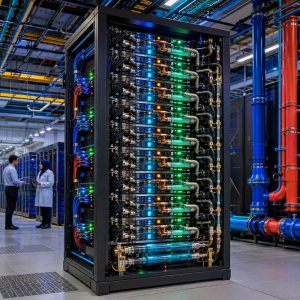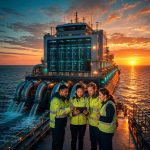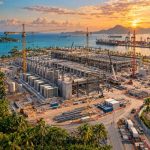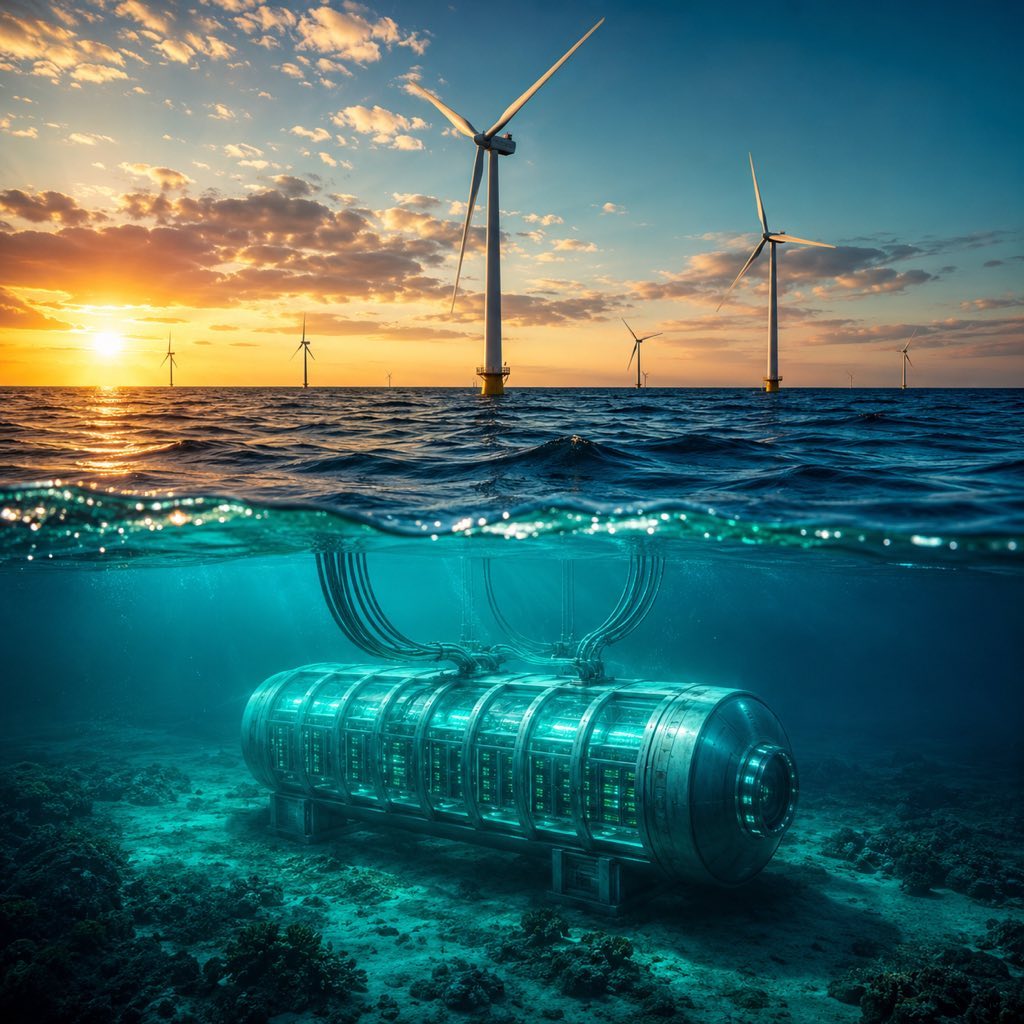
Inside the Lin-gang Subsea Facility
The numbers describe a genuinely new category of infrastructure, not a lab curiosity. According to Offshore Wind’s reporting on the launch, the facility sits roughly 10 meters below the surface off the Lingang Special Area of the Shanghai Pilot Free Trade Zone, wedged physically between the first and second phases of Lin-gang’s offshore wind farm. That placement is not cosmetic — it lets the data center draw power directly from adjacent turbines rather than routing electricity through the onshore grid twice.
The project moved from paper to production fast by data center standards: a cooperation agreement between HiCloud Technology, the Administrative Committee of Lingang Special Area, and Shanghai Lingang Special Area Investment Holding Group was signed in June 2025, construction finished by October 2025, an official launch was announced in February 2026, and Tom’s Hardware confirmed full operational status on May 18, 2026. GPU compute inside the sealed cabins comes from China Telecom and LinkWise, targeting AI training support tasks, big-data annotation, and 5G infrastructure workloads. At CNY 1.6 billion (roughly $226 million), the build reportedly delivers a 1.15 PUE against an industry average closer to 1.5, cuts electricity consumption by 22.8%, and eliminates data center water use entirely — because seawater does the cooling passively, with no chillers, no evaporation towers, and no potable water drawn from a stressed municipal supply.
This is not HiCloud’s first subsea deployment either. The company, also known as Hailanyun, installed an earlier 500-server capsule off Hainan’s Lingshui county back in December 2023, part of a provincial plan that the South China Morning Post reported aims for 100 underwater data cabins under Hainan’s five-year development plan. Lin-gang is the scaled-up, wind-integrated version of that earlier bet — and the first to combine underwater cooling with dedicated offshore renewable generation at full commercial capacity.
Why Ocean Cooling Solves AI’s Two Crises at Once
Data centers are running into a wall that has nothing to do with chip supply. Modern AI training and inference clusters are power-hungry in a way that traditional web infrastructure never was, and the grid is struggling to keep pace. Pew Research’s analysis of U.S. data center energy use notes that data centers already account for roughly a quarter of Virginia’s total electricity supply and double-digit shares in states like North Dakota, Nebraska, Iowa, and Oregon — and that the sector is on pace to drive nearly half of all new U.S. electricity demand growth through 2030. Ireland faces the same crunch on a national scale, with data centers already consuming more than a fifth of the country’s electricity.
Cooling is the second half of the same problem. Air cooling cannot keep up with the density of modern GPU racks, which is why NVIDIA’s own engineering team frames liquid cooling as now essential for its Rubin-generation architecture — a fully liquid-cooled design that NVIDIA says delivers up to 300x better water efficiency and roughly 25x better energy efficiency than air-cooled equivalents. CoreSite’s 2026 data center outlook goes further, arguing that power has become “the defining intersection of AI growth and data center operations” for 2026, pushing operators toward behind-the-meter arrangements like fuel cells and small nuclear reactors just to keep new capacity online. Seawater cooling and dedicated offshore wind sidestep both constraints at once: the ocean is an effectively infinite heat sink, and a wind farm built specifically to feed the data center doesn’t compete with residential or industrial load on the same grid segment.
The scale advantage matters too — a single 24 MW subsea facility is modest against the 100-750 MW campuses now common for frontier AI training, but as a proof point it demonstrates that the model works at commercial scale, not just in a single sealed pod. DataCenterKnowledge’s June 2026 roundup of global builds — including NVIDIA and IREN’s up-to-5GW AI infrastructure partnership and SoftBank’s €75 billion France buildout — shows just how far behind land-based capacity additions are running relative to demand, which is exactly the pressure subsea designs are trying to relieve.
Advertisement
Why This Isn’t a Repeat of Microsoft’s Natick
Skeptics have reason to be cautious, because the industry already ran this experiment once and shelved it. Microsoft’s Project Natick submerged 855 servers off Scotland’s Orkney Islands in 2018 and left them unattended for over two years. The results were genuinely good — TechRadar reported a 0.7% server failure rate underwater versus 5.9% for an onshore control group, attributed partly to the sealed, oxygen-free, temperature-stable environment. Microsoft still discontinued the project in June 2024, because a single non-serviceable pressure vessel meant every hardware refresh or repair required hauling the entire capsule back to the surface — an operational dead end for a technology that needs constant GPU upgrades.
HiCloud’s design is built around exactly that failure mode. Rather than one sealed unit, the Lin-gang facility uses modular cabins — each built and pressure-tested on land, deployed within roughly 90 days, and designed to be individually retrieved and swapped rather than serviced in place. That doesn’t eliminate the maintenance problem industry observers still flag; CleanTechnica’s assessment of the underwater data center trend is blunt that “servicing submerged cutting-edge hardware will continue to be challenging: replacing, upgrading, or repairing servers requires specialized marine operations.” But modularity converts an all-or-nothing recovery operation into a routine one, which is the difference between a research pilot and something an operator can actually run a business on.
What Cloud and Infrastructure Leaders Should Do About It
1. Model coastal cooling into your next data center site selection, even if you never go subsea
The core lesson from Lin-gang isn’t “build underwater” — it’s that colocating compute with a dedicated renewable power source and a natural heat sink cuts both PUE and grid dependency at once. Coastal or riverfront sites with access to seawater or deep freshwater cooling loops, paired with an on-site or adjacent renewable power purchase agreement, can capture most of the same benefit without the marine engineering. CTOs scoping 2027 capacity should ask vendors directly what PUE and water-use numbers a proposed site can hit against the 1.15 PUE / zero-water benchmark this project has now put on the table.
2. Treat maintainability as a first-order design constraint, not an afterthought
Project Natick failed commercially, not technically, because Microsoft built a design nobody could service without a full recovery operation. Any infrastructure investment in novel cooling — subsea, immersion, or otherwise — should be evaluated on hardware refresh cycles from day one: can GPUs be swapped in under a quarter without disrupting the whole facility? If the answer requires shutting down or physically relocating the unit, the design has the same fatal flaw Natick did, regardless of how good its thermal numbers look on paper.
3. Track offshore wind and subsea permitting as a data center lever, not just an energy-policy issue
Data center site selection teams historically evaluate grid interconnection queues and land cost. Lin-gang shows that offshore wind lease timelines and coastal permitting are becoming a parallel lever worth tracking, especially in markets with congested onshore grids. Infrastructure investors and hyperscalers scouting new regions should start mapping offshore wind pipeline maturity alongside traditional grid capacity data — the two are converging into a single site-selection variable in markets that can support it.
Where This Fits in 2026’s Infrastructure Race
Lin-gang won’t replace land-based hyperscale campuses — 24 MW is a rounding error next to the multi-hundred-megawatt AI factories under construction across Texas, Virginia, and France this year. What it demonstrates is a viable third pathway between “build more onshore capacity and fight the grid for it” and “wait for nuclear and fusion to solve power at scale”: pairing dedicated offshore renewable generation with a natural, water-free heat sink, engineered from the start to be serviceable rather than sealed shut.
The real test isn’t this single facility — it’s whether HiCloud, or a competitor, scales the modular-cabin model to the hundreds of megawatts that frontier AI training actually needs, and whether the retrieval-and-swap maintenance model holds up once thousands of GPU generations have cycled through it rather than one. Until that happens, Lin-gang is best read as a credible proof-of-concept rather than a template every hyperscaler will copy in the next 24 months — but it’s the first subsea facility with the commercial numbers (PUE, cost, uptime) to be taken seriously as one.
Frequently Asked Questions
What is China’s underwater data center and where is it located?
It is a commercial data center developed by HiCloud Technology, submerged roughly 10 meters underwater off the Lingang Special Area of the Shanghai Pilot Free Trade Zone. It reached full commercial operation on May 18, 2026, running 2,000 servers at 24 megawatts, powered directly by an adjacent offshore wind farm and cooled passively by seawater.
How is this different from Microsoft’s Project Natick?
Project Natick used a single sealed, non-serviceable pressure vessel, which Microsoft discontinued in 2024 despite good reliability results because any hardware refresh required retrieving the entire unit. HiCloud’s Lin-gang facility uses modular cabins designed to be individually retrieved and swapped, addressing the exact maintainability flaw that ended Natick.
Could Algeria realistically build something like this?
Not in the near term. Algeria lacks offshore wind capacity and marine data-center engineering experience, and current priorities center on grid reliability and conventional cooling efficiency. The transferable lesson is smaller: coastal siting paired with dedicated renewable power and natural cooling can cut PUE and water use, which is directly applicable to Algeria’s Mediterranean coast even without subsea construction.
Sources & Further Reading
- China Puts ‘World’s First’ Offshore Wind-Powered Underwater Data Centre into Operation — Offshore Wind
- China Says ‘World’s First’ Offshore Wind-Powered Underwater Data Center Has Entered Full Operation — Tom’s Hardware
- China Launches World’s First Commercial Underwater Data Centre in Hainan — South China Morning Post
- What We Know About Energy Use at U.S. Data Centers Amid the AI Boom — Pew Research Center
- Hotter Than a Hot Tub: The 45°C Breakthrough to Cool AI’s Biggest Machines — NVIDIA Blog
- Data Center Outlook 2026: Power and Cooling Challenges and Solutions Are Top of Mind — CoreSite
- New Data Center Developments: June 2026 — Data Center Knowledge
- Goodbye Natick! Microsoft Has Given Up on Its Underwater Data Center Pilot — TechRadar
- Underwater Data Centers Are Real, But The Hype Is Getting Ahead Of The Engineering — CleanTechnica
🔗 Related Intelligence
Samsung’s Floating AI Data Center: Why Compute Is Now Going to Sea

Liquid Cooling Goes Mainstream: The Race to Cool AI’s Insatiable Heat
Data Centers Are Draining Aquifers: The Water War Big Tech Doesn’t Want You to See
Liquid Cooling in AI Data Centers: Why Direct-to-Chip Is the New Default