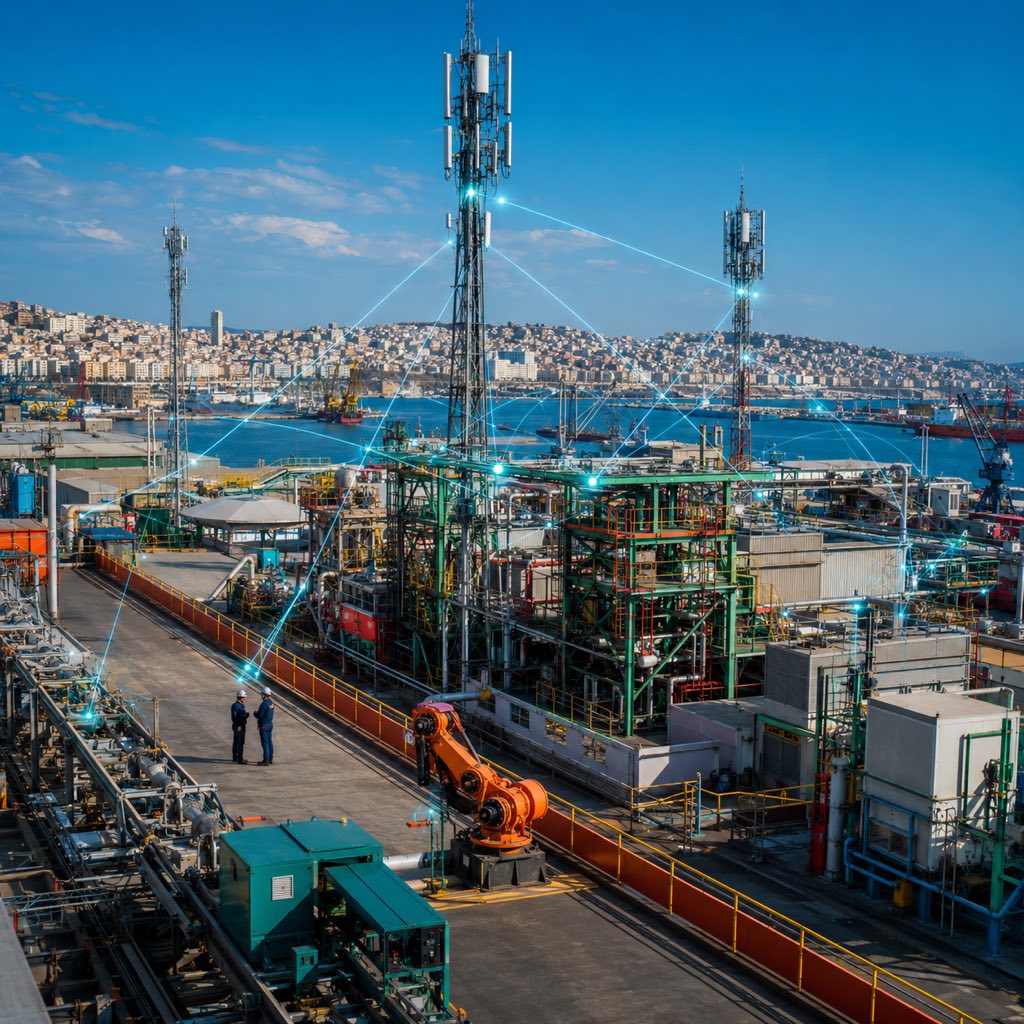
From a Faster Phone Signal to an Industrial Platform
When Algeria’s Ministry of Post and Telecommunications cleared Mobilis, Djezzy and Ooredoo to deploy 5G in late 2025, the headline numbers were about consumers: gigabit downloads and a smoother mobile experience. According to Connecting Africa, the three operators paid a combined DZD 63.9 billion — roughly $492 million — for licenses granted in July 2025, with eight pilot wilayas first and a six-year mandate for nationwide coverage. Mobilis reported 1.2 Gbps downlink speeds in February 2025 trials, and Djezzy has since rolled out across 18 provinces — eight initial wilayas plus ten more brought forward ahead of their original Q2 2026 schedule.
But the more consequential story for Algerian industry is architectural, not just about speed. Today’s launches run mostly in Non-Standalone (NSA) mode, where the new 5G radio rides on top of the existing 4G core. The leap that matters for factories, gas plants and ports is the move to Standalone (SA) 5G — a cloud-native 5G core that runs independently of 4G. As Ericsson explains, Standalone is what makes network slicing, end-to-end ultra-low latency and clean security separation possible. That is the foundation Algerian enterprises should be planning around now.
From Coverage to Capability: What Standalone 5G Changes
1. Network slicing turns one network into many guaranteed-performance networks
The single most important capability that Standalone unlocks is network slicing: carving one physical 5G network into multiple isolated virtual networks, each with its own guarantees for speed, latency and security. As Telefónica describes, an operator can run a low-power IoT slice for thousands of industrial sensors, a separate ultra-reliable slice for a robotic arm, and a high-bandwidth video slice for quality-control cameras — all on the same towers, fully partitioned. For an Algerian manufacturer, this means a Mobilis, Djezzy or Ooredoo slice can be tailored to a single plant’s traffic profile without the cost of building private infrastructure from scratch.
2. Ultra-low latency (URLLC) makes real-time control possible
Standalone 5G’s new core supports URLLC — Ultra-Reliable Low-Latency Communication — with theoretical latencies in the 1-5 millisecond range, versus the higher and less predictable delays of NSA. That millisecond-class responsiveness is the threshold for closed-loop industrial control: autonomous guided vehicles in a warehouse, computer-vision defect detection on a production line, and remote operation of equipment in hazardous energy environments. Algeria’s energy and manufacturing operators run exactly the kind of high-reliability processes — mining, logistics and heavy industry typically demand greater than 99.99% reliability — where this latency floor is the difference between a demo and a deployment.
3. Private and dedicated networks bring the slice inside the fence line
For sites that need full control — a refinery, a port terminal, a large factory — Standalone 5G enables private networks: a dedicated 5G network covering a single campus, often combining operator spectrum with on-site equipment. Globally this is where the money is going. Industry analysts estimate that more than 70% of private network investment — about $5.1 billion — is heading into standalone private 5G, positioned to become the dominant connectivity layer for Industry 4.0. Algerian operators have already signalled they want this enterprise market: at the 5G Vertical Industry Summit in Algiers on 28 January 2026, Ooredoo and equipment partner ZTE demonstrated robot-assisted automation, smart-manufacturing zones and live ultra-low-latency tests on the commercial 3.5 GHz band.
Advertisement
What Algerian Enterprises Should Do Now
The window between today’s NSA rollout and tomorrow’s Standalone capability is a planning opportunity. The enterprises that map their use cases now will be first in line when operators open slicing and private-network offers commercially.
1. Inventory your latency-sensitive and connection-dense use cases first
Before talking to an operator, build a short list of processes that either need millisecond responsiveness (robotic control, AGVs, remote operation) or massive sensor density (predictive-maintenance arrays, environmental monitoring). These are the workloads that justify a dedicated slice or private network. Manufacturers should look at production-line vision and AGV fleets; energy operators at remote-site telemetry and worker-safety systems; logistics and port operators at asset tracking and yard automation. This inventory becomes the technical brief that turns a vague “we want 5G” into a costed slice specification.
2. Talk to all three operators about enterprise slicing roadmaps, not just consumer plans
Mobilis, Djezzy and Ooredoo are competing for the same enterprise revenue, and the Ooredoo–ZTE summit shows they are actively courting industrial customers. CIOs and industrial CTOs should request each operator’s Standalone and slicing timeline, ask which wilayas will get SA coverage first, and negotiate enterprise service-level agreements with explicit latency and reliability floors rather than accepting consumer-grade best-effort terms. Because Djezzy accelerated ten wilayas ahead of schedule, location-specific timing is now a real negotiating lever.
3. Run a single-site pilot before committing to a multi-plant rollout
Rather than wiring an entire industrial estate at once, choose one site — a single production hall, one warehouse, one well-pad cluster — and run a contained pilot that proves the latency and reliability numbers against your own process. A pilot also forces the organisational work that technology alone doesn’t solve: integrating the 5G slice with existing OT systems, defining who owns the network on the factory floor, and building the cybersecurity perimeter around a network that now reaches deep into operations. Prove the ROI on one site, then template it.
Algeria’s Industrial Connectivity Roadmap
The deeper point is that 5G in Algeria is arriving as two distinct products at once. The consumer product — faster phones across a growing list of wilayas — is already here and will keep expanding toward the six-year nationwide target. The industrial product — Standalone cores, network slices and private campus networks — is the one that maps onto the government’s stated ambitions for Industry 4.0, IoT and cloud, and onto a digital ecosystem projected to contribute around $13 billion to GDP by 2030.
For Algerian manufacturing, energy and logistics, the practical sequence is clear: the radio coverage is being built now, the Standalone capability that unlocks slicing and private networks is the next layer, and the enterprises that have already inventoried their use cases and opened operator conversations will convert that capability into productivity fastest. The 3.5 GHz spectrum, the operator competition for enterprise revenue, and live demonstrations like the Algiers summit all point the same way — the industrial opportunity is real, and the time to design for it is during the build-out, not after it.
Frequently Asked Questions
What is the difference between Non-Standalone and Standalone 5G?
Non-Standalone (NSA) 5G runs the new 5G radio on top of the existing 4G core, delivering faster speeds but not the full feature set. Standalone (SA) 5G adds a separate cloud-native 5G core that runs independently of 4G. Standalone is what unlocks network slicing, end-to-end ultra-low latency (URLLC) and clean security separation — the capabilities that matter most for industrial use.
Why does network slicing matter for Algerian industry?
Network slicing lets a single physical 5G network be split into multiple isolated virtual networks, each with its own guaranteed speed, latency and security. A manufacturer can run a low-power slice for thousands of sensors, an ultra-reliable slice for robotic control, and a high-bandwidth slice for quality-control video — all on operator infrastructure, without building a network from scratch.
How can an Algerian manufacturer start using industrial 5G now?
Begin by listing the processes that need millisecond responsiveness or massive sensor density, then ask Mobilis, Djezzy and Ooredoo about their Standalone and slicing roadmaps and which wilayas get SA coverage first. Run a single-site pilot to validate latency and reliability against your own process before scaling to multiple plants.
Sources & Further Reading
- Algeria Launches 5G Rollout — Connecting Africa
- Algeria to Get 5G as Mobilis, Djezzy and Ooredoo Commence Rollouts — Developing Telecoms
- Djezzy Rolls Out 5G Network Across 18 Provinces in Algeria — Telecompaper
- ZTE Joins Ooredoo Algeria’s 5G Vertical Industry Summit — ZTE
- What is 5G Standalone? SA Means Network Slicing, Security, and Automation — Ericsson
- 5G SA Network Slicing: Specifications and Use Cases — Telefónica
- Private LTE & 5G Network Ecosystem 2025-2030 — Research and Markets
🔗 Related Intelligence

Algeria 5G Enterprise: Industrial IoT and Smart Factory Use Cases Now Viable in 2026

Algeria’s 5G Commercial Launch: Enterprise IoT Connectivity Roadmap for 2026

Algeria 5G Rural Policy: How Coverage Obligations in the Six-Year Rollout Create Market Opportunities

Algeria’s 5G Is Live: Where Is the Edge Computing Layer?