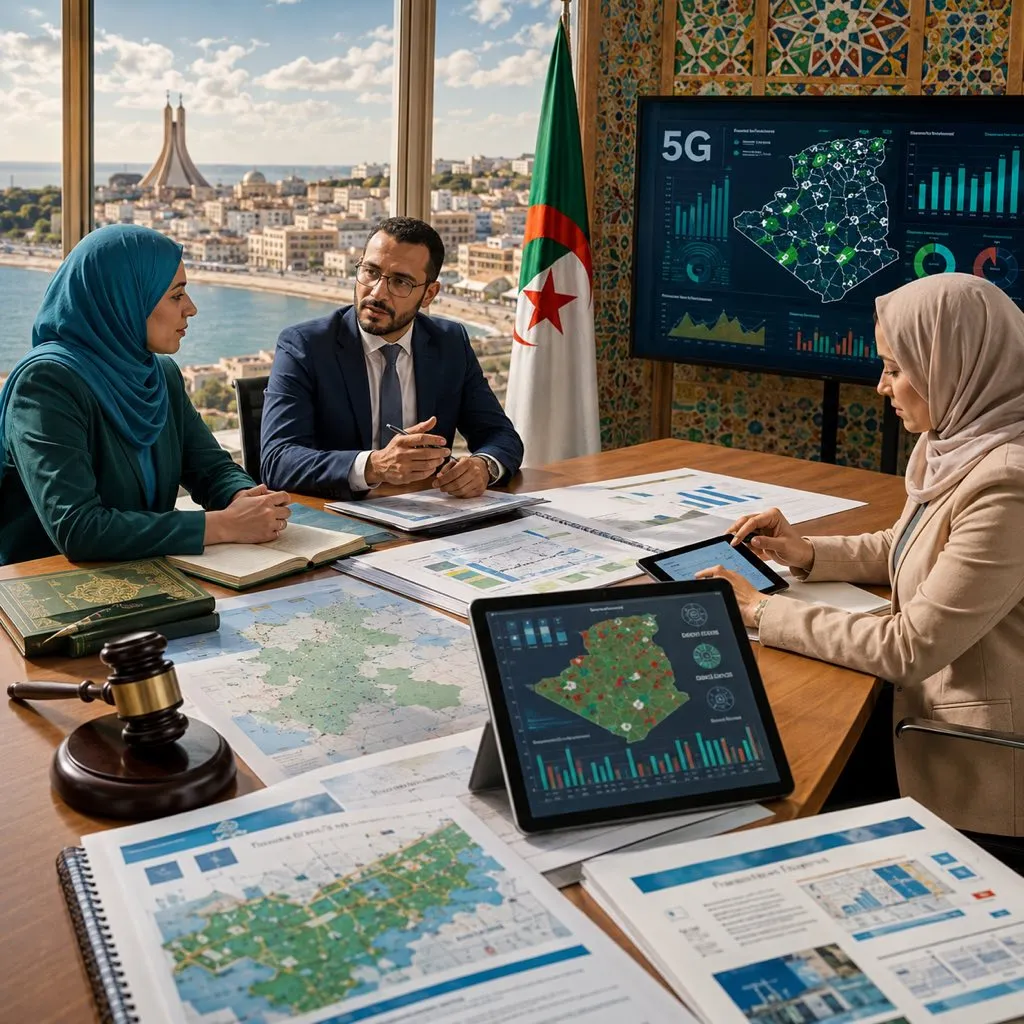
Algeria’s 5G Launch: A Commercial Start with a Regulatory Architecture Behind It
Algeria joined the 5G era in December 2025 when the government formally activated 5G commercial services, following years of infrastructure preparation and spectrum planning. The launch, covered by TechAfrica News and Connecting Africa, positioned Algeria among the first North African countries to achieve commercial 5G availability, alongside Morocco and Egypt.
But the commercial launch is only the starting point. The more consequential regulatory development is the six-year rollout plan that establishes phase-specific coverage obligations for Algeria’s three licensed mobile operators: Mobilis (the state-owned incumbent), Djezzy (owned by VEON), and Ooredoo Algeria. As reported by North Africa Post and analyzed by Trends in Africa, the six-year plan mandates a phased geographic expansion from urban centers to wilaya capitals to secondary towns and, in the final phases, strategically designated rural areas.
This is not simply a deployment roadmap — it is a regulatory commitment with license condition teeth. The coverage milestones built into the six-year plan are enforceable obligations, not aspirational targets. Operators that miss milestones face potential regulatory action by ARPCE, which holds the licensing authority. That enforcement dimension is what transforms the six-year plan from a government communications exercise into a market-shaping framework.
What the Six-Year Plan Actually Requires of Operators
The six-year rollout timeline, with its phased obligation structure, creates a predictable investment calendar for the operators and a structured set of market opportunities for the companies that serve them. The key structural features of the plan are:
Phase 1 (2025-2027) — Urban and Wilaya Capitals. The initial phase concentrates 5G rollout on the 10 largest cities and all 58 wilaya capitals. In practice, this means major urban centers — Algiers, Oran, Constantine, Annaba, Sétif, Tlemcen, Batna, Blida, Béjaïa, and Djelfa — receive priority deployment. At the wilaya capital level, this is significant: Algeria has 58 wilayas, and their capitals collectively cover approximately 70% of the country’s economically active population. Phase 1 obligations are already active as of December 2025.
Phase 2 (2027-2029) — Secondary Towns and Industrial Zones. The second phase requires operators to extend coverage to secondary municipalities (daïras and communes with population thresholds defined in the license conditions) and to declared industrial zones. Algeria’s network of industrial zones — concentrated in the north and the oil-and-gas producing south — represents high-value connectivity anchors: mines, processing facilities, and logistics hubs that generate the per-unit revenue needed to fund rural network economics.
Phase 3 (2029-2031) — Rural and Strategic Areas. The final phase covers the most challenging connectivity geography: agricultural zones, transport corridors in the interior, and areas designated as strategically important for the government’s economic diversification agenda. This is where universal service fund (USF) economics and NGSO satellite connectivity will need to complement terrestrial 5G — the per-tower economics in deep rural Algeria do not work without subsidy or regulatory cross-subsidy mechanisms.
Advertisement
What Tech and Infrastructure Companies Should Do About the Coverage Obligations
The six-year coverage mandate creates time-bound opportunities across infrastructure services, enterprise connectivity, and application development. The following actions are structured around the phase timeline.
1. Align Infrastructure Service Bids with Phase 1 Wilaya Capital Rollout Now
The 58 wilaya capital coverage obligation is active today. Mobilis, Djezzy, and Ooredoo are all simultaneously deploying 5G infrastructure across wilaya capitals — meaning tower construction, fiber backhaul installation, antenna procurement, and site acquisition are all under procurement pressure in the 2025-2027 window. Algerian companies in civil engineering, tower erection, fiber splicing, power supply, and site management should be positioning for subcontract bids on operator infrastructure programs. The operators will be under cost pressure to meet Phase 1 deadlines, and competitive subcontract pricing combined with local presence (avoiding import logistics) gives Algerian infrastructure service companies a structural advantage over international competitors. Submit expressions of interest directly to Mobilis Infrastructure Division, Djezzy Network Operations, and Ooredoo Algeria’s procurement portal before H2 2026.
2. Design Enterprise 5G Connectivity Products for the Industrial Zone Coverage Window
Phase 2’s industrial zone coverage obligation (2027-2029) creates a defined window for enterprise connectivity product development. Algerian companies building smart factory, IoT industrial monitoring, and logistics automation products that require 5G connectivity — ultra-low latency, network slicing, or massive IoT density — should design those products now, targeting commercial launch to coincide with Phase 2 infrastructure availability. The 18-month product development cycle for enterprise hardware-software bundles means that starting in 2026 positions a product for market entry in 2028, precisely when Phase 2 coverage is coming online. Companies that wait for 5G to arrive before designing products will be 18-24 months behind the market.
3. Engage ARPCE’s Universal Service Fund Mechanisms Directly
Algeria’s universal service framework, grounded in the country’s electronic communications law, includes mechanisms for subsidizing connectivity in areas where commercial rollout economics are insufficient. Phase 3’s rural coverage obligation will almost certainly require USF support — the math of deploying and operating a 5G base station in a rural area with few hundred users simply does not work at commercial tariff levels. Algerian companies that specialize in rural connectivity infrastructure (tower construction in difficult terrain, renewable energy-powered base stations, shared passive infrastructure), and those developing applications for the agriculture, water management, and transport sectors that would use rural 5G connectivity, should actively engage ARPCE’s universal service consultation processes. The USF allocation process rewards operators that can demonstrate cost-effective rural deployment partnerships with technology vendors, creating a direct commercial incentive for local tech companies to participate.
4. Monitor Competitor Coverage Maps for Market Entry Timing
The six-year plan creates a competitive dynamic among the three operators: all three face the same coverage milestones but have different financial positions, different network infrastructure starting points, and different strategic priorities. Mobilis, as the state-owned incumbent with the largest existing 4G network footprint, is likely to move fastest on Phase 1 wilaya capital coverage. Djezzy and Ooredoo, as private operators with parent-company capital access (VEON and Ooredoo Group respectively), may deploy more aggressively in higher-revenue urban clusters. For enterprise buyers of 5G connectivity services — particularly for fixed wireless access, private 5G networks, or high-bandwidth backhaul — the practical availability of 5G from at least one operator at a given location is the relevant trigger, not the regulatory deadline. Monitoring operator coverage announcement cadences allows enterprises to phase their own network upgrade plans accordingly.
5. Position Solutions for the Phase 3 Agriculture-5G Convergence
Algeria’s agricultural sector — which accounts for approximately 12% of GDP and employs over 10% of the working population — is an explicit target of the Phase 3 rural 5G coverage mandate. Precision agriculture applications using 5G-connected sensors for soil monitoring, irrigation control, and harvest optimization require reliable, low-latency connectivity that current 4G networks cannot deliver in most agricultural zones. Algerian agritech developers and hardware companies should begin building their precision agriculture product roadmaps around Phase 3 coverage availability (2029-2031), using the intervening 3-5 years to pilot with satellite connectivity (following the NGSO licensing framework) and to develop agronomic datasets that will make their 5G-native products differentiated from imports when Phase 3 coverage arrives.
The Regulatory Question: What Happens If Operators Miss Coverage Milestones
The six-year plan’s value as a market signal depends on its enforceability. The critical regulatory question is: what happens if one or more operators fail to meet Phase 1 or Phase 2 coverage milestones?
ARPCE has the formal authority to impose financial penalties and, in extreme cases, to revoke or modify license conditions for operators that materially miss coverage commitments. But the practical enforcement dynamic in Algeria’s telecom sector has historically involved negotiated remediation — operators that demonstrate good-faith progress on coverage targets but face specific infrastructure challenges (land acquisition disputes, import logistics delays for equipment, local permitting issues at wilaya level) can negotiate timeline adjustments with ARPCE. This means that coverage milestone dates should be understood as regulatory anchors that create negotiating pressure, not hard deadlines that produce automatic sanctions.
For tech and infrastructure companies, the implication is to treat the coverage obligation timeline as a planning floor rather than a guarantee: design products and service bids that are viable on the announced schedule, but build in flexibility for 6-12 month slippage at any given milestone. The six-year plan has been designed with this graduated, phased architecture precisely because the government recognizes that rigid deadlines applied to infrastructure rollout in a country of Algeria’s geographic scale would produce compliance theatre rather than actual coverage.
Frequently Asked Questions
What are the key phases of Algeria’s six-year 5G rollout plan?
The six-year plan (2025-2031) has three main phases: Phase 1 (2025-2027) covers the 10 largest cities and all 58 wilaya capitals; Phase 2 (2027-2029) extends coverage to secondary municipalities and declared industrial zones; and Phase 3 (2029-2031) targets rural areas, agricultural zones, and strategically designated transport corridors. All three licensed operators — Mobilis, Djezzy, and Ooredoo — are bound by these phase milestones as license conditions.
How do universal service obligations affect the rural coverage mandate?
Phase 3’s rural coverage requirement will require universal service fund (USF) support because the commercial economics of deploying 5G in low-population-density rural areas do not work at market tariff levels. ARPCE administers the USF mechanism under Algeria’s electronic communications law. Tech companies and infrastructure providers that develop cost-effective rural deployment solutions and partner with operators on USF-eligible projects gain access to regulatory subsidy streams that improve the economics of rural coverage buildout.
What is the opportunity for Algerian tech companies in the 5G rollout?
The rollout creates opportunities across three domains: infrastructure services (civil engineering, tower installation, fiber backhaul, power systems) for Phase 1 and Phase 2 deployment; enterprise connectivity products (private 5G networks, industrial IoT, smart factory solutions) timed to Phase 2 industrial zone coverage; and agricultural technology applications (precision farming sensors, irrigation automation, supply chain monitoring) positioned for Phase 3 rural coverage. Companies that begin product and service development now will reach market readiness before the coverage phases activate.
Sources & Further Reading
- Algeria Officially Launches 5G Network, Opening a New Era of Digital Connectivity — TechAfrica News
- Algeria Launches 5G Rollout — Connecting Africa
- Algeria Rolls Out 5G Network with Six-Year Expansion Plan — North Africa Post
- Algeria Enters the 5G Era with a Gradual National Rollout and Cautious Optimism — Trends in Africa
- Algeria Opens 5G Deployment Amid Infrastructure and Coverage Concerns — Ecofin Agency
🔗 Related Intelligence

Algeria’s 5G Standalone Leap: Private Networks and Slicing for Industry 4.0

Algeria 5G Enterprise: Industrial IoT and Smart Factory Use Cases Now Viable in 2026

Algeria’s 5G License Framework: What ARPCE’s Coverage Obligations and QoS Rules Mean for Businesses

Algeria’s 5G Commercial Launch: Enterprise IoT Connectivity Roadmap for 2026