The $492 Million Spectrum Bet
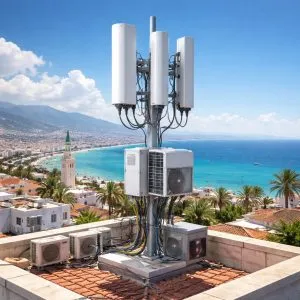
Algeria's three mobile operators — Algérie Télécom-owned Mobilis, Djezzy and Ooredoo — paid a combined 63.9 billion Algerian Dinar (approximately $492 million) for 5G licences confirmed by executive decree and published in the government gazette in late 2025. Under the terms, operators must achieve full nationwide coverage within six years, with initial deployment in eight designated pilot provinces.
This is a meaningful bet. Mobilis carried roughly 23.5 million mobile subscribers at the end of Q3 2025 (per Omdia data cited in the Connecting Africa briefing), Djezzy around 17.7 million, and Ooredoo Algeria 14.8 million. The Ministry of Post and Telecommunications has framed 5G as the backbone for AI, IoT, cloud, digital health, Industry 4.0 and smart mobility — a digital ecosystem projected to contribute $9 billion to GDP in 2025 and $13 billion by 2030.
Why MEC Is the Piece That Actually Unlocks Those Use Cases
5G radio alone doesn't deliver low-latency experiences. The round-trip to a distant cloud region (London, Frankfurt, Dubai — Algeria still has no hyperscaler region) typically adds 40-80 ms of latency, which is more than enough to ruin the promises that 5G marketing materials make: autonomous vehicle telemetry, AR-guided maintenance in refineries, surgical robotics, real-time video analytics, cloud gaming.
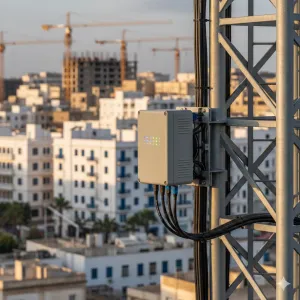
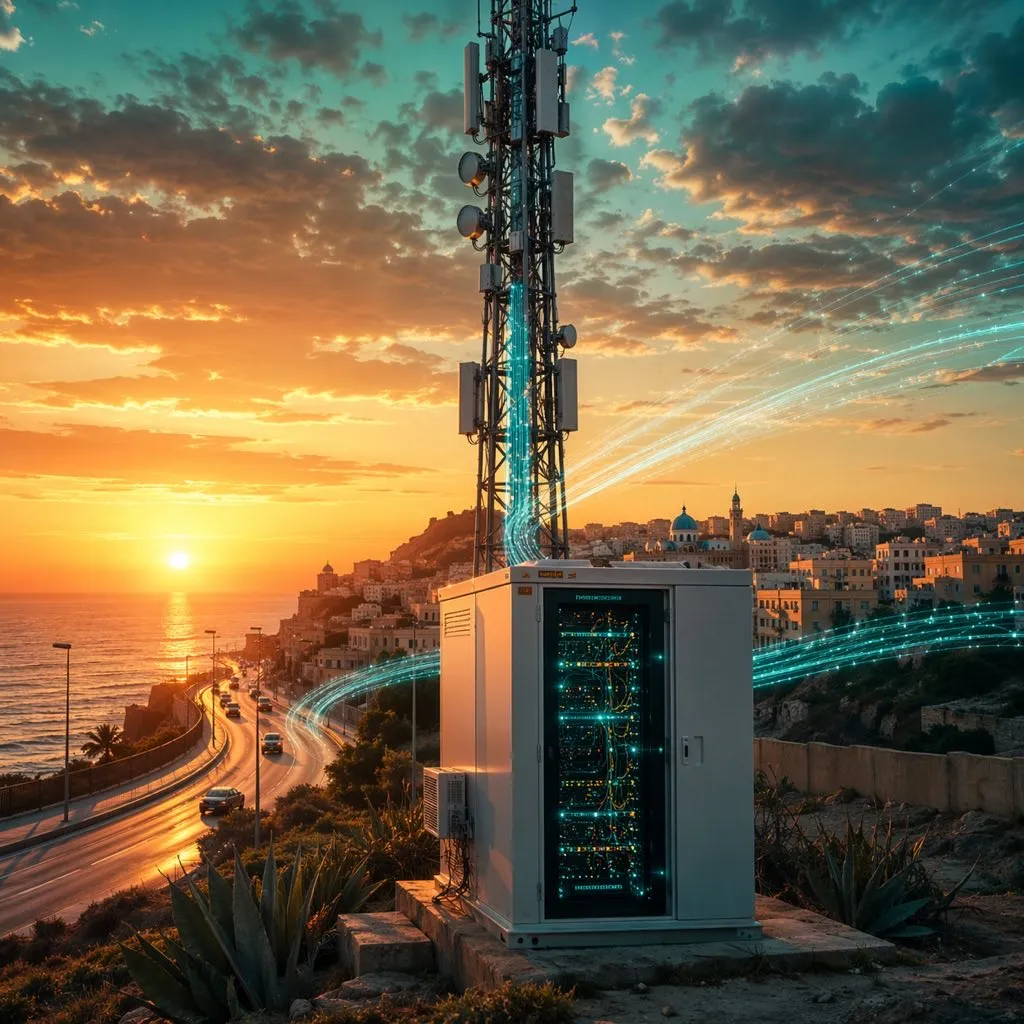
Multi-access Edge Computing (MEC) is the fix. It places compute and storage inside the operator's network — typically at aggregation points or even at base-station sites — so that applications can respond in single-digit milliseconds. The ETSI-standardised MEC framework, widely implemented by hyperscalers (AWS Wavelength, Azure Private MEC, Google Distributed Cloud Edge) and open-source stacks (StarlingX, OpenShift on Arm), is the bridge between radio access and cloud. Without it, Algeria's 5G rollout becomes expensive bandwidth — not the Industry 4.0 platform the national plan imagines.
Advertisement
The Quiet Gap in the Rollout Plan
Public statements from Mobilis, Djezzy and Ooredoo emphasise coverage rollout, spectrum assignments and retail tariffs. None have publicly announced a MEC platform partner, nor an edge-cloud offering for enterprise customers. The worldwide mobile edge computing market is projected to exceed $1.7 billion by 2026 according to a 2021 ResearchAndMarkets forecast, with 5G operators in Europe, the Gulf and East Africa already shipping MEC-enabled slices for enterprises.
For Algerian enterprises planning factory digitisation, port automation or smart-city tenders, the practical question is: can my 5G slice guarantee sub-10ms latency to a compute node inside the operator's network? Today, the honest answer is "not yet, and nobody has said when."
What Algerian Decision-Makers Should Actually Do
Enterprise buyers specifying 5G-based projects in 2026 should write MEC requirements into their RFPs even when the operator can't yet deliver — this creates commercial pressure and reveals whether the operator has a roadmap. System integrators and local cloud providers (Icosnet, Ayrade, Oracle Algeria partners) have an opening: an independent edge-compute layer that peers with operator networks can fill the gap faster than waiting for telco-native MEC. And regulators at ARPCE could accelerate the conversation by requiring MEC disclosures as part of coverage reporting.
Frequently Asked Questions
What is the difference between 5G and 5G MEC?
5G is the radio access technology; MEC (Multi-access Edge Computing) is a compute layer placed inside the operator's network so that applications run close to the user. Without MEC, 5G traffic still has to travel to a distant cloud region, which adds 40-80 ms of latency and negates most of 5G's low-latency promise. MEC is what makes sub-10ms use cases feasible.
Has any Algerian operator deployed MEC yet?
As of April 2026, no Algerian operator (Mobilis, Djezzy or Ooredoo) has publicly announced a MEC platform or partner. Public communications focus on coverage, spectrum and retail tariffs. This is a meaningful gap relative to 5G rollouts in the Gulf, Europe and parts of East Africa where MEC deployments have been announced alongside the radio rollout.
What should Algerian CTOs ask their 5G operator?
Three questions: (1) What is the roadmap for MEC deployment, and at which aggregation points? (2) What guaranteed latency can you deliver for a 5G slice terminating on an in-country edge node? (3) Which MEC platform (hyperscaler or open-source) will host enterprise workloads? Getting written answers — or an acknowledgment that none exist yet — should shape procurement decisions in 2026.