The Strategy at Adoption: Six Pillars, One Timeline
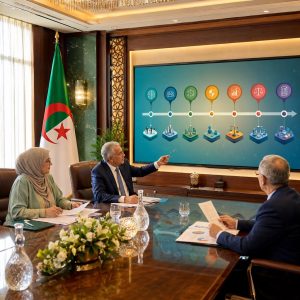
On December 8, 2024, Algeria's National AI Council formally adopted the 2025-2030 National Artificial Intelligence Strategy, chaired by Professor Merouane Debbah — the French-Algerian researcher who founded Khalifa University's 6G Research Center in Abu Dhabi and joined Algeria's AI Council as scientific lead. The strategy organizes national action across six pillars: scientific research, talent development, hardware and infrastructure, investment promotion and ecosystem building, data protection and regulation, and sector-specific deployment in agriculture, healthcare, and cybersecurity.
The strategy reports to both the Minister of Higher Education and Scientific Research and the Minister of Knowledge Economy, Start-ups and Micro-enterprises — a dual accountability designed to bridge academic R&D and commercial deployment. Algeria committed to a headline target: AI contributing 7% of GDP by 2027, a figure drawn from an expected market expansion from $498.9 million in 2025 to $1.69 billion by 2030, growing at a 27.67% CAGR.
Sixteen months into implementation, which pillars are on track, and which are lagging?
What Is Delivering: Compute, Skills, and Risk Capital
Three pillars show concrete 2025-2026 milestones.
Hardware and infrastructure. Algeria inaugurated its first national AI school data centre in 2025, equipped with NVIDIA H100, L40S, and A40 accelerators as reported by Middle East AI News. The centre supports students and researchers in developing AI models across computer vision, agriculture, industry, finance, and public services. The April 15, 2026 agreement with Huawei opens a parallel compute channel via Ascend-line GPUs, specifically addressing the supply constraints imposed by US export controls on non-hyperscaler buyers.
Talent development. The first Skills Center opened in Setif in February 2025 at former Algerie Telecom premises, offering free training in AI, cloud, IoT, and cybersecurity. The model is designed for replication across wilayas. In parallel, Algeria's universities now run 57,702 students across 74 AI master's programs in 52 universities, according to New Lines Institute analysis — one of the strongest computer science education bases in Africa.
Investment and ecosystem. In February 2025, Algerie Telecom launched a 1.5 billion DZD fund (approximately $11 million) targeting AI, cybersecurity, and robotics startups. The first tranche has already backed several portfolio companies, and the Ministry of Knowledge Economy has tied this fund into the A-venture accelerator's pipeline. An estimated 50 to 60 AI and AI-enabled startups now operate in Algeria, up from roughly 30 in 2022.
Advertisement
What Is Lagging: Research Output, Regulation, and Sector Deployment
Three pillars remain mostly on paper.
Scientific research output. Algeria's academic base is strong on numbers but weak on internationally-cited output. While the country hosts 74 AI master's programs, its production of peer-reviewed research at top venues (NeurIPS, ICML, ACL, CVPR) remains low in comparison to Tunisia, Morocco, and Egypt on a per-capita basis. The strategy calls for a national AI publications target, but no verifiable counter is public as of April 2026.
Data protection and regulatory framework. Algeria's data protection regime rests on Law 18-07 of 2018 on personal data protection and ARPT Decision No. 48 of 2017 on data localization. Neither was designed for the generative AI era. The strategy commits to a refreshed framework covering training data, model governance, cross-border transfers, and algorithmic transparency — but draft legislation has not been tabled publicly. This is the strategy's most significant credibility gap.
Sector-specific deployment. Agriculture, healthcare, and cybersecurity were selected as priority verticals. Healthcare has seen hospital management system digitization and pilot diagnostic tools. Cybersecurity has the ANSSI-led supply chain defense program. Agriculture, by contrast, has no visible AI program despite representing 12% of GDP and employing roughly 25% of the workforce.
The 2026-2027 Delivery Window
The credibility of the 7% AI-to-GDP target by 2027 rests on three decisions in the next 12 to 18 months. First, whether the draft AI regulation is tabled and passed — without it, enterprise AI adoption stalls on legal uncertainty. Second, whether the Skills Center model replicates beyond Setif; the strategy implied a minimum of five centers by end-2026. Third, whether the Huawei compute channel materializes in concrete GPU shipments, making up for the NVIDIA supply constraint.
Debbah's dual role — leading Algeria's AI Council while directing Khalifa University's Digital Future Institute in Abu Dhabi — is a signal, not a weakness. The strategy explicitly banks on the Algerian diaspora as a research and governance resource. But without domestic regulatory and deployment milestones, strategy becomes a document rather than a transformation.
Frequently Asked Questions
What are the six pillars of Algeria's National AI Strategy?
The six pillars are: scientific research, talent development, hardware and infrastructure investment, investment promotion and ecosystem building, data protection and regulatory framework, and sector-specific AI deployment across agriculture, healthcare, and cybersecurity. The strategy was adopted on December 8, 2024 under the leadership of Professor Merouane Debbah.
Which parts of the strategy are delivering after 16 months?
Three pillars show concrete progress: the first AI school data centre equipped with NVIDIA H100/L40S/A40 processors, the first Skills Center opened in Setif in February 2025 with free training in AI, cloud, IoT, and cybersecurity, and the 1.5 billion DZD Algerie Telecom fund backing AI, cybersecurity, and robotics startups. Research output quantification, updated data regulation, and agriculture-AI deployment remain the weakest areas.
How does the 7% AI-to-GDP target by 2027 affect Algerian enterprises?
If the target is credibly pursued, public procurement and sector-specific regulations will increasingly favor AI-enabled bids across agriculture, healthcare, and cybersecurity. Enterprise CIOs should plan for mandatory AI integration reporting in procurement processes starting 2026-2027, and should align pilot projects to the strategy's priority verticals to access associated funding and public partnerships.
Sources & Further Reading
- Algerian Government Announces Adoption of National AI Strategy — Digital Policy Alert
- Algeria Unveils AI Strategy to Boost Digital Transformation — Ecofin Agency
- Algeria inaugurates national AI school data centre — Middle East AI News
- Algeria Bets Big on AI Startups with New Investment Fund — Launch Base Africa
- Why Algeria Is Positioned To Become North Africa's AI Leader — New Lines Institute
- Artificial Intelligence — Algeria Market Forecast — Statista