The Announcement That Reframes Algeria’s Gaming Conversation
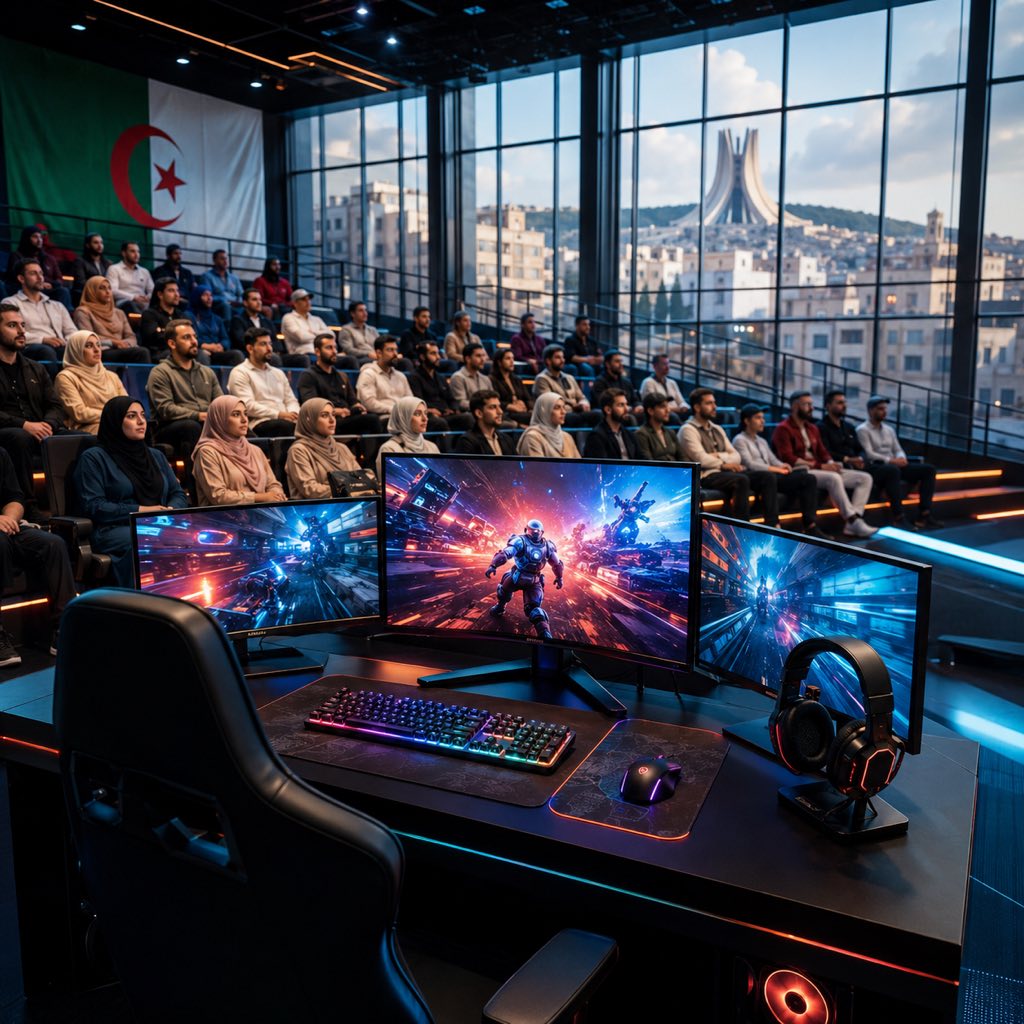
For years, Algerian gaming has been treated as a cultural phenomenon — cyber cafes, Free Fire and PUBG Mobile tournaments on Discord, weekend FIFA leagues run by private organisers — but rarely as an industrial policy line item. That changed when Minister of Post and Telecommunications Sid Ali Zerrouki convened a consultative meeting with the gaming ecosystem — developers, associations, content creators, professional players, world champions, and telecom operators — and announced two coordinated moves: the launch of Fiber Game, presented as Algeria’s first major national e-sports and gaming event, and a refresh of Algérie Télécom’s Idoom Fibre Gamers offer on 5 February 2026.
According to the DZWatch readout of the announcement, Fiber Game is intended to be a recurring gathering for the gaming ecosystem — a place to surface local talent, attract international competition, and signal to global game studios that Algeria wants their activity. Behind the event sits a numeric target that is genuinely ambitious: capture 10 percent of Africa’s gaming market by 2028, which Tech Review Africa’s coverage pins at roughly $400 million in annual value. That target lands on a continent whose gaming market was valued at $1.8 billion in 2024 by Carry1st and Newzoo, growing 12.4 percent year-on-year — six times the global rate.
For AI and automation readers, the interesting layer is not the tournaments themselves but the data, infrastructure, and tooling assumptions that have to be true for a $400-million domestic gaming sector to exist. That stack is where the durable Algerian product opportunity sits.
What the Numbers Actually Say
The 10 percent / $400 million figure is the headline, but a few surrounding data points make the policy direction more concrete. Africa added 32 million new gamers in 2024 to reach 349 million, and 87 percent of them play on mobile — a structure that maps closely to Algeria’s smartphone-first internet base. The continent’s top three revenue markets in 2024 were Egypt at $368 million, Nigeria at $300 million, and South Africa at $278 million — the band Algeria is implicitly setting itself the goal of joining within 24 months.
On the infrastructure side, Algérie Télécom’s Idoom Fibre Gamers offer advertises download speeds up to 1 Gbps and upload speeds up to 600 Mbps, with explicit emphasis on minimising ping — the latency metric that determines whether a Counter-Strike 2 or Valorant player can compete on regional MENA servers without a structural handicap. The operator also bundles gaming peripherals (headsets, keyboards, mice, microphones) into the offer, treating connectivity and equipment as a single product rather than separate purchases.
The third anchoring number is the AI market context Algeria is building this on. The country’s broader AI market is projected to grow from $498.9 million in 2025 to roughly $1.69 billion by 2030 — a 27.67 percent compound annual growth rate, with generative AI growing even faster at 41.5 percent. Algérie Télécom itself committed 1.5 billion dinars (around $11 million) in 2025 to fund AI, cybersecurity, and robotics startups, and Algeria opened its first national startup cluster focused on AI and cybersecurity at the Sidi Abdellah science and technology hub. The Fiber Game initiative sits on top of this scaffolding — not adjacent to it.
Advertisement
Where AI Plugs Into the Gaming Stack
A national esports event by itself does not create an industry. The pieces that turn tournament hype into a domestic value chain are largely AI-shaped: procedural content generation for studios that cannot afford 200-person art teams, machine-learning anti-cheat that protects competitive integrity at scale, real-time player-behaviour analytics that telecoms and tournament organisers need to price sponsorships, and Arabic / Darija natural-language tooling for community moderation, localisation, and live commentary. None of those layers exist in Algerian Arabic at production quality today.
The applied opportunity is not generic — it tracks five specific surfaces. Studios producing mobile titles for the Maghreb and Sahel need text-to-asset and animation tooling that compresses art budgets by 50–80 percent, which is the only way a small studio can ship a competitive shooter or arena game without external publisher capital. Anti-cheat needs to evolve from signature matching to ML-based behavioural detection because the Idoom Fibre Gamers ping floor will surface a new generation of competitive players whose match data must be trustworthy. Sponsorship pricing requires player segmentation, watch-time analytics, and conversion attribution — work that today is done manually inside marketing agencies and will not scale to a $400-million market.
The fifth surface is the one most worth watching: AI-driven game preservation, translation, and dubbing for the Arabic-speaking diaspora. Africa is now the fastest-growing region for gaming globally, but the catalogue of titles localised to MSA Arabic — let alone any North African variant — is thin. A studio that ships an Arabic localisation toolchain backed by domain-tuned models has a wedge into the entire MENA market, not just Algeria.
What Algerian Gaming and AI Founders Should Do
1. Build a Studio Around a Narrow, AI-Compressed Production Pipeline
The instinct after a national event announcement is to pitch the next big publisher-backed AAA title. Don’t. The realistic Algerian studio in 2026 should ship a single mobile or browser title — a tactical shooter, racing game, or arena fighter — built on a production pipeline that uses generative tooling for environment art, character variants, and animation in-betweens. The thesis is that a 6-to-12-person studio with the right tooling can produce what a 40-person studio shipped in 2022, which is the only economic shape that closes inside Algeria’s funding reality. Treat the Fiber Game ecosystem as the distribution and tournament partner, not the customer. Concrete benchmark: ship the first commercial title within 9 months of incorporation; if pre-production takes longer than 90 days, the scope is wrong.
2. Bid for the Algerie Telecom and ARPCE Tooling Surface, Not Just the Title Layer
The Idoom Fibre Gamers offer creates immediate infrastructure problems Algérie Télécom does not currently have in-house tooling to solve at scale — ping quality monitoring per gaming session, peripheral fraud detection, sponsorship analytics for tournaments, and player verification for prize disbursement. These are B2B contracts a focused Algerian AI startup can win because no foreign competitor has the on-the-ground access. Approach Algérie Télécom and the Algerian Regulatory Authority for Post and Electronic Communications (ARPCE) with a single shovel-ready proposal — for example, a real-time ping and packet-loss dashboard per Idoom Fibre Gamers subscriber — and use the contract as the wedge into the broader Fiber Game stack. Pricing benchmark: structure the first deal as a 12-month pilot with a fixed monthly fee plus per-subscriber overage, not a one-off license sale.
3. Develop Arabic and Darija Language Tooling for Community, Moderation, and Casting
The single missing layer for Algerian esports to scale into a $400-million market is language. Live tournament casting in Algerian Arabic, automated highlight clipping with Arabic captions, community moderation tooling that catches toxicity and cheating in Darija, and AI dubbing of foreign creator content into MSA Arabic are all unbuilt surfaces. The talent pool is real — Algeria has 57,702 students enrolled across 74 AI master’s programs in 52 universities, the strongest academic foundation in North Africa — so the constraint is not raw AI capability but product focus. Founders should pick one narrow language surface, ship a beta to a single Fiber Game partner, and use the event as the public reference customer. The pan-Arab addressable market beyond Algeria multiplies the local win by an order of magnitude.
4. Treat Fiber Game as a Data Generation Event, Not Only a Tournament
The first edition of Fiber Game will generate the richest Algerian-specific gaming dataset the country has ever produced — player demographics, device mix, network performance, viewing patterns, sponsorship engagement. Whoever builds the data infrastructure for that first event — even informally, as a partner rather than vendor — owns the longitudinal baseline for everything that follows. Founders working in player analytics, sponsorship measurement, or anti-cheat should approach Algérie Télécom, the Ministry of Post and Telecommunications, and any confirmed Fiber Game organising body before the event with a clear data-handling proposal. The product is not analytics-as-a-service. The product is becoming the reference dataset.
Where This Fits in Algeria’s 2026 Ecosystem
Fiber Game is the latest in a sequence of 2026 announcements that move Algeria’s tech economy from individual pilot projects toward sector-level scaffolding — alongside the Sidi Abdellah AI and cybersecurity cluster and Algérie Télécom’s 1.5-billion-dinar startup fund. The pattern is consistent: a public-sector signal followed by infrastructure investment followed by an invitation to private builders. Gaming is now inside that pattern.
The honest framing is that the $400-million / 10 percent target by 2028 is a stretch goal, not a baseline forecast. To hit it, Algeria needs not only the event and the fibre product, but also a credible local studio pipeline, an Arabic-language tooling stack, and at least two or three tournaments per year operating at MENA-circuit production quality. None of those exist today. All of them are buildable, and all of them are AI-shaped. Founders who treat Fiber Game as the start of a 24-month sector-formation window — rather than as a single event — will be the ones who define what Algerian gaming looks like by the time the 2028 target comes due.
Frequently Asked Questions
What is the Fiber Game national event?
Fiber Game is the inaugural national esports and gaming event announced by Algeria’s Ministry of Post and Telecommunications in early 2026. It is positioned as a recurring platform to surface local talent, host international competition, and attract global game studios to Algeria. The event is paired with an upgrade of Algérie Télécom’s Idoom Fibre Gamers fibre offer, which launched on 5 February 2026 with download speeds up to 1 Gbps and upload speeds up to 600 Mbps.
How realistic is the 10 percent of Africa’s gaming market target by 2028?
The 10 percent / $400 million target is a stretch goal rather than a baseline forecast. Africa’s gaming market was valued at $1.8 billion in 2024 and is growing 12.4 percent year-on-year — six times the global rate — so the continent-level pie is expanding fast. To reach the target Algeria would need a credible local studio pipeline, Arabic-language tooling, and tournaments operating at MENA-circuit production quality. None of those exist at scale today, but the 24-month formation window is the point of the policy push.
Where does AI fit into Algeria’s gaming strategy?
AI is the layer most likely to convert event hype into a durable industry. The highest-value surfaces are AI-compressed studio production pipelines for small Algerian teams, machine-learning anti-cheat for competitive integrity on the new fibre infrastructure, sponsorship and player analytics for telecoms and tournament organisers, and Arabic and Darija language tooling for casting, moderation, and localisation. Algeria’s AI market is projected to grow from $498.9 million in 2025 to $1.69 billion by 2030 at a 27.67 percent CAGR, which is the scaffolding the gaming opportunity sits on.
Sources & Further Reading
- Algeria Moves to Build Structured Video Game Industry, Targets Major Share of Africa’s Gaming Market — Tech Review Africa
- First Major Electronic Gaming Event to be Organized in Algeria — DZWatch
- Idoom Fiber Gamers: Algeria Telecom Announces Ultra-Fast Speeds at Attractive Prices — Algérie Télécom
- African Gaming Market Defies Global Trends and Continues to Grow Exponentially — Carry1st & Newzoo
- Algeria Builds First AI and Cybersecurity Hub to Scale Its Startup Ecosystem — Ecofin Agency
- Why Algeria Is Positioned To Become North Africa’s AI Leader — New Lines Institute
- Sid Ali Zerrouki — Consultative Meeting with Gaming Ecosystem Actors (X / Twitter)
🔗 Related Intelligence
Algeria’s Gaming and Esports Industry: From Cyber Cafés to Competitive Teams
Doubling the Pipe: Algeria’s Plan to Expand International Fibre Capacity for the AI Era

Algeria SportsTech: Fitness Apps, Analytics, and the Stadium Opportunity
Game Development Careers in Algeria: Unity Skills and Local Studios in 2026