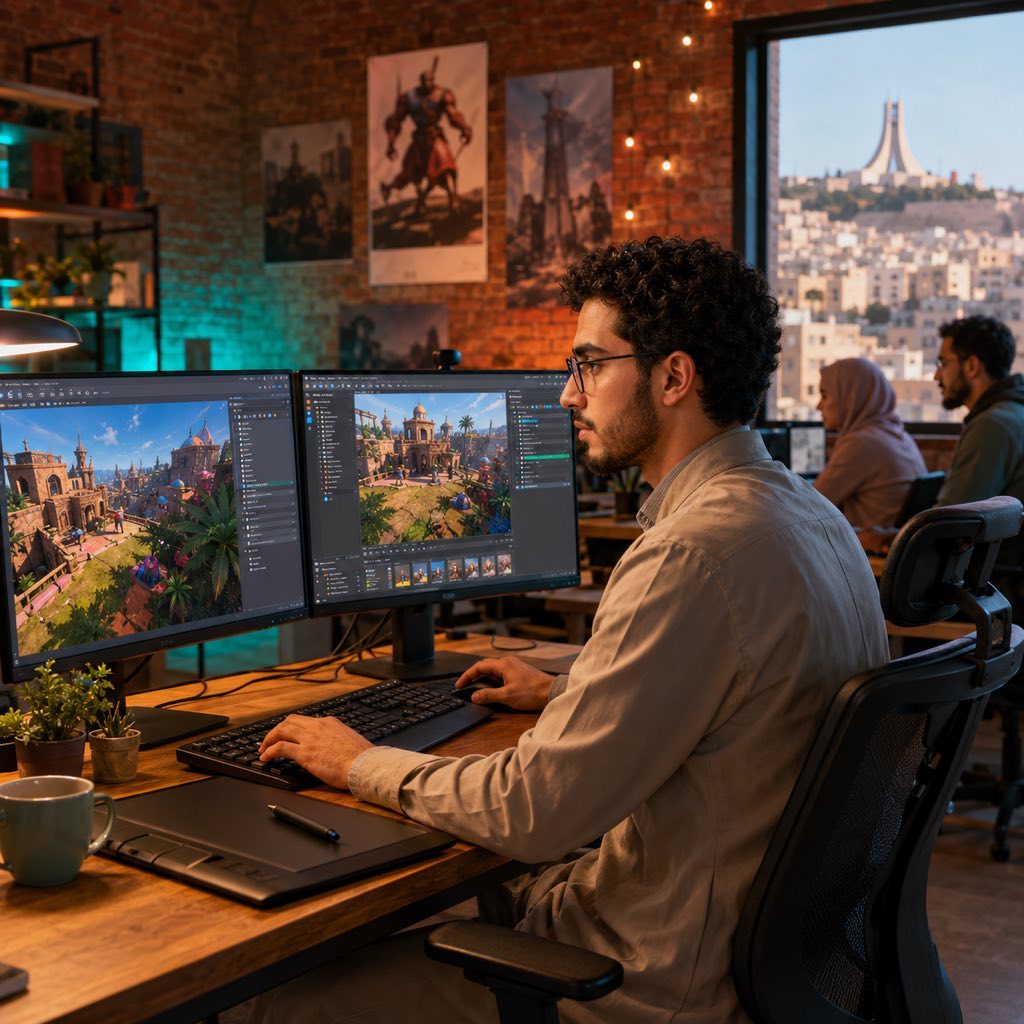
A Gaming Passion Is Becoming a Payable Skill
For a generation of Algerians who grew up on mobile and PC games, the leap from player to paid developer has never been more concrete. According to the State of the African Video Game Industry report from SpielFabrique and Xsolla, covered by PocketGamer.biz, the continent’s games industry generated about $2.29 billion in 2025, with mobile accounting for roughly 60% of that value and the region posting a 12.32% compound annual growth rate — comfortably ahead of the global average of about 7.5%.
That growth matters for a country with a young, highly connected, mobile-first population. Games are one of the few software products an Algerian team can build, publish to a global storefront, and earn from without needing an import licence, a foreign bank account, or a physical office abroad. A finished mobile game on Google Play or Steam reaches players in Lagos, Paris, or Jakarta the same day it reaches players in Algiers. For anyone weighing a career in tech, game development sits at the rare intersection of a genuine passion and a real export market.
The Studios Building Local Talent
Algeria already has a small but growing cluster of studios turning that market into jobs. Xerise is a boutique studio built around a handful of computer engineers and designers who have shipped more than 20 titles — from platformers to puzzle and shoot-’em-up games — using the Unity engine. The studio won the best Algerian mobile game title at the Algeria Web Awards in 2016 and earned an International Mobile Gaming Awards nomination in 2017, evidence that locally made games can compete beyond the country’s borders.
In Sétif, Jana Games — founded in 2014 by Seifeddine Wassim Haddar — describes itself as a multi-platform studio focused on game design, development, and game art. It is one of the longer-running names in the scene and a reminder that Algerian game studios are now a decade into building institutional experience.
These studios did not appear overnight. A 2022 country report from Games Industry Africa documented roughly 15 developers, of which around 11 were active at the time — a historical baseline worth reading as a starting point, not a current headcount. The same report noted that Algeria’s mobile broadband ranking climbed from 98th place in 2016 to 35th by 2020, the kind of connectivity gain that makes distribution, live updates, and online multiplayer viable. Four years on, the direction of travel is clear: more studios, more shipped titles, and a widening pool of developers who have learned their craft locally.
Advertisement
Why Unity and C# Are the Core Bet
If there is one skill stack to build a game career around in Algeria, it is Unity and C#. Unity is the dominant engine for mobile and indie development worldwide, and it is what the studios above already use. C# is Unity’s primary scripting language, which means the two skills reinforce each other: learn C# fundamentals, and you can immediately apply them inside a real engine rather than in isolation.
The mobile-first reality of the African market shapes what “good” looks like. Because more than 95% of the continent’s roughly 349 million gamers play on smartphones, the highest-value skills are the ones that make a 3D or 2D game run smoothly on a mid-range Android device: efficient asset pipelines, lightweight shaders, memory management, and monetisation design that respects players’ data costs. A developer who can ship a polished, low-footprint mobile game is far more employable than one who can only build a demanding PC prototype.
Around that core sit the adjacent crafts that studios hire for: game art and animation, level and systems design, audio, and increasingly virtual and augmented reality, which Xerise and others already offer as commercial services. None of these require leaving the country to learn. What they require is a portfolio of finished, playable work.
What Aspiring Developers, Educators, and Studio Founders Should Do
1. Master Unity and C# with a mobile-first, portfolio-driven plan
Do not treat Unity as a course to complete — treat it as a portfolio to fill. Start with C# fundamentals, then rebuild three small, finished games inside Unity: a 2D platformer, a puzzle game, and one simple 3D mobile title optimised for a mid-range Android phone. Finishing beats ambition; a studio hiring in Algiers or Sétif will trust a candidate who has shipped three complete games over one who has an unfinished open-world project. Avoid tutorial loops that never produce a released build — the goal is playable evidence, not watched hours.
2. Publish small, finished games to build export income
Algerian developers can register directly on Google Play, Steam, itch.io, and Apple’s store and earn from players worldwide. Ship a free game with an ad or in-app-purchase model early, even if revenue is tiny, because a public release teaches you store optimisation, analytics, crash reporting, and player retention — the exact skills studios pay for. Treat your first three published titles as paid education. Do not wait for a “big idea”; a small, complete, well-reviewed game is worth more than a large one that never launches.
3. Build a game-dev track around Unity, C#, and 3D pipelines
Coding bootcamps and university computer-science departments can turn the current cluster of studios into a pipeline by teaching Unity, C#, and mobile 3D art as a coherent track rather than scattered electives. Anchor the curriculum in a capstone shipped game and invite studio founders as guest reviewers. Partner with existing communities such as the Algerian Game Developers group so students meet working developers before they graduate. The goal is graduates with a released title, not just a transcript — that single deliverable is what closes the gap between a diploma and a first industry job.
4. Hire for shipped portfolios and design for export contracts
For studio founders, the fastest way to grow a team is to hire on demonstrated output — a public game, a GitHub repository, a game-jam entry — rather than credentials alone. Structure work so it can serve export clients: advergames, contract mobile development, and VR/AR solutions for businesses are all revenue streams Algerian studios already sell. Build remote-friendly processes from day one so your team can win work from clients abroad. Do not over-hire before you have recurring revenue; a lean team that ships is more resilient than a large one waiting on a single title.
5. Plug into the community and global job boards
Careers in this field are built through networks as much as skills. Join local developer communities and international game jams, publish devlogs, and track openings on global boards such as the IGDA careers listing filtered for Algeria. Remote and contract roles let Algerian developers earn from studios worldwide while staying home. Do not treat job hunting as a one-time event after graduation — a visible, consistent public presence is what brings opportunities to you rather than the other way around.
Where This Fits in Algeria’s 2026 Digital Economy
Game development is a compact model of what a thriving digital economy looks like: young talent, a globally distributable product, and revenue that flows in from abroad. The momentum is continental. In July 2026, Google Play launched its first $1 million Indie Games Fund for Africa, backing ten studios with grants of $50,000 to $200,000 each plus mentorship — a signal that global platforms now see African-made games as investable rather than charitable. Whatever the eligibility maps look like in any given year, the self-publishing route through Google Play, Steam, and itch.io is already open to every Algerian developer with a finished build.
The opportunity for Algeria is to convert individual passion into an organised craft — through studios that hire on shipped work, through educators who teach Unity and C# as a career track, and through developers who publish early and often. The foundations are in place: a decade of studio experience, improving connectivity, and a mobile-first market growing faster than the rest of the world. The next step is simply to build on it, one released game at a time.
Frequently Asked Questions
What skills do I need to start a game development career in Algeria?
The core stack is Unity, the industry-standard game engine, and C#, its primary scripting language. Because more than 90% of African gamers play on smartphones, mobile-first optimisation — lightweight assets, efficient memory use, and sensible monetisation — is especially valuable. Adjacent skills such as game art, level design, and audio round out a hireable profile. Most importantly, you need a portfolio of finished, playable games rather than unfinished prototypes.
Which game studios operate in Algeria?
Algeria has a small but growing cluster of studios. Xerise is a boutique studio that has shipped more than 20 Unity titles and won a best Algerian mobile game award in 2016, while Jana Games, founded in Sétif in 2014, works across game design, development, and art. A 2022 Games Industry Africa report documented roughly 15 developers at the time, and the scene has continued to expand since.
Can Algerian developers earn money from games internationally?
Yes. Developers can publish directly to Google Play, Steam, itch.io, and Apple’s store and earn from players worldwide, and studios also sell contract work such as advergames and VR/AR solutions to clients abroad. Africa’s games industry generated about $2.29 billion in 2025 and is growing at 12.32% a year, so the addressable market is expanding. Remote and contract roles, including those listed on global boards like IGDA’s careers page, let Algerian developers earn while based at home.
Sources & Further Reading
🔗 Related Intelligence

Algeria’s Tech Talent Demand: AI Skills, Hiring Surges, and Career Paths for Developers in 2026

Skills on the Rise 2026: An AI-Engineering Career Roadmap for Algerian Developers

Platform Engineering in Algeria: The Developer Career Path Built for 2026

Hackathons to Careers: Algeria Needs One Talent Pipeline