From the Fiber Modem to the Last Meter
For most of the past five years, connectivity progress in Algeria was measured at the building entrance: was there fiber to the home, and how fast was the line? That question is now largely settled for a growing share of the country. According to La Tribune Algérie’s MWC 2026 coverage, Algerie Telecom reached 3 million FTTH subscribers by February 2026, climbing from 2.6 million in October 2025 and 2.9 million in December 2025. The same reporting notes the operator was recognized with the “Best Practice of Home Broadband Development” prize at Mobile World Congress 2026 in Barcelona, presented at the fifth edition of the Green All-Optical Network Forum.
The milestone that matters for businesses, though, is what comes after the fiber line lands. Algerie Telecom has begun rolling out Wi-Fi 7 and fiber-to-the-room (FTTR) — the technologies that carry a fast fiber connection cleanly across an entire premises instead of losing it in the walls. That shifts the connectivity conversation from “do we have fiber?” to “does the fiber reach every room, desk, and device at full speed?” This is the last-meter race, and it is where hotels, offices, and campuses now compete.
What FTTR and Wi-Fi 7 Actually Change Inside a Building
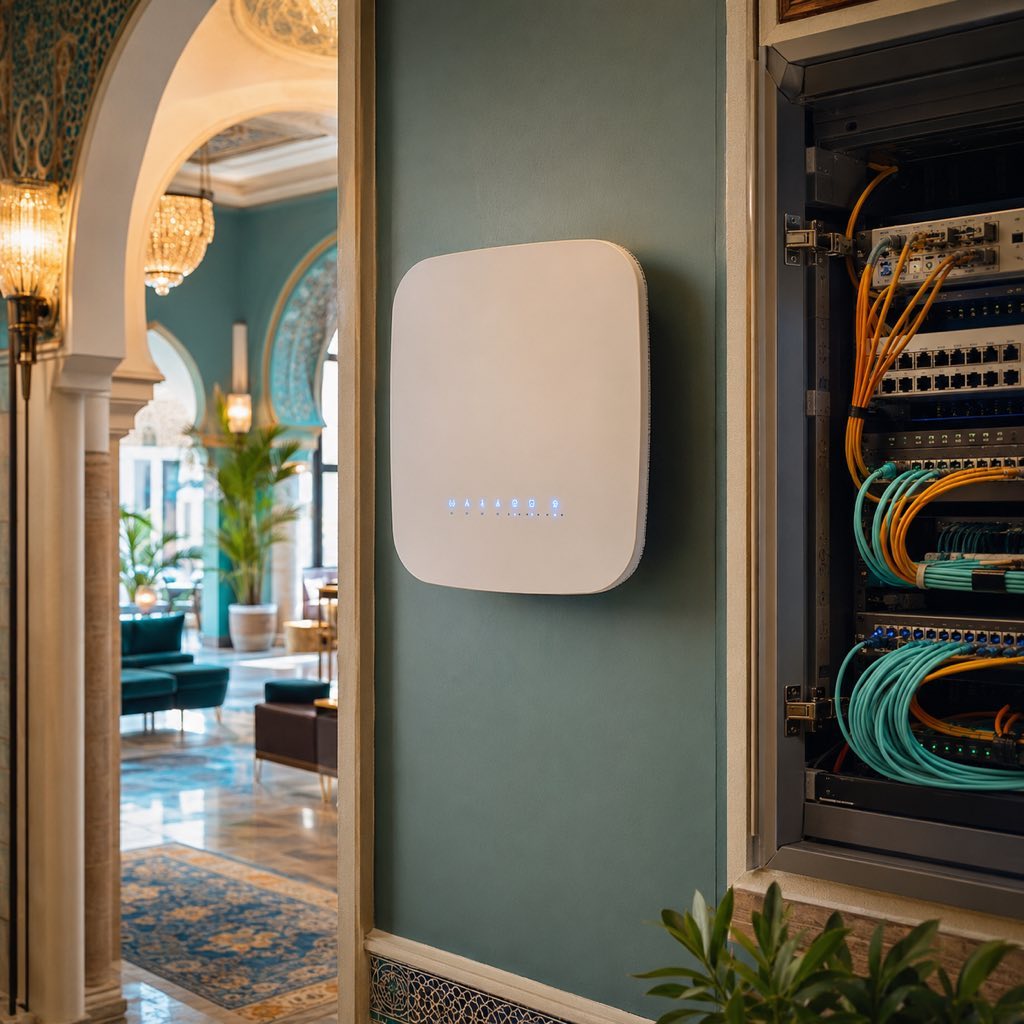
FTTR extends the optical fiber past the entry modem and runs thin fiber cabling directly to individual rooms, each ending in a small Wi-Fi access point. Instead of one router in a corner fighting through concrete walls, every room gets its own strong signal fed by fiber rather than by a weakening wireless repeat. For a hotel with 200 rooms or an office spread over several floors, that difference is the gap between “the Wi-Fi works near reception” and “the Wi-Fi works everywhere, identically.”
Wi-Fi 7 is the wireless standard that sits on top. As Algerie Invest reported, Algerie Telecom’s Wi-Fi 7 deployment is a first on the African continent, with theoretical speeds reaching up to 46 Gbit/s — described as nearly five times faster than Wi-Fi 6. Real-world speeds are always lower than theoretical peaks, but the practical gains are meaningful: lower latency for video calls, more simultaneous devices per access point, and steadier performance in dense environments like conference halls and hotel lobbies.
The two technologies are complementary. FTTR solves the physical distribution problem — getting the signal to every room without degradation. Wi-Fi 7 solves the capacity and latency problem once the signal is there. Together they turn a fast building entrance into fast coverage in every corner, which is exactly what premises-heavy businesses need.
Advertisement
Why Hospitality and Enterprise Are the First Real Use Cases
The earliest visible FTTR and Wi-Fi 7 use case in Algeria is hospitality. Algerie Invest notes that a Wi-Fi 7 installation is already underway at the El Aurassi hotel in Algiers, with wider generalization expected from 2027. Hotels are a natural first market: guests judge a property partly on connectivity, rooms are spread across many floors and thick walls, and business travelers increasingly expect video-call-grade Wi-Fi in the room, not just the lobby.
Enterprises are the second wave. The underlying FTTH network that makes this possible has grown fast — Algerie Invest reports the country moved from 350,000 FTTH subscribers in 2020 to more than 2 million by 2025, and Algerie Telecom is targeting fiber coverage across 100% of wilayas by 2027. Coverage is already deep in several areas: afrik.com reports more than three million households connected to FTTH as of early 2026, and La Tribune notes Constantine and Annaba are fully connected while Algiers sits near 98%. On top of that, Algerie Telecom launched the first FTTH offer at 1.6 Gbit/s in Africa in August 2025, and raised existing tiers — 500 Mbit/s to 1 Gbit/s, and 1.2 Gbit/s to 1.5 Gbit/s — without price increases. For an office, that combination means the bottleneck is no longer the line into the building; it is the internal distribution, which is precisely what FTTR and Wi-Fi 7 address.
What Algerian Enterprises and Hospitality Teams Should Do Now
1. Hospitality IT managers: audit in-room connectivity before the next renovation cycle
Do not wait for guest complaints to reveal dead zones. Walk every floor with a signal-mapping app and record where throughput drops below a usable video-call threshold — typically rooms furthest from the current router and those behind reinforced walls. FTTR retrofits are far cheaper to plan during a scheduled renovation than as an emergency fix, because the thin fiber cabling can be run alongside other works. With El Aurassi as an early reference deployment and generalization expected from 2027, hotels that map their weak points now can move quickly when they schedule an upgrade, rather than starting the assessment from zero.
2. Enterprise facilities and IT leads: treat the last meter as part of the network SLA
Most Algerian enterprise IT contracts specify the speed of the line into the building but say nothing about coverage inside it. That gap is now worth closing. When negotiating or renewing connectivity, define coverage and per-zone throughput as measurable service levels — meeting rooms, open-plan floors, and warehouse edges included — not just the headline fiber speed at the entry point. A 1.5 Gbit/s line means little if half the building runs on a weak wireless repeat. Frame the last meter as a facilities-and-IT joint responsibility, and budget FTTR distribution as infrastructure, the same way you budget structured cabling.
3. Algerie Telecom B2B sales teams: package FTTR + Wi-Fi 7 as a managed premises offer
The business opportunity is not selling a faster line — it is selling guaranteed in-building experience. Bundle FTTR distribution, Wi-Fi 7 access points, and a coverage guarantee into a single managed offer aimed at hotels, clinics, and multi-floor offices, with per-room or per-zone service levels rather than a single entry-point speed. Lead with the hospitality reference: a property that can advertise fast, reliable in-room Wi-Fi has a concrete commercial reason to buy. Position the offer around outcomes the buyer can market to their own customers, not around gigabits, and make the coverage guarantee the differentiator competitors relying on a single router cannot match.
Where This Fits in Algeria’s 2026 Connectivity Roadmap
Algeria’s fiber story has moved from access to quality. The FTTH footprint — 3 million subscribers and a 2027 goal of nationwide fiber — is the foundation, and the recognition Algerie Telecom collected at MWC Barcelona and from the European Society for Quality Research in Brussels reflects how far the home-broadband layer has come. The next chapter is premises-grade connectivity: the point where a fast national network becomes a fast experience in every room and at every desk.
For businesses, the practical lesson is timing. FTTR and Wi-Fi 7 are early in Algeria, with hospitality leading and broader rollout expected from 2027. That window favors organizations that prepare now — mapping their buildings, rewriting their connectivity requirements, and treating the last meter as strategic infrastructure rather than an afterthought. The fiber lead Algeria built at the front door is real; the advantage in 2026 and beyond goes to those who carry it all the way to the last meter.
Frequently Asked Questions
What is the difference between FTTH and FTTR?
FTTH (fiber-to-the-home) brings the optical fiber line up to a building or apartment, ending at a modem near the entrance. FTTR (fiber-to-the-room) extends that fiber further, running thin cabling from the modem to individual rooms, each with its own Wi-Fi access point. FTTH solves getting fast internet to the door; FTTR solves distributing it at full speed inside.
How fast is Wi-Fi 7 compared to earlier standards?
According to Algerie Invest, Algerie Telecom’s Wi-Fi 7 offers theoretical speeds up to 46 Gbit/s — described as nearly five times faster than Wi-Fi 6. Real-world speeds are lower than theoretical peaks, but Wi-Fi 7 also improves latency and lets each access point handle more simultaneous devices, which matters most in dense settings like hotel lobbies and conference halls.
Where is Wi-Fi 7 and FTTR available in Algeria right now?
Deployment is early-stage. An installation is underway at the El Aurassi hotel in Algiers, and Algerie Telecom expects wider generalization from 2027. The underlying FTTH network is far broader — 3 million subscribers as of February 2026, with Constantine and Annaba fully connected and Algiers near 98% coverage — which is the base that premises-grade FTTR and Wi-Fi 7 build on.
Sources & Further Reading
- Algérie Télécom primée à Bruxelles pour la fibre et le Wi-Fi 7 — Afrik.com
- MWC 2026 : Algérie Télécom primée pour le haut débit résidentiel FTTH — La Tribune Algérie
- Algérie Télécom accélère sa transformation numérique : objectif 100% fibre d’ici 2027 — Algérie Invest
- Algérie Télécom décroche le prix Best Practice of Home Broadband Development — Interfil Algérie
- Algérie Télécom honoured with Quality Achievements Award 2026 — Radio Algérie
🔗 Related Intelligence
Algeria 5G FWA Roadmap: What the 2027 Fixed Wireless Launch Means for Enterprises
Mapping the Gaps: How Algeria Télécom’s Fiber Survey Will Unlock Rural Cloud Access

Algeria Telecom’s All-Fiber Plan: CEO Aït Saïd Maps Path to 7 Million Connected Households by 2027

Doubling the Pipe: Algeria’s Plan to Expand International Fibre Capacity for the AI Era