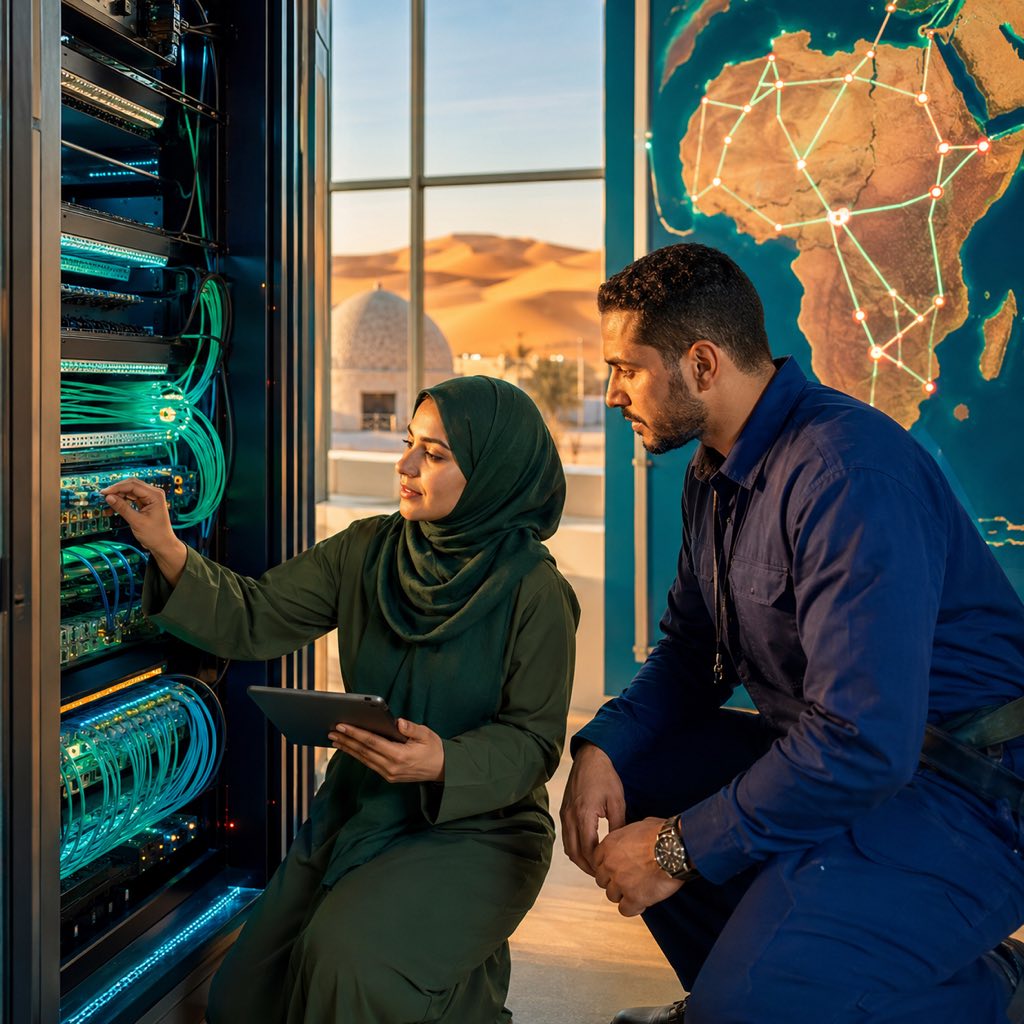
A 2002 Blueprint Finally Lights Up at the Algerian Frontier
For more than two decades, the Trans-Saharan Optical Fibre Backbone existed mostly on paper and in committee minutes. The project was inscribed as a continental growth priority in January 2002 under the New Partnership for Africa’s Development (NEPAD), and an early agreement on construction, operation, and maintenance was signed in Niamey in July 2005. The vision was always ambitious: a roughly 4,500 km terrestrial fibre spine stitching Algeria, Niger, Nigeria, Chad, Mali, and Mauritania into one connected corridor across the Sahara.
What changed in late 2025 is that the southern half started physically arriving at Algeria’s doorstep. According to Ecofin Agency, Niger completed 1,031 km of fibre optic cable across five routes, with a provisional handover ceremony held on 14 November 2025. The flagship northern route — Arlit–Assamaka–Algerian border — runs 220 km and terminates exactly where Algeria’s grid begins. As Telecompaper reported, the same build-out simultaneously opened corridors toward Chad (Diffa–N’Guigmi, 186 km), Nigeria (Zinder–Magaria, 117 km), Benin (Niamey–Dosso–Gaya, 300 km), and Burkina Faso (Niamey–Makalondi, 118 km).
On the Algerian side, the country has already deployed roughly 2,600 km of fibre linking Algiers down to In Guezzam at the Niger border, plus an extension toward Tindouf province. Algeria hosted the 5th session of the Trans-Saharan Optical Fibre Backbone Liaison Committee on 7 July 2024, with the leadership of Algérie Télécom in attendance — the operator that anchors the national segment. With both halves now reaching the same frontier post, the corridor stops being theoretical.
The scale of the national commitment is significant. The full NEPAD network is roughly 4,500 km long, and per an earlier breakdown reported by Ecofin Agency, Algeria’s planned share was about 2,800 km — by far the largest single-country segment, ahead of Niger (around 900 km) and Nigeria (around 800 km). The trajectory from the project’s first inter-presidential meeting and the July 2005 Niamey agreement to today’s near-complete Algerian segment shows how much of the corridor’s spine Algeria chose to carry. That investment is now positioned to pay off precisely because the southern feeders have caught up.
Why Geography Makes Algeria the Natural Transit Anchor
The strategic logic is straightforward. Niger, Mali, Chad, and Burkina Faso are landlocked. Their international internet capacity has historically depended on long, expensive routes to West African coastal landing stations, often passing through multiple intermediary networks before reaching a submarine cable. Every extra hop adds latency, cost, and a point of failure.
Algeria offers a shorter, more direct path north to the Mediterranean, where multiple submarine cable systems land and connect onward to Europe’s internet exchanges. By terminating the southern corridors at In Guezzam and carrying that traffic up its own 2,600 km national spine, Algeria can position itself as a transit gateway — the bridge between the Sahel’s growing demand for bandwidth and the dense fibre markets of the north. The Algerian Ministry of Post & Telecommunications frames the backbone explicitly as a vehicle for regional integration and digital cooperation across the six participating countries.
This is a leadership opportunity that fits Algeria’s broader digital-economy ambitions. The country has steadily expanded its domestic fibre footprint and submarine connectivity over the past decade. A trans-Saharan transit role builds directly on those investments, turning national infrastructure into a regional asset and giving Algerian operators a new category of cross-border wholesale revenue.
Advertisement
What Algerian Telecom Leaders Should Do
The corridor’s physical arrival at the border creates a concrete commercial and engineering agenda. Here is where Algeria’s telecom decision-makers can move first.
1. Productise cross-border transit capacity as a wholesale offer
The most immediate opportunity is packaging In Guezzam-to-Mediterranean transit as a defined wholesale product for Sahel carriers. Rather than treating the link as a diplomatic milestone, Algérie Télécom and its wholesale arm can publish capacity tiers, service-level commitments, and IP-transit pricing for landlocked neighbours. The 220 km Niger segment now physically reaches the frontier, so the missing piece is a commercial framework that lets a Niamey ISP buy capacity to Europe over Algerian fibre with a clear contract — not a case-by-case negotiation.
2. Engineer redundancy and peering at the In Guezzam handoff
A transit corridor is only as valuable as its reliability. Decision-makers should prioritise dual-path routing on the 2,600 km national spine so a single fibre cut in the deep south does not isolate the whole corridor. Establishing a structured cross-border interconnection point at In Guezzam — with clear handoff standards, monitoring, and capacity headroom — turns a point-to-point link into a resilient gateway that carriers can trust for production traffic.
3. Align with regional carriers before capacity demand spikes
Sahel data demand is rising as mobile penetration and digital services grow. Algerian operators should open commercial conversations with Niger, Mali, and Chad carriers now, while capacity is being commissioned, rather than after neighbours have locked into alternative coastal routes. Early framework agreements — even memoranda of intent on transit volumes — let Algeria shape the corridor’s economics and secure anchor customers before competing paths mature.
The Bigger Picture: Infrastructure as Regional Influence
The Trans-Saharan Backbone is more than a connectivity project — it is a demonstration of how Algeria can convert long-term infrastructure investment into regional standing. A country that routes its neighbours’ internet traffic becomes structurally important to their digital economies, and that importance compounds: transit relationships create payment flows, technical cooperation, joint maintenance arrangements, and a seat at the table in regional connectivity planning.
The 24-year arc from a 2002 NEPAD priority to a 2026 live corridor shows the value of patient infrastructure-building. The southern segments arriving at In Guezzam in late 2025 are the payoff of commitments Algeria sustained across changing global telecom landscapes. The next phase is execution: moving from completed kilometres to commissioned, revenue-generating capacity. If Algeria moves decisively on wholesale productisation and resilience engineering, the Sahel’s path to the global internet can run through Algerian fibre — a position that strengthens both the national digital economy and Algeria’s voice in shaping African connectivity for the decade ahead.
Frequently Asked Questions
What is the Trans-Saharan Optical Fibre Backbone?
It is a roughly 4,500 km terrestrial fibre-optic network launched under NEPAD (a continental priority since January 2002) to connect Algeria, Niger, Nigeria, Chad, Mali, and Mauritania. It aims to give landlocked Sahel countries a direct fibre path to international internet capacity, with Algeria forming the northern anchor toward the Mediterranean.
How far has the project advanced in 2025-2026?
Niger completed 1,031 km of fibre across five routes, with a provisional handover on 14 November 2025, including a 220 km link to the Algerian border via Arlit and Assamaka. Algeria has separately deployed about 2,600 km from Algiers to In Guezzam at the Niger frontier, plus a Tindouf extension, so both halves now meet at the same border.
Why does this matter for Algeria specifically?
Because Algeria sits at the northern end of the corridor, it can act as a transit gateway routing landlocked Sahel neighbours’ internet traffic up to Mediterranean submarine cables. That creates new wholesale transit revenue for Algerian operators, deepens regional ties, and turns national fibre investment into a strategic regional asset.
Sources & Further Reading
- Further Reading
- Niger Completes 1,031 km of Fiber Optic Backbone to Link With Neighbors — Ecofin Agency
- Niger Completes Sections of Trans-Saharan Fibre Backbone — Telecompaper
- Trans-Saharan Fiber Optic Backbone — Algeria Ministry of Post & Telecommunications
- Algeria and Nigeria Update Their Partnerships Around the Trans-Saharan Fibre Optic Backbone Project — Ecofin Agency
- Dorsale transsaharienne à fibre optique : l’Algérie déploie ses 2 600 km — Algeria Invest
🔗 Related Intelligence

African Digital Summit: Algeria’s Infrastructure Bet
Mapping the Gaps: How Algeria Télécom’s Fiber Survey Will Unlock Rural Cloud Access

Algeria as Africa’s Digital Transit Hub: The Cloud Corridor Strategy for 2026–2030

ICT Africa Summit in Algiers: Algeria’s Bid to Lead Continental Digital Infrastructure