
A New Skills Frontier Opens at Sidi Abdellah
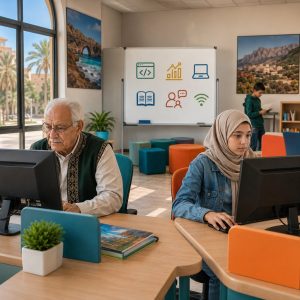
On June 8, 2026, Algeria opened its first national centre dedicated to educational technologies and virtual teaching at the Chahid Abdelhafid-Ihaddaden Science and Technology Campus in Sidi Abdellah, near Algiers. According to WeAreTech Africa, the centre functions as a development and experimentation platform for new learning methods, weaving artificial intelligence and digital tools into both pedagogy and scientific research.
The day after the launch, Higher Education and Scientific Research Minister Kamel Baddari toured the facility, which Ecofin Agency describes as the first national centre of its kind — combining AI governance oversight, innovation labs, and digital learning infrastructure. Co-developed with input from Professor Elias Zerhouni and Professor Mustapha Khiati, it is designed as an integrated multilingual virtual system serving all the major scientific disciplines.
For students, educators, and career-switchers, the more important story is not the building — it is the job market it creates. A national EdTech centre needs people who can design courses, build learning platforms, train AI tutors, and measure whether any of it actually helps students learn. These are roles that barely existed in Algeria’s formal labour market a few years ago, and they are exactly the kinds of jobs that emerging-technology careers are now built around.
The Careers This Centre Will Create
The EdTech sector sits at the intersection of three growing demand curves. The first is Algeria’s broader push for digital talent: as Ecofin Agency notes, the Algeria Digital 2030 strategy targets the training of 500,000 technology specialists, and the Chabab Tech programme — launched in May 2025 — already channels young people into cloud computing, cybersecurity, and AI. The second is the national AI market itself, valued at $498.9 million in 2025 and projected to reach $1.69 billion by 2030, per the same figures. The third is the centre’s own ambition to support a “fourth-generation university” built on service digitisation and intelligent learning.
Those forces translate into concrete job families. Instructional designers structure content so it can be learned online without a teacher physically present. EdTech developers build the platforms, distance-learning tools, and specialised resources the centre is designed to host. AI-tutoring specialists train, evaluate, and supervise the AI systems that personalise learning — work that overlaps directly with the AI governance oversight the centre is meant to provide. Around them sit learning-data analysts, multilingual content engineers, and accessibility specialists who make sure Arabic-, French-, and English-language learners are all served by the same system.
This matters in a labour market where, as Ecofin Agency reports, youth unemployment for 16-24 year-olds stood at 29.3% in October 2024, and university graduates made up 31.4% of the unemployed. EdTech careers are unusually accessible: many of them reward portfolio work and demonstrated skill over a specific diploma, which means a motivated graduate or self-learner can enter the field faster than in heavily-credentialed professions.
Advertisement
What students and educators should do
The centre is the demand signal. The supply side — the skills — is something individuals can start building immediately, without waiting for a formal programme to enrol them. Here is a practical sequence.
1. Build an instructional-design portfolio before you need a job title
Instructional design is the most accessible entry point because it rewards demonstrated work over credentials. Take one subject you already know well — a maths module, a coding tutorial, a lab procedure — and rebuild it as a self-paced online lesson with clear learning objectives, short activities, and a way to check understanding. Publish two or three of these as a portfolio. When the EdTech centre and the platforms around it start hiring, a candidate who can show “here are three courses I designed and the completion data” stands ahead of one who can only cite a transcript. Free frameworks like Bloom’s taxonomy and the ADDIE model give the vocabulary; the portfolio gives the proof.
2. Learn the EdTech developer stack, not just generic coding
EdTech developers need a specific slice of the software world: the standards and tools that learning platforms run on. Focus your study on Learning Management System (LMS) integration, the SCORM and xAPI standards that track learner progress, and the web stack (JavaScript, a modern framework, and a backend) that distance-learning platforms are built from. The centre is explicitly designed to host distance-learning platforms and specialised resources, so developers who understand how learning content moves between systems — not just how to write an app — are the ones who will build it. Pair this with the cloud-computing skills already prioritised by the Chabab Tech programme.
3. Specialise in AI tutoring and AI governance for education
This is the highest-growth, least-crowded lane. AI-tutoring specialists design the prompts, guardrails, and evaluation methods that let an AI system tutor a student safely and effectively — and then check that it does not mislead, hallucinate, or widen gaps between strong and weak learners. Because the Sidi Abdellah centre pairs AI tooling with explicit AI governance oversight, the people who can do both — make the AI useful and keep it accountable — are rare and valuable. Start by learning prompt engineering, basic model evaluation, and the emerging norms for responsible AI in classrooms, then apply them to a single real subject.
4. Master multilingual and accessible content engineering
Algeria’s centre is built as an integrated multilingual virtual system, which makes language and accessibility a career advantage rather than an afterthought. Educators and content specialists who can produce the same lesson cleanly in Arabic, French, and English — and who understand how to make material usable for learners with disabilities or low bandwidth — solve a problem the centre must solve at national scale. This is a natural bridge for working teachers: the subject expertise you already have, combined with multilingual content skills, is exactly what an EdTech platform needs.
Where This Fits in Algeria’s 2026 Ecosystem
The EdTech centre is one node in a wider build-out. It connects to the Chabab Tech talent pipeline, to the National School of Artificial Intelligence and its dedicated computing infrastructure, and to the national goal of establishing 20,000 startups by 2029 — many of which will be EdTech and AI ventures that need exactly the skills described above. With 65% of university places allocated to scientific disciplines for the 2025-2026 year, the supply of technically-minded graduates is rising at the same moment the demand for EdTech talent is forming.
For students, the practical message is to treat EdTech as a career path with multiple doors — design, development, AI, and content — rather than a single competitive funnel. For educators, the centre reframes existing classroom expertise as a transferable asset in a digitising system. And for the country, the value of a national EdTech centre is realised only when the people to staff it already have the skills; the work of building those skills can begin now, ahead of any formal enrolment.
Frequently Asked Questions
What is Algeria’s new national EdTech centre?
It is Algeria’s first national centre dedicated to educational technologies and virtual teaching, inaugurated on June 8, 2026 at the Chahid Abdelhafid-Ihaddaden campus in Sidi Abdellah near Algiers. It combines AI governance oversight, innovation labs, and digital learning infrastructure, and was toured by Higher Education Minister Kamel Baddari. It is designed as an integrated multilingual virtual system serving all major scientific disciplines.
What new careers does the EdTech centre open up?
The centre creates demand for instructional designers, EdTech developers, AI-tutoring specialists, learning-data analysts, and multilingual content engineers. These roles support distance-learning platforms and AI-assisted teaching, and they fit within Algeria Digital 2030’s target of training 500,000 technology specialists. Many reward demonstrated portfolio work over a specific diploma.
How can a student or teacher start building EdTech skills now?
Begin with a portfolio: rebuild a subject you know as a self-paced online lesson with clear objectives and assessments. Then learn the EdTech developer stack (LMS integration, SCORM/xAPI, web development), specialise in AI tutoring and AI governance, and develop multilingual content skills in Arabic, French, and English. These can be learned ahead of any formal programme and applied to real subjects immediately.
Sources & Further Reading
- Further Reading
- Algeria launches first national EdTech innovation centre amid push for digital skills — Ecofin Agency
- L’Algérie inaugure son premier centre dédié à l’enseignement virtuel et à l’IA — WeAreTech Africa
- L’Algérie tisse son filet EdTech pour former ses jeunes aux métiers de demain — Agence Ecofin
- Le nouveau dispositif mise sur l’insertion des jeunes dans les métiers techniques — Le Nouveau Républicain
🔗 Related Intelligence

Algeria Opens National AI & Virtual Education Center: What It Means for Universities

AI Literacy for Algeria’s Non-Tech Professionals: The Career Advantage That Compounds in 2026
Algeria’s ‘7-to-77’ Programme: National Digital Skills Initiative Opens Seven Regional Centers

Algeria’s Tech Talent Demand: AI Skills, Hiring Surges, and Career Paths for Developers in 2026