What Virginia Actually Passed
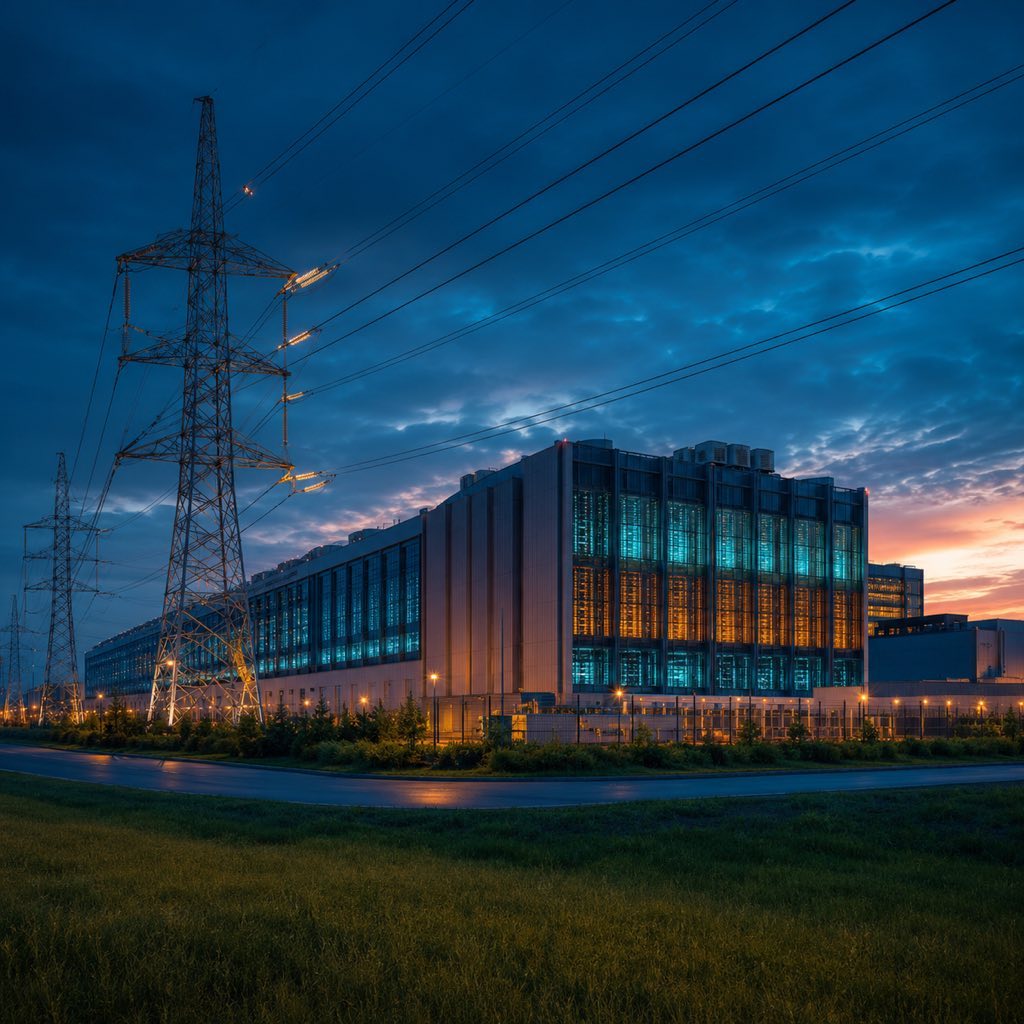
Virginia’s General Assembly closed its 2026 budget standoff by attaching a new levy directly to the thing hyperscale data centers consume most: electricity. Under House Bill 30 from the 2026 Special Session, signed by Governor Abigail Spanberger on June 30, 2026, every data center in the state now owes $0.011 per kilowatt-hour of electricity it consumes, effective July 1, 2026. The tax applies to power drawn from the grid and to self-generated electricity, including behind-the-meter generation — closing an obvious loophole where an operator might have tried to dodge the levy by running its own on-site gas turbines or solar arrays.
The scale involved is what makes the number land. According to Data Center Knowledge’s coverage of the bill, a continuously operating 500 MW facility — a mid-size hyperscale campus by 2026 standards — will owe approximately $48 million annually. A 1 GW campus, the size increasingly common among frontier AI labs’ dedicated training clusters, would owe close to $100 million before any refund. Williams Mullen’s legal analysis confirms the facility definition covers any operation “primarily engaged in the storage, management, and processing of digital data” that supports at least one megawatt of electrical capacity — a threshold low enough to capture most colocation and enterprise-scale operators, not just AI hyperscalers, though internet-access and telecom providers are explicitly excluded.
Collections are capped: once annual revenue crosses $600 million, the excess gets refunded pro rata to the operators who paid it. First payments are due covering the July 1 to September 1, 2026 period, and the State Corporation Commission must issue implementation guidelines within 60 days of enactment. Utilities collect the tax on monthly invoices for grid-supplied power; operators self-remit for anything they generate on-site.
The $1.9 Billion Subsidy Problem Behind the Tax
Virginia didn’t invent this tax out of nowhere — it built it to plug a hole the state itself created. Virginia’s sales-and-use tax exemption for qualifying data center equipment, in place for over a decade to attract the industry, cost the state an estimated $1.9 billion in forgone revenue in fiscal 2025 alone, according to BDO’s tax analysis of the new law. Rather than touch that exemption — which remains fully intact under the new law — legislators found a different lever: tax the electricity instead of the hardware.
That choice matters because Northern Virginia’s “Data Center Alley,” centered on Loudoun County, is the largest concentration of data center capacity in the United States, and its power draw has been straining the regional grid and pushing up electricity costs for ordinary ratepayers who have nothing to do with cloud computing. The electricity tax is explicitly designed so surging AI and cloud compute demand generates state revenue and, through the refund mechanism, insulates non-data-center customers from subsidizing the buildout. It is a fundamentally different instrument from a sales tax break: it scales directly with consumption, meaning the facilities drawing the most power from the grid pay the most into the fund, month by month, indefinitely — not as a one-time construction incentive but as an ongoing operating cost.
Virginia isn’t acting in isolation. MultiState’s 2026 legislative tracking found that more than 30 states filed over 300 data center-related bills within six weeks of the 2026 session opening, with at least 18 states introducing bills to create special utility rate classes for large energy users. New York, South Dakota, and Oklahoma have floated construction moratoriums to study grid and environmental impact before approving new capacity, while Maine has already repealed its data center sales tax exemption outright and Ohio, Illinois, and Arizona have suspended theirs pending review.
Advertisement
What Enterprise Cloud Leaders Should Do About It
Virginia’s per-kilowatt tax is the first of its kind, but the underlying pressure — data center power demand outpacing what state grids and sales-tax incentive structures were designed to absorb — is not unique to Virginia. Cloud buyers and site-selection teams need to treat this as the opening move in a longer regulatory cycle, not a one-off local quirk.
1. Model electricity-tax pass-through into your cloud TCO before your next contract renewal
Hyperscalers do not absorb new operating taxes quietly — they pass them through, either as an explicit line item or folded into regional pricing tiers. If your workloads run in US-East-1 or any other Virginia-anchored region, ask your account team directly whether the $0.011/kWh levy is being passed through, and get the answer in writing before renewal. A 500 MW facility’s $48 million annual bill has to land somewhere in the pricing stack; assume it lands closer to you than the press release suggests, and budget a low-single-digit percentage increase on Virginia-region compute for FY2027.
2. Diversify away from single-state regional concentration risk
Virginia hosts roughly a third of the world’s known hyperscale data center capacity by some industry estimates, which means an enormous share of global cloud workloads sit inside one state’s regulatory and tax jurisdiction. With over 30 states now actively legislating on data center energy costs, treating any single region as a permanent low-cost anchor is a planning error. Multi-region architecture isn’t just a resilience best practice anymore — it’s a hedge against jurisdiction-specific tax and grid-capacity risk that is now moving faster than most enterprise cloud strategies account for.
3. Push providers for contractual transparency on tax and surcharge pass-through clauses
Most enterprise cloud agreements are silent on how new state-level operating taxes get allocated to customers. Before signing or renewing a multi-year commitment, request an explicit clause defining how future energy-related taxes, grid-connection fees, or carbon surcharges will be handled — passed through directly, absorbed into list price, or capped. Don’t accept “we’ll factor it into future pricing” as an answer; that language gives the provider unilateral discretion over a cost driver that’s now provably real and growing across US jurisdictions.
4. Track the state legislative wave, not just the Virginia headline
Virginia’s tax will not stay unique for long if it hits its $600 million target without driving away investment — a real possibility, since 2026 industry commentary noted the levy “leaves existing data center tax subsidies in place while clawing back revenue through power use,” a softer approach than an outright construction moratorium. Set a recurring quarterly review of data center legislation in the states where your primary cloud regions sit, particularly around utility rate-class changes and sales tax exemption repeals, both of which are moving faster than direct consumption taxes and could hit your contracts sooner.
Where This Fits in the Global Power-Cost Reckoning
Virginia’s tax is small in absolute terms next to the trillion-dollar capital being poured into AI data center buildouts globally, but it marks a structural turning point: electricity, not land or tax breaks, is now the resource state governments treat as scarce enough to price directly. For over a decade, US states competed to attract data centers with sales tax exemptions, treating the facilities as economic development wins. Virginia’s $1.9 billion annual exemption cost shows why that model is straining — the incentive succeeded so completely that the state now hosts more data center load than its own subsidy math can sustain without a new revenue source.
The refund-above-cap design is the detail worth watching closest. By returning any collections over $600 million pro rata to the operators who paid them, Virginia signaled it wants steady revenue, not runaway extraction — a deliberate attempt to avoid scaring off future investment while still making current operators fund the grid strain they cause. Whether that balance holds depends on what happens next: if other states copy the per-kWh mechanism rather than the blunter moratoriums New York and Oklahoma are testing, cloud infrastructure costs across the US could see a slow, permanent upward drift tied not to compute demand but to jurisdiction-by-jurisdiction energy politics.
Frequently Asked Questions
What is Virginia’s new data center electricity tax and when did it take effect?
Virginia now charges data centers $0.011 per kilowatt-hour of electricity consumed, whether drawn from the grid or self-generated. The tax took effect July 1, 2026, under House Bill 30 from the state’s 2026 Special Session, signed by Governor Abigail Spanberger on June 30, 2026.
How much revenue is the tax expected to raise, and what happens if it collects more?
The state projects roughly $600 million a year in revenue. If annual collections exceed that cap, the excess is refunded pro rata to the data center operators who paid it, so the tax is designed to hold steady rather than grow indefinitely with rising power consumption.
Is Virginia the only US state considering taxing data centers this way?
Virginia is the first to enact a per-kilowatt-hour consumption tax specifically, but it’s part of a much broader wave — more than 30 states filed over 300 data center-related bills within six weeks of the 2026 legislative session, including special utility rate classes, construction moratoriums in states like New York and Oklahoma, and sales tax exemption repeals in Maine, Ohio, Illinois, and Arizona.
Sources & Further Reading
- Virginia Approves First-Ever Data Center Power Tax — Data Center Knowledge
- Virginia Budget Creates New Electricity Consumption Tax for Data Centers — Williams Mullen
- Virginia Enacts Unprecedented Electricity Consumption Tax on Data Centers — BDO
- State Data Center Legislation in 2026 Tackles Energy and Tax Issues — MultiState
- Virginia Approves First Data Center Power Tax — Kiplinger
🔗 Related Intelligence

Texas vs. Virginia: The Data Center Capital of the World Is Shifting

EPRI: US Data Centers Could Eat 17% of National Power by 2030 — The Grid Is Now the AI Bottleneck
Publicly Announced Data Center Projects Now Top $1 Trillion and 68 Gigawatts of Connected Load