From One Card to Four: What Algerie Poste Actually Changed
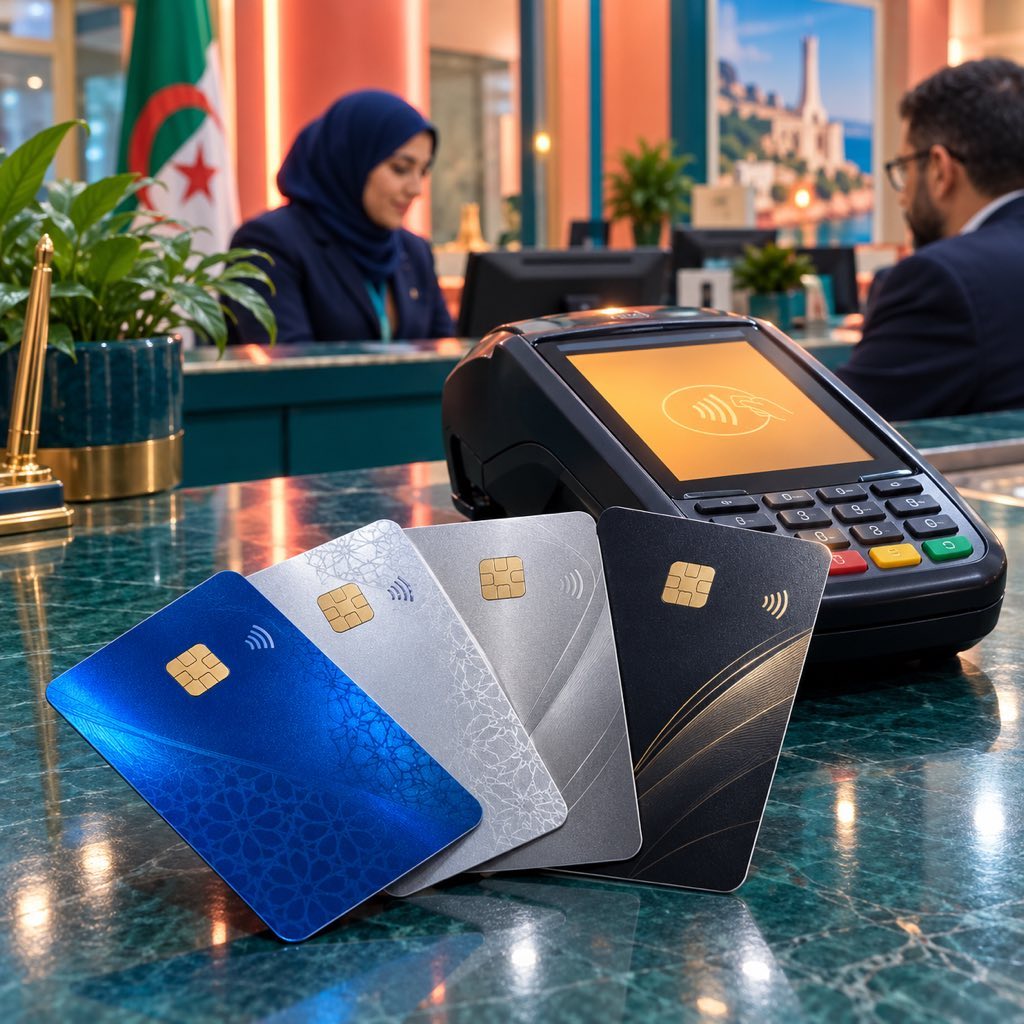
For a decade, the Edahabia card was one product for everyone: a single national payment card issued by Algerie Poste to give tens of millions of citizens their first electronic wallet. That era is ending. Algerie Poste has moved to a segmented range, with El Moudjahid reporting four distinct Edahabia types — Bleue (Blue), Premium, Platinum and Black — replacing the one-size-fits-all model.
The foundation of the range is the renamed base card. According to Algerie360’s reporting on the rollout, the standard Edahabia is now branded “Edahabia Classic” (the Blue tier), and its validity has been extended from two years to four — halving how often the average holder needs to renew. Radio Algérie confirmed that a first batch of the modernized Classic card would be issued within days of the announcement, with the Platinum and Black tiers to be revealed shortly after, each aimed at specific categories of beneficiaries.
This is not a cosmetic rebrand. Moving from one card to four is a deliberate segmentation strategy — the same playbook retail banks worldwide use to match products to customer value, and a clear signal that Algeria’s payment infrastructure has matured past the “get everyone a card” phase into a “serve everyone the right card” phase.
Reading the Ceilings: How the Tiers Differ
The most concrete difference between tiers is the ceiling structure — the daily withdrawal and payment limits that determine what a card can actually do. On the Classic (Blue) card, the published 2026 ceiling guide lists a daily ATM withdrawal limit of 15,000 DA and a daily payment limit of 50,000 DA, with a monthly loading ceiling of 200,000 DA. The Premium tier lifts those materially — roughly 50,000 DA in daily withdrawals and 200,000 DA in payments — while Platinum and Black are positioned above Premium with the highest ceilings and additional premium services.
Those numbers matter more than they look. A 50,000 DA daily payment cap is fine for groceries and utility bills, but it blocks the transactions that actually push people toward cash: paying a landlord, settling a supplier invoice, or buying a big-ticket appliance. By creating tiers whose limits scale with the holder’s needs, Algerie Poste is removing the ceiling as a reason to fall back on banknotes. Holders can already adjust some limits themselves through the BaridiNet and BaridiMob apps, so the tier a customer chooses becomes a starting envelope rather than a hard wall.
Algerie Poste has been deliberate about not over-promising the exact Platinum and Black figures before launch — the sources consistently describe them as offering “higher ceilings and premium services” without publishing precise caps yet. That is the honest state of the information today, and merchants and fintechs planning around the new tiers should treat the Premium ceilings as the confirmed baseline and the top-tier numbers as forthcoming.
Advertisement
Why Segmentation Signals a Maturing Market
The tiering makes far more sense once you see the scale behind it. Algeria crossed a genuine adoption threshold in 2025: more than 17.6 million Edahabia cards were in circulation, a 13% year-on-year increase, and by the end of March 2026 the country passed 22 million payment cards in total, combining roughly 18 million Edahabia cards with about 4.2 million CIB bank cards.
Usage climbed even faster than issuance. Edahabia recorded around 8.5 million transactions per day in 2025, up from about 5 million in 2023. Online transactions grew 179% over the year, point-of-sale (TPE) payments roughly doubled, and the terminal network expanded from around 68,000 machines at the end of 2024 to more than 104,000 by the end of March 2026. When a base of that size is transacting daily, a single undifferentiated product starts leaving value on the table: high-volume users need higher limits, the diaspora needs cards that survive large transfers, and premium customers expect service levels a basic card was never designed to deliver.
Segmentation is what a payment market does once inclusion is largely solved. The first job — getting a card into every hand — is well advanced. The next job is depth: turning cards people hold into cards people use for the transactions that still run on cash. A tiered range is the tool for that job, and it moves Edahabia from a public-service instrument toward a genuinely competitive retail-banking product line.
What Algerian Merchants, PSPs, and Diaspora Users Should Do About It
1. Merchants: re-check your TPE ceilings and treat premium cards as a bigger-basket segment
If you run a retail or services business, the arrival of higher-ceiling cards changes your average-transaction math. A customer who could previously only pay 50,000 DA per day by card now has tiers that clear several times that. Audit your TPE acquiring limits with your bank so a Platinum or Black holder is never declined at checkout for a ceiling you set conservatively years ago. Big-ticket sectors — appliances, furniture, private clinics, travel agencies — should actively promote card acceptance for these tiers, because every declined high-value payment is a transaction that reverts to cash and disappears from your books.
2. PSPs and fintechs: build tier-aware products, not one-size-fits-all flows
Payment service providers licensed under Algeria’s fintech framework now have a segmentation signal to design around. A Premium or Platinum holder is a documented higher-value customer — the right audience for installment checkout, subscription billing, and value-added services that a Classic-only base could not support. Design onboarding and risk rules that read the tier, not just the card, and prioritize integrations with BaridiMob and BaridiNet so top-tier customers get the seamless mobile experience they expect. The 179% jump in online transactions in 2025 shows the demand is already there.
3. Diaspora users and high-value payers: match the tier to the transaction, not the prestige
For Algerians abroad managing rent, property purchases, or supplier payments back home, the Premium and higher tiers exist precisely so a large legitimate payment does not hit a ceiling and bounce. Choose your tier by the size of your typical transaction rather than by the name on the card. Before committing, confirm the current withdrawal and payment ceilings and any adjustment options in BaridiNet, since limits can be tuned in-app — the tier sets your envelope, but the app lets you fine-tune it.
4. Banks and the CIB ecosystem: benchmark against a moving standard
With Edahabia now offering Platinum and Black experiences, the roughly 4.2 million CIB cardholders and their issuing banks are competing against a raised expectation for premium service in the domestic market. Banks should benchmark their own card portfolios against the new Edahabia tiers — validity periods, ceiling flexibility, and digital self-service — and view the segmentation as a shared opportunity to deepen a fast-growing 22-million-card market rather than a fixed pie to defend.
Where This Fits in Algeria’s 2026 Cashless Push
Edahabia’s tiering is one piece of a broader, well-documented shift toward electronic payment across Algeria. The card base is large and still growing, daily transaction volumes have nearly doubled since 2023, and the acceptance network — over 104,000 terminals — is finally wide enough to make card-first behavior realistic for everyday purchases. A segmented product range is the natural next layer on top of that infrastructure: once the rails exist and the cards are in wallets, the differentiator becomes how well each product fits its holder.
The honest caveat is that the top-tier economics are still emerging. The exact Platinum and Black ceilings, fees, and premium services have not all been published, and the real test will be execution — whether higher-tier customers experience genuinely faster service and whether merchants upgrade their acceptance to match. But the direction is unambiguous and constructive. Algeria has spent years building breadth in electronic payments; the Edahabia tiers are an early, concrete move toward building depth. For merchants, fintechs, and the diaspora, the practical response is the same: understand which tier your customers and transactions belong to, and design for the higher ceilings now arriving rather than the single card that is on its way out.
Frequently Asked Questions
What are the four Edahabia card tiers Algerie Poste is introducing?
Algerie Poste is moving from a single Edahabia card to a four-tier range: Blue (the renamed Edahabia Classic), Premium, Platinum, and Black. Each tier offers progressively higher withdrawal and payment ceilings plus premium services, with the top Platinum and Black tiers aimed at customers seeking a high-end banking experience. The Classic card’s validity has also been extended from two years to four.
How do the Edahabia ceilings differ between Classic and Premium?
Published ceiling guidance lists the Classic (Blue) card at roughly 15,000 DA in daily ATM withdrawals and 50,000 DA in daily payments, with a 200,000 DA monthly loading ceiling. The Premium tier lifts those to approximately 50,000 DA in withdrawals and 200,000 DA in payments. Platinum and Black sit above Premium with the highest ceilings, though Algerie Poste has not yet published their exact figures. Some limits can be adjusted in the BaridiNet and BaridiMob apps.
Why does tiering the Edahabia card matter for Algeria’s digital economy?
With more than 17.6 million Edahabia cards in circulation and around 8.5 million transactions a day in 2025, Algeria has largely solved the financial-inclusion phase of getting cards into hands. Tiering is the next step — matching products to how much people actually transact, so higher-value payments like rent and big-ticket purchases stay on cards instead of reverting to cash. It signals a payment market maturing from basic inclusion toward differentiated, banking-grade products.
Sources & Further Reading
- Bleue, premium, platinum et black : 4 nouveaux types d’«Edahabia» émis — El Moudjahid
- Algérie Poste introduit la « Carte EDAHABIA Classique » et prépare de nouvelles cartes bancaires — Algerie360
- Carte Edahabia : Algérie Poste annonce d’importants changements — Observalgérie
- Modernisation : Algérie Poste lance la nouvelle carte Edahabia Classic — Radio Algérie
- Plus de 17,6 millions de cartes Edahabia et plus de 4,2 millions de cartes CIB en circulation en 2025 — La Voie d’Algérie
- Algérie : le paiement électronique franchit le cap des 22 millions de cartes — We Are Tech Africa
- Carte eDahabia : activation, plafonds, paiement en ligne — le guide 2026 — Android DZ
🔗 Related Intelligence

BaridiMob’s Rise: How Algeria’s Postal Wallet Now Powers 70% of Edahabia Payments

Algeria’s 20 Million Payment Cards: Milestone or Mirage?
Algeria’s 22 Million Payment Cards, 104K POS & 46% Surge: The Fintech Runway Mapped
Algeria’s E-Commerce Pivot: From COD Dominance to Digital Payment Adoption