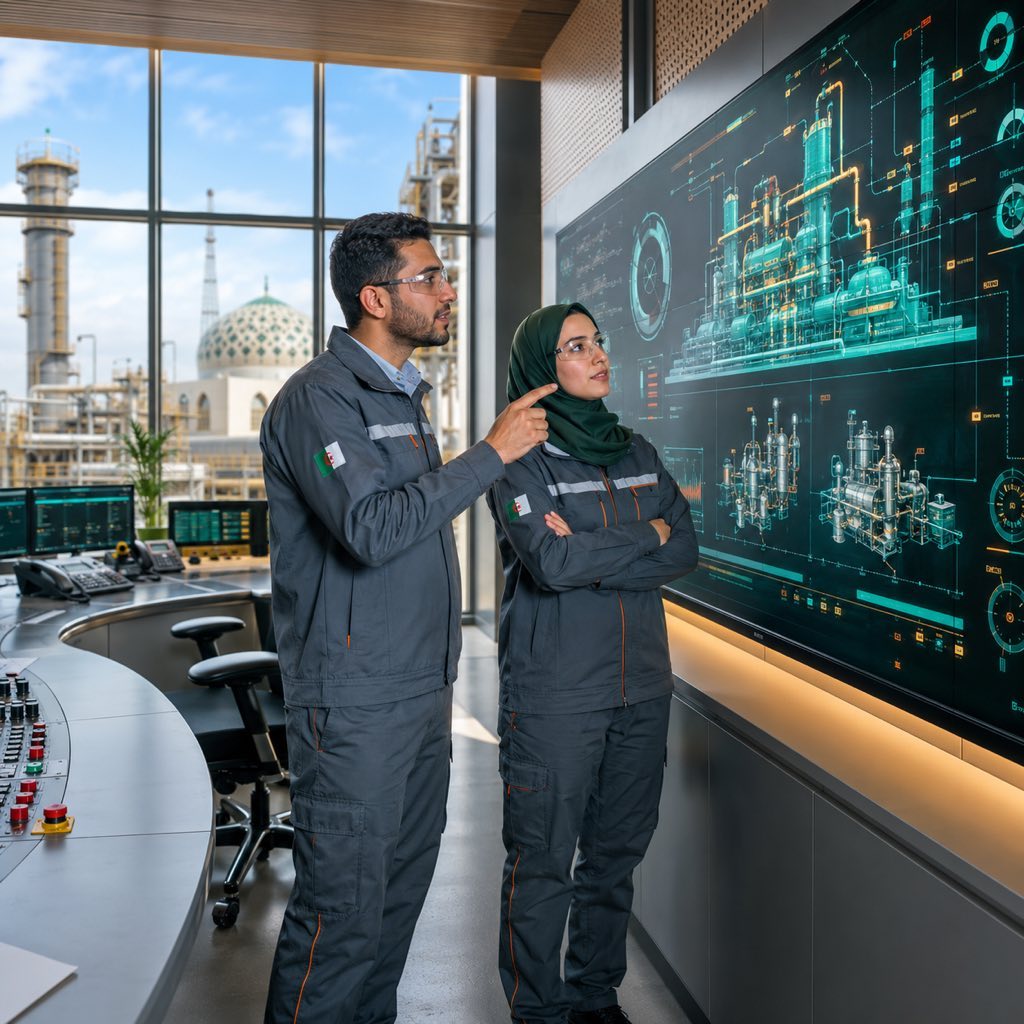
What AVEVA Day Algérie Actually Delivered
On 30 June 2026, at the Sid Rached training centre in Algiers, AVEVA — a global industrial software vendor majority-owned by Schneider Electric — ran its first dedicated industrial AI event for the Algerian market. According to Algérie Éco’s coverage of the event, the day gathered industry leaders around a single message: asset reliability, operational efficiency and sustainability now depend on turning raw industrial data into decisions.
The framing was deliberate. Khaled Salah, AVEVA’s Vice-President for Africa, told attendees that “digital transformation is no longer optional; it is now essential.” Anouar Chara, Schneider Electric’s CEO for Algeria and Tunisia, described the joint pitch as helping industrial organisations “combine electrification, automation and industrial intelligence” — the three layers a modern plant needs to run in one loop rather than in three disconnected silos.
The technical sessions were concrete rather than aspirational. They covered predictive analysis, multi-site operations, and AI-powered operations built on AVEVA’s PI data infrastructure and its CONNECT cloud platform. In plain terms: pull time-series data off equipment, move it into a common data layer, and run analytics that flag a failing pump or a drifting process weeks before it stops production. That is the difference between reactive maintenance and predictive maintenance — and it is the capability Algerian energy, process and manufacturing operators were shown.
Why IT and OT Convergence Is the Real Prize
The headline word at the event was “AI,” but the load-bearing idea underneath it is convergence between IT (information technology — the enterprise systems, ERPs, databases and cloud) and OT (operational technology — the sensors, PLCs, SCADA and control systems that actually run a plant). For decades these two worlds have been walled off. OT data sits trapped in plant historians; IT data sits in business systems; and no single view connects a maintenance cost to the machine that generated it.
Industrial AI only works when that wall comes down. AVEVA’s own product roadmap makes the dependency explicit. At AVEVA World 2026 in Milan on 20 May 2026, which drew more than 3,500 delegates, the company announced upgrades to its CONNECT platform: integrations with Snowflake and ServiceNow, an industrial knowledge graph arriving in Q1 2027, and a “Flows” data-processing engine (from its Crosser acquisition) shipping in Q2 2026 with more than 800 connectors. Its Operations Control suite added native C# and Python support for edge-deployed AI, plus Model Context Protocol (MCP) integrations that let large language models query live operational data.
The reason this matters for Algeria is a number AVEVA itself put on stage: Gartner projects that through 2026, roughly 60% of AI projects will fail if they are built on data that is not AI-ready. The Algérie 360 report on the event stressed the same point from the local angle — the value is in the industrial data foundation, not the model. For an Algerian plant, the first investment is not an algorithm; it is a clean, connected, trusted data layer that OT and IT both feed.
Advertisement
What Algerian Industrial Operators Should Do
1. Audit your OT data before buying any AI
Before evaluating a single AI vendor, map what operational data you already generate and whether it is captured, time-stamped and accessible. Most Algerian plants — in hydrocarbons, cement, food processing, water and utilities — have decades of sensor data locked in isolated historians or, worse, on paper. AVEVA’s PI infrastructure exists precisely to consolidate this, but the tool is useless if the underlying signals are missing or unreliable. Start with one production line: inventory the sensors, confirm the sampling rates, and document the gaps. If 60% of AI projects fail on non-ready data, a data audit is the single highest-return week of work you can schedule this quarter.
2. Pick one predictive-maintenance use case, not a platform-wide rollout
Do not try to “become an AI company.” Choose one asset class where unplanned downtime is expensive and well-instrumented — rotating equipment (pumps, compressors, turbines) is the classic entry point. Run a predictive-analytics pilot on that asset, measure the avoided downtime in dinars over two to three months, and use that number to justify the next use case. The Le Chiffre d’Affaires coverage framed the AVEVA–Schneider push as accelerating exactly this kind of staged digital transformation rather than a big-bang replacement. A scoped pilot also keeps procurement small enough to approve quickly.
3. Negotiate for data sovereignty and on-premises options up front
Convergence should not mean surrendering your operational data to a foreign cloud you cannot control. AVEVA’s roadmap includes Customer-Hosted SaaS and on-premises deployment specifically for enterprises with data-sovereignty and security requirements — a direct fit for Algerian firms in strategic sectors. Put deployment topology in the contract from day one: where the data lives, who can access it, and how it moves between edge, plant and cloud. Do not accept a cloud-only default because it is the vendor’s easiest path; ask for the hybrid architecture and get the sovereignty terms in writing.
4. Build the OT/IT team before you build the system
The hardest part of convergence is organisational, not technical. Predictive analytics needs an automation engineer who understands the process AND a data engineer who understands the pipeline — two roles that rarely report to the same manager in an Algerian industrial firm today. Designate a small cross-functional team, give it ownership of the pilot, and pair it with the vendor’s engineers during deployment so the knowledge stays in-house. Training centres like Sid Rached, where this event was held, are a signal that the skills transfer is available locally — use it rather than importing every capability.
Where This Fits in Digital Algeria 2030
AVEVA Day Algérie is a small event, but it lands on a large opportunity. Algeria’s Digital Algeria 2030 strategy sets a national direction toward AI and next-generation technology adoption, and industry — contributing around 45% of GDP by the organisers’ figure — is where that ambition meets physical output. The convergence story is what makes the ambition executable: you cannot run national-scale industrial AI on data that is trapped, dirty or disconnected, so the groundwork is a data foundation that every future model, digital twin or optimisation engine can draw on.
The realistic path is incremental. The plants that win will not be the ones that buy the most AI in 2026; they will be the ones that spend 2026 getting their OT and IT data to talk to each other, prove one predictive use case, and compound from there. Vendors like AVEVA and Schneider Electric provide the software layer, but the durable advantage is internal: clean data, a converged team, and a discipline of measuring avoided downtime in real money. That is a build Algerian industry can start now — and a foundation that pays back long before 2030.
Frequently Asked Questions
What is IT/OT convergence and why does industrial AI need it?
IT (information technology) covers enterprise systems — ERPs, databases and cloud — while OT (operational technology) covers the sensors, PLCs and SCADA systems that run a plant. Convergence means joining these two historically separate data worlds into one layer. Industrial AI needs it because predictive analytics can only work when operational signals and business context sit together; Gartner projects roughly 60% of AI projects will fail through 2026 if built on data that is not AI-ready.
What did AVEVA and Schneider Electric announce in Algeria?
They held AVEVA Day Algérie on 30 June 2026 at the Sid Rached training centre in Algiers — their first dedicated industrial AI event for the market. Sessions covered predictive analysis, multi-site operations and AI-powered operations built on AVEVA’s PI data infrastructure and CONNECT cloud platform, aimed at improving asset reliability, operational efficiency and sustainability across energy, process and manufacturing sectors.
How should an Algerian plant start with industrial AI without a big budget?
Start with a data audit on one production line to confirm your sensors, sampling rates and gaps, then run a single predictive-maintenance pilot on rotating equipment where downtime is expensive. Measure avoided downtime in dinars over two to three months and use that result to justify the next use case. This staged approach keeps procurement small and avoids the platform-wide rollouts that most often fail.
Sources & Further Reading
- Façonner l’avenir industriel de l’Algérie avec l’IA et la donnée industrielle — Algérie Éco
- AVEVA announces new capabilities to embed AI across industrial organizations at AVEVA World 2026 — AVEVA
- Façonner l’avenir industriel de l’Algérie avec l’IA et la donnée industrielle — Algérie 360
- AVEVA et Schneider Electric accélèrent la transformation numérique en Algérie — Le Chiffre d’Affaires
- AVEVA mise sur l’IA pour accélérer la transformation industrielle en Algérie — Le Nouveau Républicain
🔗 Related Intelligence
Algeria’s Industrial Zones: How AI and Industry 4.0 Are Entering the Factory Floor

AI Predictive Maintenance in Algeria’s Industrial Zones

Algeria’s National AI Strategy: 500 Digital Projects and the Implementation Reality in 2026

Algeria’s 2025-2030 AI Strategy: Implementation Checkpoint at 16 Months