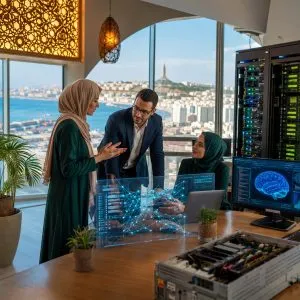
Algeria’s technology sector is undergoing a genuine structural shift. A new generation of founders, developers, and investors is embracing artificial intelligence — not as a buzzword, but as a practical tool for solving real problems in logistics, agriculture, and financial services. The market for AI in Algeria is projected to grow from $498.9 million in 2025 to $1.69 billion by 2030, representing a compound annual growth rate of 27.67%, with the generative AI sub-segment alone projected at $179.6 million in 2025 growing at 41.5% CAGR.
Algeria’s startup ecosystem ranks #111 globally and #4 in Northern Africa (behind Egypt, Tunisia, and Morocco) according to StartupBlink’s 2025 rankings, with 7.2% growth in 2025. The numbers are still modest by global standards, but the trajectory — and the government policy behind it — is unmistakable.
The Ecosystem in Numbers
Algeria’s startup ecosystem has expanded significantly under the national “Startup Label” framework. More than 7,800 companies have registered on the official startup.dz platform, with approximately 2,300 holding the formal “Startup Label” — a distinction that grants access to state funding, tax exemptions, and procurement preferences. The government has set a target of 20,000 labeled startups by 2029, backed by specialized investment funds and 124 active university incubators engaging 60,000 students in startup-oriented final-year projects.
It is important to read these numbers carefully: “registered” and “labeled” are different statuses, and labeled startups represent the more selective, investment-ready tier. The national target of 20,000 startups reflects political ambition as much as current trajectory — but the support infrastructure being built around it is real.
An estimated 50-60 active AI and AI-enabled startups operate in Algeria as of mid-2025. Fewer than 15% have received government support, suggesting the ecosystem is growing organically alongside the state-backed programs.
Leading Companies and Key Deals
- Yassir: Algeria’s most prominent startup and the highest-valued in North Africa. The super-app — covering rides, deliveries, and fintech — raised a $150 million Series B in November 2022 led by BOND (Mary Meeker), bringing total funding to approximately $200 million. As of 2025, it reports 8 million users and 100,000 active drivers and merchants across 45 cities in 6 countries, with 4,500 total employees. Co-founder Noureddine Tayebi has explained the super-app model as a trust-building necessity in a region where many users are unbanked. In December 2025, Yassir signed a strategic cloud partnership with Huawei for AI and mobility solutions.
- VOLZ: A travel-tech startup that raised $5 million (600 million DZD) in a Series A in December 2025 — the largest amount ever raised by an Algerian startup in local currency. VOLZ allows users to book flights and pay in Algerian dinars, solving a real pain point for domestic travelers. Critically, this was the first exit for the Algeria Startup Fund (ASF), which earned a 3.35x return on its investment.
- Moustachir: An electronic consulting platform that became the first startup listed on the Algiers Stock Exchange in early 2025. The IPO at 760 DZD per share was oversubscribed by 119%, raising 94 million DZD (~$724,000) from 306 shareholders — a small but symbolically significant milestone.
- FarmAI: An agri-tech startup that won second prize globally and the People’s Choice Award at Huawei’s “Tech4Good” competition, securing a $100,000 investment to automate wheat rust detection using drones and AI vision systems.
- TemTem: A super-app covering ride-hailing, delivery, and e-commerce, with 200,000+ clients and 4,000+ drivers operating across 21 of 48 wilayas. The company raised $1.7 million in seed funding plus a $4 million Series A. The opportunity is structural: modern trade accounts for only 3% of total FMCG turnover in Algeria, leaving massive room for digital commerce.
- ALPAY and SofizPay: Active fintech platforms competing in Algeria’s nascent digital payments market. SofizPay has integrated with over 10,000 merchants accepting Dahabia and CIB card payments, while ALPAY offers QR-based payments and identity verification.
Advertisement
State-Backed Funding Mechanisms
Algeria has built a multi-layered public funding infrastructure for startups:
- Algeria Startup Fund (ASF): Established in partnership with six public banks (including BADR, CPA, and BEA), with a capital of 2.4 billion DZD. ASF has reviewed 350+ applications, processed 139 funding requests across 20 sectors in 22 provinces, and funded over 100 startups. The VOLZ exit demonstrates the fund can generate real returns.
- Algerie Telecom AI Fund: In February 2025, state telecom operator Algerie Telecom launched a dedicated 1.5 billion DZD fund (approximately $11 million) specifically targeting startups in AI, cybersecurity, and robotics — the clearest policy signal yet that AI is being treated as an industrial priority.
- FCPR Venture Capital Framework (2025): A new regulatory framework allowing private venture capital funds (Fonds Commun de Placement à Risque) to start with as little as 50 million DZD and just two unitholders. Afiya Investments became the first approved FCPR — a structural game-changer for private VC in Algeria.
- Stock Exchange Access: The Algiers Stock Exchange (which saw 43% market capitalization growth in H1 2025, reaching 522 billion DZD) has waived IPO fees for startups through 2028, encouraging public listings as an exit path.
- DjazairIA: Algeria’s first AI-dedicated incubator, offering coworking spaces, coaching, fundraising support, and international marketing for AI startups focused on energy, healthcare, agriculture, and education.
Key Trends to Watch
- NLP in Darija and Tamazight: Startups are training language models on Algerian Arabic and Tamazight to serve the local market more effectively — a technically demanding challenge given these languages’ limited digital resources. This is both a commercial opportunity and a cultural preservation play.
- AgriTech + AI: With agriculture contributing approximately 13% of GDP (World Bank, 2023), the government is prioritizing smart farming. Tools for crop disease detection, smart irrigation, and yield optimization are being piloted, with FarmAI’s Huawei-backed drone systems leading the way.
- FinTech Automation: Digital payment platforms are integrating AI-driven credit scoring to reach Algeria’s largely unbanked population. The BaridiMob mobile wallet (Algeria Post) has already normalized digital transactions for millions; AI can deepen financial inclusion further.
- Energy Sector AI: Hydrocarbons represent roughly 20-25% of GDP but account for 60% of government revenue and 90% of exports. Sonatrach and international partners are integrating AI for exploration optimization, predictive maintenance, and operational efficiency — one of the highest-value application domains in the country.
- Government AI: AI-driven university placement for baccalaureate graduates is already operational. Facial recognition at Houari Boumediene Airport and predictive flood-warning systems in Ghardaia demonstrate institutional willingness. The SNTN-2030 strategy plans 500+ digital projects for 2025-2026, with 75% focused on modernizing public services.
Infrastructure: Real Progress, Real Gaps
The infrastructure story is improving faster than most observers realize:
- Fiber optic network: Over 140,000 km of fiber deployed (up to 200,000 km including all network segments), with 2.5 million FTTH subscribers as of September 2025 — covering 27% of households.
- International bandwidth: 9.8 Tb/s, with plans to double capacity.
- AI Supercomputing Center: Under construction in Oran with GPU clusters for AI workloads, targeting researchers, startups, and academia.
- Non-hydrocarbon exports: Tripled since 2017, reaching $5.1 billion in 2023 — demonstrating that Algeria’s economic diversification is not just aspirational.
Constraints remain real: limited GPU compute access, connectivity gaps outside major cities, and a brain drain of senior engineers are genuine headwinds. SNTN-2030 aims to train 500,000 ICT specialists and reduce tech talent emigration by 40% — ambitious targets that will determine whether the ecosystem can scale.
Frequently Asked Questions
How is AI reshaping Algeria’s startup ecosystem in 2026?
AI enables Algerian startups to compete globally by automating processes and reducing costs. Local AI incubators and government support through the national AI strategy are accelerating growth in fintech, agritech, and e-commerce.
What are the main challenges facing Algerian AI startups?
Key challenges include limited venture capital, brain drain to Europe, regulatory uncertainty around data protection, and infrastructure gaps in high-performance computing outside major cities.
Which sectors offer the best AI startup opportunities in Algeria?
Agriculture, energy optimization, financial services, and government digital transformation combine large datasets, clear efficiency gains, and growing institutional willingness to invest.
Sources & Further Reading
- Statista — AI Market Algeria Forecast
- StartupBlink — Algeria Startup Ecosystem Rankings 2025
- TechCrunch — Yassir Raises $150M Series B
- Technext — VOLZ Closes $5M Series A
- LaunchBase Africa — Moustachir IPO
- LaunchBase Africa — Inside Algeria’s Startup Labelling System
- WeAreTech Africa — Algeria Targets 20,000 Startups by 2029
- Startup Algeria — ASF Overview
- New Lines Institute — Why Algeria Is Positioned To Become North Africa’s AI Leader
- World Bank — How Algeria Is Crafting a Dynamic Economy