
What Sidi Abdellah Actually Is
The “Chahid Abdelhafid-Ihaddaden” Scientific and Technological Pole at Sidi Abdellah is not a coworking space or a pop-up accelerator. It is an 87-hectare national infrastructure that houses four national schools — covering mathematics, nanosciences, autonomous systems, and artificial intelligence — with 20,000 educational places and residences for 11,000 students. The National School of Artificial Intelligence has been operational since 2021.
On April 23, 2026, three ministers jointly inaugurated Algeria’s first national startup cluster dedicated to AI and cybersecurity within this pole: Kamel Baddari (Higher Education and Scientific Research), Noureddine Ouadah (Knowledge Economy and Startups), and Sid Ali Zerrouki (Post and Telecommunications), as iAfrica confirmed in its coverage of the launch. The joint ministerial oversight signals that the cluster is positioned as a cross-government strategic initiative, not a single-ministry side project.
According to Tech in Africa’s coverage of the launch, the cluster’s stated mandate is to bridge “the persistent structural gap between academic research and industrial application” — a gap that has long kept Algerian university patents on shelves rather than in markets. Officials confirmed that over 2,800 patents have been filed from Algeria’s university system, yet very few have been commercialized. The cluster is designed to change that calculus by putting founders, researchers, and industry players in the same physical and institutional environment.
The target sectors — health, agriculture, energy, and digital services — map directly onto Algeria’s diversification agenda away from hydrocarbons. Cybersecurity is embedded as a horizontal capability across all sectors, not a standalone vertical.
Why This Matters for Algerian Founders Now
Algeria currently has 7,800+ registered startups (approximately 2,300 formally labeled), but the national target is 20,000 registered startups by 2029. That gap — roughly 12,200 new startups in three years — requires structured institutional infrastructure, not just individual hustle. The Sidi Abdellah cluster is the first facility explicitly built to absorb, develop, and graduate startups at scale.
The timing is also significant. EcoFina Agency reported that the cluster accepts “startups from both academic and traditional entrepreneurial backgrounds” — meaning you do not need to be a university researcher or a graduate of one of the pole’s schools to apply. The academic connection is an asset, not a prerequisite.
Youth unemployment near 30% is the macro-pressure driving the political will behind this initiative. The cluster is framed explicitly as a talent retention mechanism — Middle East AI News noted that officials cited retaining domestic talent and attracting the scientific diaspora as explicit goals. For diaspora founders considering a return, this signals state-level infrastructure to support them.
Expansion is already planned. Officials indicated the Sidi Abdellah model could extend to other university campuses, with 2027 as a consolidation benchmark. Getting in at the founding cohort of the flagship location carries first-mover advantages that will be harder to capture once the model scales.
Advertisement
What Algerian Founders Should Do Right Now
1. Map Your Startup Against the Four Target Sectors Before Applying
Health, agriculture, energy, and digital services are not vague — they are the sectors where the Algerian state is actively deploying budget and policy attention in 2026. Before approaching the cluster, audit your product against at least one of these verticals with specificity. “AI for health” is too broad; “AI-assisted early diagnosis tools for district hospitals” is the right level of precision. The cluster’s mandate is commercializing research, so applications that show a clear path from prototype to deployed product in a strategic sector will be prioritized. Cross-reference your pitch with Algeria’s 2025-2029 national economic diversification targets — those are the criteria reviewers will use.
2. Secure Your Startup Label Before Applying to the Cluster
The Algeria startup ecosystem operates on a label-first logic. The Startup.dz label (awarded by the National Council for Startups) gives your company legal recognition, tax advantages, and access to public procurement. While the cluster accepts startups from both academic and commercial backgrounds, having the label demonstrates institutional legitimacy and signals that your startup has already cleared a vetting process. If you don’t have the label yet, file for it in parallel with your cluster preparation — the two processes reinforce each other and the label application is the single fastest way to signal seriousness to any state-linked institution.
3. Prepare a Commercialization Brief, Not Just a Pitch Deck
The cluster’s stated mission is bridging research to application — not funding early ideation. When you approach the cluster, the question is not “what’s your vision?” but “what’s your route to market and what does the pole’s infrastructure help you execute?” Prepare a two-page commercialization brief that covers: current prototype stage, target customer (named institution or sector), the specific resource from the pole (lab access, research collaboration, investor introductions) you need, and a 12-month milestone map. The 2,800+ patents filed by Algeria’s universities are potential licensing assets — if your startup can build on existing university IP, frame that explicitly.
4. Use the Structured Investor Access as a Due Diligence Signal
The Middle East AI News coverage confirmed that the cluster provides “structured investor meetings for early-stage financing.” This is the most operationally valuable benefit for founders who have been struggling to get in front of credible local capital. Treat the investor introductions not just as funding opportunities but as due diligence rehearsals. International investors, DFIs, and later-stage VCs will all ask whether your startup has engaged with the national ecosystem infrastructure — being a cluster member answers that question definitively. Document every investor meeting, what was discussed, and what follow-up was agreed. That paper trail becomes part of your funding story.
Where This Fits in Algeria’s 2026 Ecosystem
The Sidi Abdellah cluster is the most significant structural addition to Algeria’s startup ecosystem since the 2020 Startup Law. It fills the institutional gap that existed between the Startup.dz label (legal recognition) and access to real commercialization resources — labs, researchers, industry partners, and investors. The 87-hectare pole with four national schools is not a temporary program; it is permanent infrastructure with ministerial backing at the highest level.
The 2029 target of 20,000 registered startups means Algeria needs roughly 4,000 newly registered startups per year. The cluster at Sidi Abdellah, and the campuses that will follow it, are the production mechanism. Founders who engage now — before the model scales and competition for cluster slots intensifies — are positioning themselves at the top of what will become a national startup conveyor belt. The diaspora angle is also worth watching: the explicit goal of attracting scientific diaspora talent creates a pathway for founders currently outside Algeria to return with institutional support rather than starting from scratch.
Frequently Asked Questions
Who is eligible to apply to the Sidi Abdellah cluster?
The cluster explicitly accepts startups from both academic and traditional entrepreneurial backgrounds — you do not need to be affiliated with a university in the pole to apply. However, having the Startup.dz national label significantly strengthens any application, as it demonstrates your startup has cleared the national vetting process.
What sectors does the Sidi Abdellah cluster focus on?
The four target sectors are health, agriculture, energy, and digital services. Cybersecurity is a horizontal capability embedded across all sectors. Startups that can demonstrate a clear product-market fit in one of these four verticals and a route to commercialization within the pole’s infrastructure are the strongest candidates.
Is there funding attached to joining the cluster?
Based on currently available public information, the cluster provides access to infrastructure, research collaboration, and structured investor introductions — but no direct grant or equity funding has been publicly announced for cluster members. Funding access comes through the investor meetings the cluster facilitates, not as a direct disbursement.
Sources & Further Reading
- Algeria Launches First AI and Cybersecurity Startup Cluster at Sidi Abdellah — iAfrica
- Algeria Builds First AI and Cybersecurity Hub to Scale Its Startup Ecosystem — EcoFina Agency
- Algeria Launches Its First Startup Cluster Dedicated to AI and Cybersecurity — Tech in Africa
- Algeria Launches First AI and Cybersecurity Cluster — Middle East AI News
- Algeria Tech AI Startup Scene — AlgeriaTech
🔗 Related Intelligence

Sidi Abdellah AI and Cybersecurity Cluster: What Algerian Startups Can Access Right Now

Algeria’s First AI Security Cluster: Why the Startup Stack Is Finally Connecting

Sidi Abdellah Opens Its Doors: Algeria’s First AI & Cybersecurity Startup Cluster
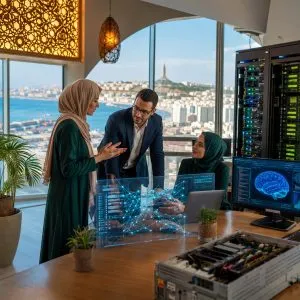
Algeria’s First AI Cluster: Inside the Sidi Abdellah Tech Hub Launch