What was actually inaugurated at Sidi Abdellah
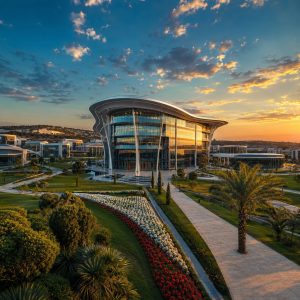
The cluster was inaugurated on April 18, 2026 at the “Chahid Abdelhafid Ihaddaden” Scientific and Technological Pole in Sidi Abdellah, west of Algiers, under the joint supervision of three ministers: Higher Education and Scientific Research Minister Kamel Baddari, Knowledge Economy and Startups Minister Noureddine Ouadah, and Post and Telecommunications Minister Sid Ali Zerrouki.
A structured meeting between private investors and startup founders was held on the same day to formalise access to early-stage financing. Officials indicated the cluster model could be extended to other campuses nationwide, with 2027 cited as a benchmark horizon for consolidating knowledge-driven growth.
The Sidi Abdellah location is not random. The same campus already hosts the Algerian Space Agency (ASAL) business incubator, inaugurated by Minister Baddari in October 2025. Co-locating an AI and cybersecurity cluster with existing space and research infrastructure is the first deliberate attempt to concentrate Algerian deep-tech activity in one place rather than scattering it across isolated programs.
Why the timing is finally aligned
Algeria has spent the last two years accumulating ecosystem ingredients without quite turning them into a system. Algérie Télécom announced in 2025 a 1.5 billion dinar (about USD 11 million) fund to back AI, cybersecurity, and robotics startups. The first national High-Performance Computing Centre focused on AI broke ground in Oran on March 16, 2025, equipped with GPU clusters for researchers and startups, with an operational window targeted for 2026-2027. Algeria’s National AI Strategy, announced by the AI Council on December 8, 2024, set six pillars covering research, skills, sector applications, investment, data governance, and ecosystem build-out.
What was missing was the connective tissue between those pieces. Tech4Connect 2026, run with Huawei in March 2026, rewarded student teams working on AgriTech and smart-city challenges using AI, 5G, and Huawei Cloud. Algeria Venture continues to act as the meeting point for ministries, founders, and ecosystem operators. On April 17, 2026, Minister Ouadah used an African Union Peace and Security Council session to call for an integrated continental framework for AI governance, signalling that Algerian AI policy is now a diplomatic file as well as a domestic one.
Taken together, these signals suggest the state is no longer treating AI as a single ministry topic. It is beginning to frame AI as a cross-cutting capability tied to infrastructure, entrepreneurship, security, and regional policy. The Sidi Abdellah cluster is the operational expression of that shift.
Advertisement
Why a cluster is structurally different from another announcement
A cluster model implies concentration, coordination, and shared infrastructure. Instead of scattering support across disconnected programs, it creates a place where ideas can move from research discussion to startup execution in a measurable way. In AI specifically, that matters because most of the value sits in the loop between domain data, applied teams, and deployment opportunities, not in the model alone.
Cybersecurity is a useful pairing for the same reason. It forces products to solve operational problems that enterprises and ministries will actually pay for: identity, monitoring, incident response, threat intelligence. It also creates customer-development discipline that pure-AI startups sometimes lack, because security buyers will not pay for a demo without a credible operational story.
The wider economic context is also unusually well aligned. Algeria currently has more than 7,800 registered startups, with a national target of 20,000 by 2029 set by President Tebboune. According to StartupBlink, the ecosystem ranked 111th globally in 2025 and grew 7.2 percent year-on-year, placing it 4th in North Africa behind Egypt, Tunisia, and Morocco. With youth unemployment near 30 percent, the political case for accelerating a digital-economy transition is hard to dispute.
What Algerian Founders and University Labs Should Do Now
The cluster is operational. The structural advantage goes to teams that engage before the first cohort fills. Three moves have outsized leverage, and each maps directly to what the cluster’s tri-ministry design was built to enable.
1. Package Research Into Buyer-Ready Use Cases
Universities and research centers now have a named commercialization layer at Sidi Abdellah. That changes the playbook but only for teams that show up with specific, scoped problems. StartupBlink’s 2025 report placed Algeria’s ecosystem 4th in North Africa — behind Egypt, Tunisia, and Morocco — precisely because research outputs rarely reach commercial form. The pattern that works: pick one domain (identity security, Arabic NLP, computer-vision inspection), define the integration point with an enterprise system, and arrive at the cluster with a pilot specification, not a demo deck. Generic AI pitches will not attract the enterprise buyers the cluster is designed to connect.
2. Activate the 1.5-Billion-Dinar Capital Pipeline
The Algérie Télécom-seeded AI and cybersecurity fund (1.5 billion dinars, roughly USD 11 million) is the most accessible early-stage capital pool in the ecosystem, and the cluster’s co-location with the Knowledge Economy ministry’s startup-labeling pipeline is the fastest path to it. Teams without a startup label should file for it before approaching outside investors: the label unlocks tax exemptions, financing access, and reduces perceived administrative risk for enterprise procurement desks. Founders planning a seed round in 2026 should anchor with domestic capital first, then use that as validation in subsequent international conversations. The university-affiliated VC accreditation introduced in March 2026 also opens a parallel channel: academic institutions that hold VC accreditation can co-invest in spin-outs from their own research labs, which means founding teams with university IP have access to capital sources that were not available 12 months ago.
3. Build the Buyer-Development Function the Cluster Cannot Do Alone
The 124 active university incubators engaging 60,000 final-year students supply the talent side. The unsolved problem is demand. Algerian AI momentum stalls when promising teams can only demo for juries and conference audiences. The cluster needs banks, telcos, industrial operators, and ministries to arrive with defined problem statements and pilot budgets — and that relationship-building cannot happen passively. Founders should map three to five enterprise accounts in adjacent sectors (water, logistics, public health), qualify whether those organizations have a procurement process for early-stage pilots, and use the cluster’s ministerial contacts as a warm introduction channel rather than waiting for buyer outreach to happen organically. Building the demand side is the work the cluster’s structure enables but cannot perform on behalf of the founder.
Where This Fits in Algeria’s 2026 Ecosystem
The three prescriptions in this article — packaging research into buyer-ready use cases, activating the Algérie Télécom capital pipeline, and building the demand side proactively — add up to one structural insight: the Sidi Abdellah cluster can only become a marketplace if both supply and demand show up with something specific to exchange. That has been the missing variable in Algerian deep-tech for a decade.
What makes April 2026 different is the density of supporting conditions. The National AI Strategy has six pillars already articulated; the HPC center in Oran is moving toward its 2026-2027 operational window; Algeria Venture is signing sector MoUs with utilities and ministries. The cluster is the coordination layer that connects these pieces. But coordination layers are only as useful as the actors who use them. Algerian founders who enter the cluster with defined pilot specifications and named enterprise conversations will shape what the cluster becomes — one that functions as a commercialization engine, or one that becomes another showcase for ideas that never reach production.
The 2029 target of 20,000 registered startups is a number that will be easy to hit and meaningless if the underlying companies cannot show revenue. The cluster’s contribution to that quality bar depends on what founding teams bring to it now, before the first cohort fills and institutional inertia sets the standard.
Frequently Asked Questions
What did Algeria launch on April 18, 2026?
Algeria launched its first national startup cluster dedicated to artificial intelligence and cybersecurity at the Sidi Abdellah Scientific and Technological Pole, under the joint supervision of three ministers: Higher Education (Baddari), Knowledge Economy and Startups (Ouadah), and Post and Telecommunications (Zerrouki). A structured investor-founder meeting was held on the same day.
Why does an AI and cybersecurity cluster matter for startups?
A cluster reduces fragmentation by concentrating expertise, mentors, infrastructure, and buyer access in one ecosystem node. Cybersecurity in particular forces products to solve operational problems that enterprises will pay for, which gives Algerian AI startups a sharper customer-development discipline than a pure-AI showcase environment.
How should Algerian universities and founders use the cluster?
Universities should package applied research into narrow use cases that can become startup projects. Founders should look for sector partners, pilot environments, and early go-to-market support so AI and cybersecurity ideas move beyond presentations into paid deployments. The 124 active university incubators and 60,000 final-year startup students provide the supply pipeline; demand-side buyers are the missing piece the cluster has to attract.
Sources & Further Reading
- Algeria launches first AI, cybersecurity startup cluster — APS
- Algeria Builds First AI and Cybersecurity Hub to Scale Its Startup Ecosystem – Ecofin Agency
- Algeria Launches First AI and Cybersecurity Startup Cluster at Sidi Abdellah Technology Hub – iAfrica
- Algeria calls for continent-wide AI governance framework — APS
- Huawei Algeria rewards winning student teams at Tech4Connect 2026 — APS