A demand-side AI strategy, finally
Most national AI conversations begin from supply: chips, models, labs, branding. The March 18, 2026 water call inverts that. The Ministry of Knowledge Economy and Startups, working with the Ministry of Water Resources and Water Security and the Ministry of Higher Education and Scientific Research, is asking innovators, startups, scale-ups, micro-enterprises, incubators, accelerators, university researchers, and Algerian talent abroad to bring solutions to a specific national problem.
The priorities published with the call are concrete. Reducing water leaks and waste. Improving energy efficiency in desalination. Expanding water reuse. Promoting smart irrigation and sustainable agriculture. Deploying AI and the Internet of Things in water management. Climate change adaptation. None of those are abstract. Each is a measurable engineering and operations problem with budgets, owners, and field constraints attached.
That framing matters because it pushes Algerian AI work into a territory where it becomes economically serious. Generic “innovate” calls produce slide decks. Calls anchored on leakage reduction and desalination efficiency produce field deployments. Builders who win in this kind of brief stay in the country and accumulate operational experience.
Why water is the right anchor problem
The numbers explain why water is a defensible AI test case. Algeria’s piping system loses up to 50 percent of treated water to leaks, in part because of decades of deferred maintenance. The country is already Africa’s largest producer of desalinated water and ranks second in the Mediterranean for desalination capacity, with a stated goal of moving from roughly 18 percent to 60 percent of drinking water from desalination by 2030. New facilities in Tlemcen, Mostaganem, and Chlef will add 900,000 cubic meters of daily capacity. Bloomberg reported in February 2026 that Algeria is accelerating a 1 billion dollar water fix for drought-prone regions.
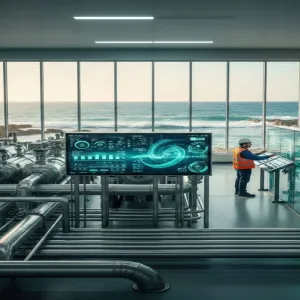
Operations at that scale generate exactly the kind of recurring, multi-source data that applied AI handles well: pressure and flow telemetry, leak signatures, energy use per cubic meter desalinated, water-quality readings, network maintenance histories, customer demand patterns, and field-team response logs. The use cases are concrete: leakage detection from acoustic and pressure sensors, predictive maintenance on pumps and membranes, demand forecasting for distribution scheduling, energy optimization for desalination plants, and field-team routing for inspections and repairs.
The ecosystem context strengthens the bet
The water call does not arrive in a vacuum. In March 2026, Huawei Algeria rewarded the winning student teams of its first Tech4Connect hackathon, a 48-hour competition focused on AgriTech and Smart Cities using AI, 5G, and Huawei Cloud, drawing more than 200 students working in three-person teams of an AI specialist, a domain expert, and a design lead. Algeria also launched its first AI and cybersecurity startup cluster and held a high-level meeting with the United Nations on digital and emerging technologies. The supply side is moving.
The water call is the demand-side complement. Ministries become problem owners; SEAAL has already signed a separate protocol with Algeria Venture (more on that elsewhere in our coverage) to host startup pilots in public water and sanitation services. The first pilot under that framework is a remote management system for a hydraulic site, developed with a startup. That is what an AI ecosystem looks like when supply and demand meet.
Advertisement
Where the program could fail
The honest risk is pilot theater. Calls like this can drift into announcement cycles where teams demonstrate prototypes that never reach procurement, never integrate with legacy supervisory control systems, and never survive field conditions like dust, heat, or unreliable connectivity in remote sites. The way to avoid that is to define pilot environments, evaluation criteria, and clear procurement pathways before founders enter the program.
A second risk is scope drift toward generic AI deliverables. The strongest proposals will avoid generic AI language and pick a single measurable operator pain point: a specific leakage detection target on a defined section of network, a measured reduction in kilowatt-hours per cubic meter desalinated, a reduction in field-response time, or a forecast-accuracy improvement that translates into operational scheduling savings. Anything broader is harder to procure, harder to evaluate, and easier to fund-and-forget.
What Algerian AI Teams Should Submit — and What to Avoid
The March 18, 2026 call is open to founders, university researchers, and Algerian talent abroad. Treating it as a product brief rather than a grant application is the differentiator. Three submission moves increase the probability of reaching procurement; one pattern kills proposals at evaluation.
1. Anchor on One Measurable Operator Pain Point
The strongest proposals target a single, verifiable operational metric rather than a broad AI category. Algeria’s piping system loses up to 50 percent of treated water in distribution — a leakage-detection solution that commits to a specific percentage reduction on a defined network segment has a procurement pathway. An energy-per-cubic-meter-desalinated improvement on a named plant has a testable baseline and an evaluable outcome. Bloomberg’s February 2026 reporting confirmed that Algeria is investing USD 1 billion in water infrastructure over the near term — which means procurement budgets exist for measurable operational improvements. Proposals that commit to a KPI auditable within 90 days are fundable; proposals promising broad AI transformation are not.
2. Design for Field Conditions, Not Lab Conditions
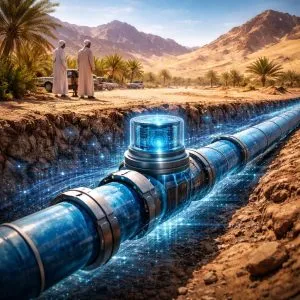
SEAAL’s existing protocol with Algeria Venture (already piloting a remote management system for a hydraulic site via a startup) shows that the pilot environment is real and operationally complex: remote sites, heat, dust, intermittent connectivity, and legacy supervisory-control systems built over decades. A proposal that ignores integration with existing SCADA infrastructure will fail in deployment even if it succeeds in prototyping. Teams should specify which data inputs are available (pressure sensors, flow meters, SCADA logs), what connectivity assumption the model makes, and how the solution degrades gracefully when sensor data is incomplete. That level of field specificity signals operational seriousness to procurement evaluators.
3. Structure as a Pilot-to-Procurement Bridge, Not a Research Project
The single most common failure mode in Algerian tech calls is a team delivering a prototype that never reaches deployment because no one defined the procurement step. Before submitting, map the chain: which ministry or operator would sign a paid contract, what budget line it would fall under, and what evaluation criteria would trigger that contract. The Ministry of Water Resources is already a co-organizer of the call, which means institutional contacts exist. Founding teams should request a named technical referent at the operating entity during the application phase, not after acceptance. The SEAAL-Algeria Venture framework is the template: a signed protocol first, then a pilot, then a procurement conversation — in that order.
What Not to Do: Generic AI Claims Without an Operator Partner
The one pattern that consistently fails in sector-specific innovation calls is generic AI positioning: “machine learning for water management” without a named operator, a defined data source, or a measurable target. The Ministry of Knowledge Economy’s own framing — deploying AI and IoT in water management, reducing leaks, improving desalination efficiency — is prescriptive enough to filter out general proposals. Teams that do not name their operator partner, specify their data pipeline, and define their evaluation metric in the first page of the application are signaling that they are responding to the category, not the problem.
The Bigger Picture
The March 2026 water call matters beyond water. It is Algeria’s clearest demonstration to date that AI strategy can be demand-led rather than supply-led — structured around a sector with real budgets, real operators, and measurable operational problems rather than around a generic innovation narrative. If the call produces even three to five deployments that reach procurement and operational integration over the next 24 months, it establishes a replicable model.
The replication path is straightforward: agriculture, logistics, and energy all share the same structural profile as water — large public-sector operators with decade-long data histories, operational pain points that AI can address without frontier-model compute, and procurement channels that are already open to local suppliers. Bloomberg’s February 2026 reporting on Algeria’s USD 1 billion water investment confirms that procurement budgets exist; the gap is the pipeline of locally developed solutions capable of meeting them. SEAAL’s protocol with Algeria Venture — a signed agreement followed by a first pilot at a hydraulic site — is the template that any sectoral ministry could adopt with an equivalent framework.
The longer-term significance is institutional. A country that learns to run demand-led AI calls — with named operators, measurable criteria, and procurement pathways — builds something more durable than any single application: it builds the administrative capacity to keep commissioning applied AI work as technology evolves. That capacity is what separates countries that accumulate industrial AI experience from those that accumulate AI announcements.
Frequently Asked Questions
What is Algeria’s water-sector technology initiative?
On March 18, 2026, the Ministry of Knowledge Economy and Startups launched a national open call for water innovation in collaboration with the Ministry of Water Resources and Water Security and the Ministry of Higher Education and Scientific Research. The published priorities include reducing water leaks and waste, improving energy efficiency in desalination, expanding water reuse, smart irrigation, and AI and IoT in water management.
Why is water a strong use case for AI in Algeria?
Algeria’s piping system loses up to 50 percent of treated water to leaks, the country plans to move desalination from roughly 18 percent to 60 percent of drinking water by 2030, and new plants in Tlemcen, Mostaganem, and Chlef will add 900,000 cubic meters of daily capacity. Operations at that scale generate sensor, energy, quality, and maintenance data that supports leak detection, predictive maintenance, demand forecasting, and energy-use optimization.
How should Algerian startups approach the water-tech opportunity?
Pick one operator, pick one measurable problem, and design a workflow that survives field conditions and integrates with legacy supervisory systems. The strongest proposals target a specific leakage-reduction figure on a defined section, an energy-per-cubic-meter improvement at a desalination plant, or a measurable reduction in field-response time, rather than generic AI language.
Sources & Further Reading
- Algeria launches national initiative for technological solutions in water sector – APS
- Ministry of Knowledge Economy and Startups Launches National Open Call for Water Innovation – TechAfrica News
- Algeria Speeds 1 Billion Dollar Water Fix for Drought-Prone Regions – Bloomberg
- Huawei Algeria rewards winning student teams at Tech4Connect 2026 – APS
- Innovation Acceleration Program in Public Services Between SEAAL and Algeria Venture – Algerian Radio