What actually happened in Algiers
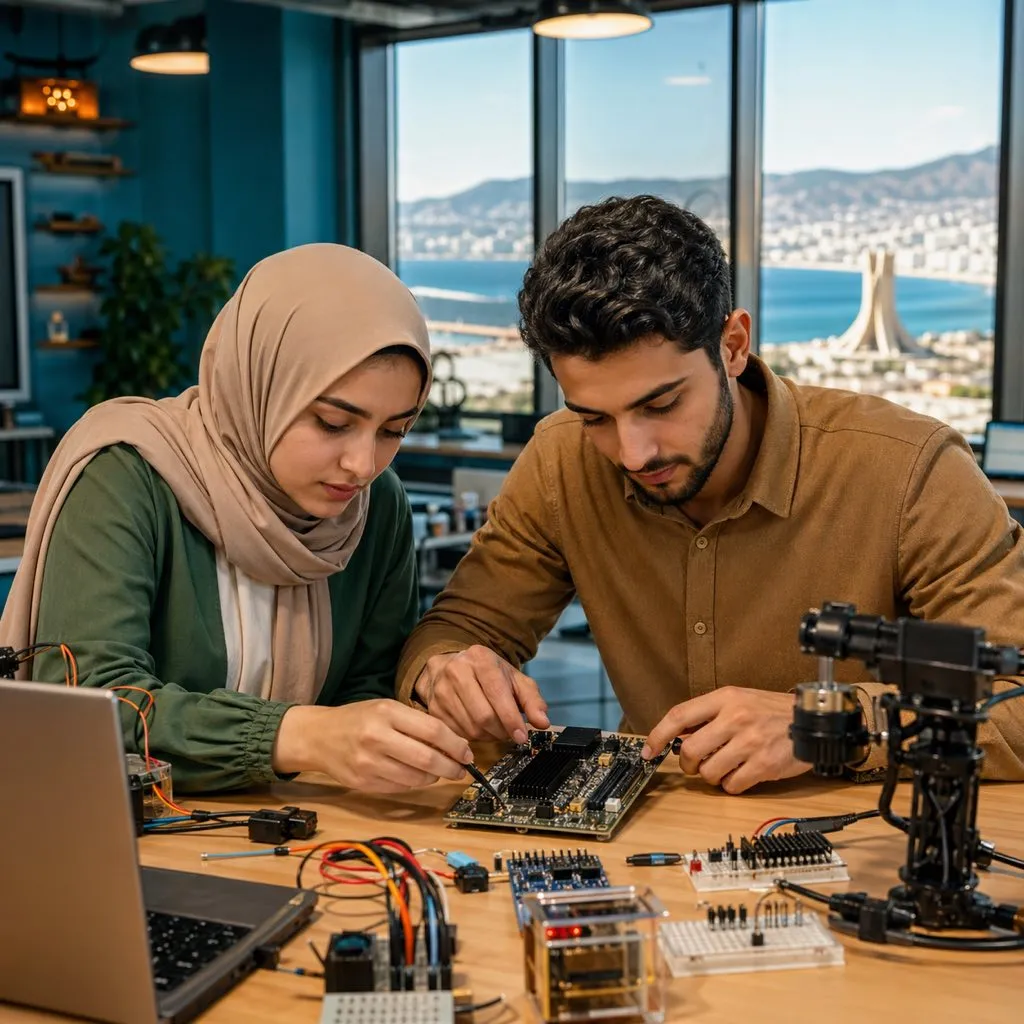
Huawei Algeria’s first edition of Tech4Connect was a 48-hour hackathon staged in early March 2026 and capped by an awards ceremony in Algiers on March 12. More than 200 students competed in three-person teams structured around a deliberate role split — one AI specialist, one domain expert, and one design lead — across two tracks focused on AgriTech and smart cities. Teams built on Huawei Cloud and combined AI, 5G connectivity, and Digital Power tooling. The University of Blida 1’s IT Community team took second place; full track-by-track rankings were not publicly disclosed.
The award ceremony was attended by Noureddine Ouadah, Minister of Knowledge Economy, Start-ups and Micro-enterprises, and Tony Sze, CEO of Huawei Algeria, alongside representatives from public and private partners. The same event also recognized students returning from the 2025 Seeds for the Future program, which sent participants from more than 44 Algerian universities through a 15-day in-country track and a one-week visit to Huawei’s headquarters in Shenzhen.
That structure matters more than the medals. A team of three with role specialization, a 48-hour build window, and a real cloud platform forces students past slide-deck ideation. They have to ship something deployable, defend it before judges, and answer questions about data, latency, and operational fit. Students who survive that process are already past the hardest filter most ecosystems impose on first-time founders — the point where vague enthusiasm meets a working prototype.
The post-hackathon gap is where most ecosystems lose value
Hackathons are easy to dismiss because most end as presentation theater. The risk in Tech4Connect 2026 is not that the event was poorly run — by all reporting it was well-organized — but that no public mechanism connects the strongest teams to the next twelve months of company-building support. Globally, the conversion rate from student hackathon to funded startup is brutal: McKinsey’s 2025 university-to-startup pipeline analysis found that under 4% of hackathon teams in emerging markets reach a paying customer within 18 months, and under 1% raise institutional capital. The bottleneck is not technical talent; it is what happens between the trophy and the first invoice.
Three things break the pipeline in practice. First, students return to coursework, internships split the team, and the codebase decays inside three months without paid engineering time. Second, none of the team typically knows how to validate demand with a real buyer in a regulated sector — agriculture, water utilities, or municipal services — so the “smart city” narrative collapses on first contact with a procurement office. Third, even if the team identifies a buyer, there is no small pilot budget that lets them deploy at low risk. A 50,000 DZD pilot would change the trajectory; without one, the team disbands.
Algeria has more institutional support than it had in 2024
This is also where the timing is more favorable than in earlier cycles. Algeria launched its first AI and cybersecurity startup cluster in 2025. The Algerian Startup Fund (ASF) has been distributing public-private capital under the Startup Label framework, and the national programme launched in 2025 mobilized more than $600 million across five years to seed 1,000 ventures. President Tebboune instituted an Innovative Researcher Award to legitimize applied work coming out of universities. The Ministry of Knowledge Economy now signs MoUs with operational sectors — the SEAAL water utility partnership with Algeria Venture is a recent example — that explicitly create startup pilot windows inside public services.
The architecture exists, but it is not yet wired into events like Tech4Connect. None of the public communication around the March 12 ceremony described a continuation track for the winning teams. There was no announced post-hackathon mentor program, no pilot budget allocation, no procurement on-ramp into Algerian Telecom or Sonelgaz, and no follow-up funding tied to milestone delivery. That is the gap.
Advertisement
Three moves that would change the math
First, organizers and partners should commit to a six-month continuation track at the moment teams are announced — mentor matching from working founders, technical milestone reviews at 30/90/180 days, and structured customer-interview cycles. Second, teams should be forced to narrow their products around one operational buyer and one measurable workflow before they receive any further support; vague “smart city” narratives rarely survive a real procurement conversation. Third, the ecosystem needs small but real pilot budgets — five to fifteen million DZD per cohort — so teams learn how to deploy under operational constraints instead of polishing slides.
The deeper point is that Algeria does not need more ceremonial proof that young people can build with AI. The Blida 1 team already produced that proof in March. What it needs is an operating model that converts student capability into first customers, first revenue, and eventually first institutional trust. If Tech4Connect becomes an intake mechanism for that model — feeding teams into the AI cluster, ASF pre-seed tranches, and SEAAL-style sector pilot windows — it will matter far beyond the event itself. If it stays a standalone celebration, the prototype energy will dissipate the way it has in previous cycles, and the next edition will have to start from zero.
Three Continuation Tracks, Three Different Startup Outcomes
Post-hackathon support is not one-size-fits-all. Teams that won Tech4Connect 2026 and their mentors should select the continuation track that matches where the team actually is — not where they wish they were. McKinsey’s 2025 university-to-startup pipeline analysis, which found under 4% of emerging-market hackathon teams reach a paying customer within 18 months, suggests the bottleneck is at three specific junctures: customer validation, pilot deployment, and regulatory navigation. The three tracks below are designed around those junctures.
AgriTech Track: Validation Against a Real Farm or Food Processor
AgriTech teams from Tech4Connect should prioritise a six-to-eight week validation sprint with one named operational buyer before any further product development. In Algeria, the most accessible entry points are ONAB (Office National des Aliments du Bétail), OAIC (Office Algérien Interprofessionnel des Céréales), or a private agro-processor with digital purchasing infrastructure. The goal is not a commercial contract — it is a structured trial where the team deploys its AI tool on real data, measures one outcome metric (yield prediction accuracy, logistics routing reduction, or disease detection precision), and produces a one-page results brief. Algeria Venture’s SEAAL partnership model provides the template: a public institution provides data access and a small operational sandbox, the startup provides a measurable output, and the pilot brief becomes the first credible evidence for ASF pre-seed consideration.
Smart City Track: Anchor to One Wilaya Problem, Not a Generic Platform
Smart city proposals are the most common hackathon output and the least fundable as submitted. The teams that convert prototype work into revenue anchor the product to a single municipal service in a single wilaya and eliminate all generic features. Concrete anchors for 2026-2027 include: real-time public transport tracking for Algiers or Constantine (ETUSA), smart water-meter anomaly detection for SEAAL or ADE, or parking optimization for a single commercial district. The Innovative Researcher Award system launched by President Tebboune provides recognition for applied work tied to operational outcomes — teams that document a measurable impact in a real wilaya service qualify faster than those presenting stage demonstrations. Target one wilaya, one service, one metric, one result document.
Cross-Sector AI Track: Position for ASF Pre-Seed Through the AI Cluster Entry Point
Teams whose projects do not fit neatly into AgriTech or smart cities should treat the AI and cybersecurity startup cluster launched in 2025 as their primary institutional gateway rather than applying directly to ASF. Cluster membership provides co-working infrastructure, access to technical mentors who have navigated the Startup Label framework, and introductions to the sector partnerships (Sonelgaz, Mobilis, Algérie Télécom) that the Ministry of Knowledge Economy has signed. The five-year, $600 million national startup programme provides pre-seed capital tranches that are disbursed on a milestone basis — teams that enter the cluster first build the track record needed to qualify within six months rather than applying cold. The minimum viable milestone the ASF review committee requires is one documented proof-of-value deployment, not a pitch deck.
Where This Fits in Algeria’s 2026 Ecosystem
The three continuation tracks — AgriTech validation against a named operational buyer, Smart City anchoring to one wilaya problem, and cross-sector AI positioning through the AI cluster entry point — synthesize the same underlying principle: every prototype that came out of Tech4Connect 2026 needs one real constraint before it can become a startup. That constraint is not a jury, a prize, or another demo stage. It is a specific buyer, a specific workflow, and a specific measurable outcome.
Algeria’s ecosystem has accumulated the pieces needed to make that constraint available. The AI and cybersecurity cluster launched in 2025, the SEAAL-Algeria Venture MoU model, the ASF pre-seed milestone structure, the Innovative Researcher Award recognition system — each of these is a mechanism that can absorb a Tech4Connect team if the team shows up with something narrow and deployable. The Blida 1 IT Community team’s second-place finish in March 2026 is a proof point that Algerian students can build with industrial-grade tools under time pressure. The ecosystem’s 2026 test is whether it can convert that proof point into the next class of first-time founders.
McKinsey’s finding that under 4% of emerging-market hackathon teams reach a paying customer within 18 months is a benchmark, not a destiny. It describes ecosystems that have not yet designed the connective tissue. Designing that tissue — explicitly, before the next Tech4Connect edition — is the highest-leverage action any organizer, sponsor, or ministry can take this year.
Frequently Asked Questions
What was Tech4Connect 2026 focused on?
Tech4Connect 2026 was Huawei Algeria’s first 48-hour student hackathon, staged in March 2026, with more than 200 students competing in AgriTech and smart-city tracks using AI, 5G, and Huawei Cloud. The University of Blida 1 IT Community team finished second.
Why are student AI demos hard to turn into startups?
Student teams typically lack customer access, procurement knowledge, data partnerships, and small pilot budgets. McKinsey’s 2025 analysis found under 4% of emerging-market hackathon teams reach a paying customer within 18 months. Without continuation support, a strong prototype becomes a portfolio piece, not a company.
How can Algeria turn Tech4Connect projects into durable companies?
Three concrete moves: a six-month continuation track with mentors and milestone reviews, mandatory narrowing to one buyer and one workflow, and pilot budgets in the 5-15 million DZD range. Wiring these into the AI cluster, ASF pre-seed, and existing sector partnerships (e.g., SEAAL-Algeria Venture) would convert event energy into deal flow.
Sources & Further Reading
- Huawei Algérie récompense les équipes étudiantes lauréates du premier hackathon Tech4Connect 2026 — L’Express DZ
- The University of Blida 1 team won second place in the Huawei Tech4Connect Hackathon — Blida 1 University
- Huawei Algérie récompense les étudiants lauréats en AgriTech et Villes intelligentes — Algerie Eco
- Tech 4 Connect 2026 — Huawei Algeria official site
- President Tebboune institutes Innovative Researcher Award — APS