The Strategic Logic Behind Linguistic Sovereignty
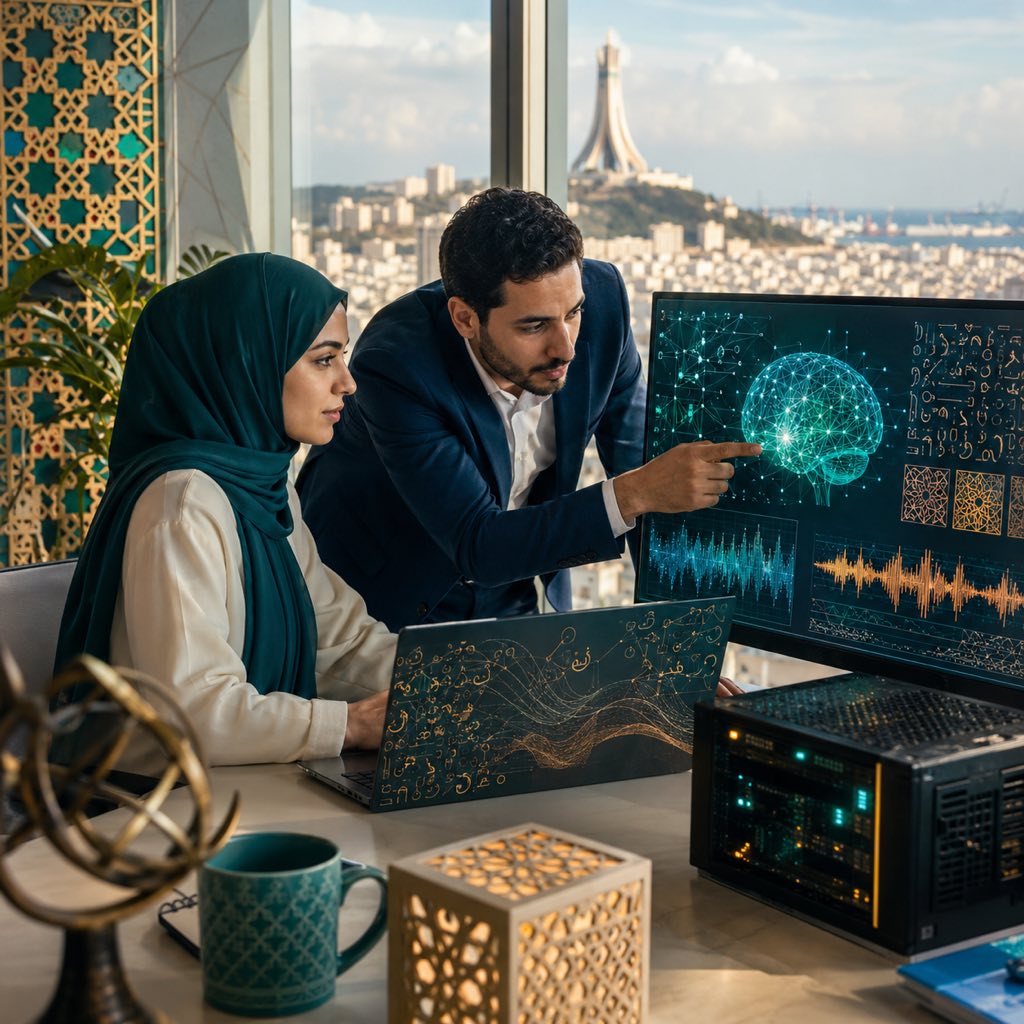
When Minister Noureddine Ouadah made his announcement at Yahia Farès University in Médéa on March 10, 2026, he was not describing a research curiosity — he was framing a national infrastructure decision. The argument is straightforward: AI systems that do not understand Arabic morphology, Algerian dialectal variation, or Tamazight script will fail in the sectors that matter most to Algeria — public administration, agriculture, healthcare, and education.
The ministry’s approach links three institutional layers. First, Algeria’s 52 universities already house 74 AI master’s programmes with 57,702 enrolled students, according to a Newlines Institute assessment of Algeria’s AI positioning. Second, the national ecosystem of startups and micro-enterprises — supported by the same ministry — provides applied deployment contexts that university labs typically lack. Third, the Yahia Farès University partnership in Médéa signals that this is not confined to Algiers institutions.
The international competitive context sharpens the urgency. In February 2026, Google announced Project Wraxal, covering 21 African languages. In November 2025, Microsoft launched Project Gecko targeting African language NLP. Both initiatives approach African languages from an external engineering perspective, optimising for broad continental coverage rather than the specific administrative, legal, and cultural terminology that local users actually encounter. Algeria’s bet is that sovereign models trained on locally curated data will outperform general-purpose multilingual systems for Algerian use cases.
Why Algeria’s Starting Position Is Stronger Than Its Score Suggests
Algeria’s 42.05/100 AI Readiness Index ranking (89th globally, behind the MENA regional average of 45.51) masks structural assets that aggregate scores cannot capture. The country maintains researchers in the top 2% of scientists globally, according to the Newlines Institute’s 2025 analysis, and ranks among Africa’s top five countries for peer-reviewed scientific publications. Human capital investment in ICT through 2030 is estimated at $550–850 million.
The linguistic challenge itself is technically demanding in ways that create defensible specialisation. Standard Arabic, Algerian Darija, and Tamazight operate on different morphological systems. Tamazight uses the Tifinagh script, which remains underrepresented in global training corpora. Building accurate speech recognition, text classification, or generative models across this triad requires linguists, phoneticians, and corpus engineers who understand Algerian usage patterns — not just engineers who can fine-tune an existing multilingual model.
The National Higher School of Artificial Intelligence (ENSIA) and partnerships with institutions including the University of Notre Dame (formalised November 2024) and Chinese universities through Huawei’s vocational training programme (which has trained 8,000 Algerian professionals in cloud computing, cybersecurity, and AI) provide research infrastructure that most African countries cannot yet match.
Advertisement
What Algerian Tech Teams and Founders Should Do Now
1. Audit Your NLP Stack for Arabic and Tamazight Coverage Gaps
Most enterprise software deployed in Algeria today relies on multilingual models fine-tuned on Modern Standard Arabic (MSA) corpus data with minimal Darija or Tamazight representation. The gap shows up in customer service chatbots that mis-parse user intent, document classification systems that fail on handwritten administrative forms, and voice interfaces that break on regional pronunciation. Before the first sovereign models ship, teams should benchmark their current NLP stack against a representative sample of real Algerian user inputs — not test sets built from MSA news corpora. Identify the failure modes now so you know exactly which sovereign model outputs to integrate when they become available. Document these gaps: they are also a commercial opportunity for startups positioned as Algerian NLP specialists.
2. Engage University Research Centres as Development Partners, Not Just Talent Pipelines
The standard posture of Algerian tech companies toward universities is to recruit graduates. The sovereign AI programme creates a new and more valuable relationship: co-development. University AI labs need real datasets, real use cases, and real feedback loops — things startups and enterprises can provide. In exchange, companies gain early access to model checkpoints, linguistic datasets, and the ability to shape evaluation benchmarks for their vertical. The ministry has explicitly framed this as a collaboration between universities, research centres, and startups. Teams that formalise a research partnership agreement now — even informally through an academic liaison — will have a structural advantage when the first model releases reach the market. Target the 52 universities already running AI master’s programmes: ENSIA, University of Sciences and Technology Houari Boumediene (USTHB), and Yahia Farès University in Médéa are the most relevant entry points.
3. Build Data Collection and Annotation Infrastructure Before the Models Arrive
The constraint on Algerian sovereign AI is not compute or algorithmic know-how — it is high-quality, annotated training data in Arabic, Darija, and Tamazight. This is a gap that private sector actors are well-positioned to fill. If your product generates user-generated text, voice recordings, or document scans in any Algerian language, you are sitting on a potentially valuable training asset. Establish data governance practices now: user consent frameworks, anonymisation pipelines, and annotation workflows. A startup that can offer a curated, consent-cleared corpus of 50,000 Algerian Arabic customer service interactions will be in a strong negotiating position with both university research labs and government AI offices. The alternative — waiting until models ship and then discovering your data is locked in unusable formats — is recoverable but costly.
Where This Fits in Algeria’s 2026 AI Ecosystem
The sovereign model initiative sits inside a broader strategic architecture. The National AI Training Programme targets 500,000 ICT specialists by 2030. The AI-driven university placement system already processes 340,000-plus baccalaureate graduates per cycle. The Sidi Abdellah AI and cybersecurity startup cluster provides a physical infrastructure node. And the National AI Fund’s first deals are beginning to move.
The linguistic sovereignty dimension is the piece that has received the least international attention but may prove the most durable. Large language models trained on English-dominant internet corpora systematically underperform on Arabic and almost completely fail on Tamazight. If Algeria produces even a small number of genuinely capable models for these languages, it will have built something that no foreign hyperscaler has prioritised — and that every Arabic- and Amazigh-speaking country in the region needs.
The realistic timeline is 18–36 months from the March 2026 announcement to a first publicly evaluable model release. Teams that begin their integration planning now, rather than when models ship, will compress their time-to-deployment significantly.
Frequently Asked Questions
What languages are Algeria’s homegrown AI models targeting?
The initiative focuses on Arabic (including Algerian Darija), Tamazight (using Tifinagh script), and locally specific administrative and cultural vocabulary that global multilingual models underrepresent. The goal is models calibrated for Algerian institutional contexts — public administration, education, healthcare — rather than general-purpose Arabic NLP.
How does Algeria’s AI readiness score compare regionally, and does it matter?
Algeria scored 42.05/100 on Oxford Insights’ 2025 AI Readiness Index (89th globally), below the MENA regional average of 45.51. However, this score reflects infrastructure gaps rather than human capital weaknesses — Algeria has 57,702 students in AI master’s programmes across 52 universities and researchers ranked in the global top 2%. For the linguistic sovereignty strategy specifically, human capital quality matters more than aggregate readiness scores.
When can Algerian companies expect to access these sovereign models?
The March 2026 ministerial announcement initiated a collaboration phase between universities, research centres, and startups. Publicly evaluable model releases are realistically 18–36 months away. Companies should use this window to build dataset infrastructure and formalise research partnerships rather than wait for a product to integrate.
Sources & Further Reading
- Algeria Enlists Startups and Universities to Build Local AI Models — Ecofin Agency
- Algeria Works to Develop Homegrown AI Models Rooted in National Culture — iAfrica
- Why Algeria Is Positioned to Become North Africa’s AI Leader — Newlines Institute
- Algeria’s AI Readiness and Sovereign Model Strategy — ASJP CERIST
🔗 Related Intelligence

Algeria Builds Sovereign AI Models Faithful to National Values and Languages

Building Arabic-First AI Models: Algeria’s Push for Language AI

Algeria’s AI Startup Map: 50-60 Active Companies and the Sectors They’re Targeting
Algeria’s AI Trainer Pipeline: From Train-the-Trainers to Startup Lab Outcomes