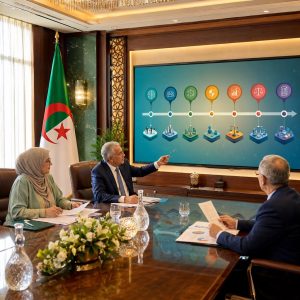
Algeria’s Multilateral Digital Platform in 2026
Algeria enters 2026 with an unusually strong institutional position in continental and global digital governance. The country holds the presidency of the ATU (African Telecommunications Union) Plenipotentiary Conference through 2026 — a four-year term that gives Algeria formal agenda-setting authority in continental telecommunications and digital economy discussions. Algeria joined the 50-in-5 digital public infrastructure campaign on April 2, 2026, committing to deploy interoperable digital identity, payment, and data-exchange systems under UNDP’s technical framework. And Minister of Post and Telecommunications Sid Ali Zerrouki holds a seat on the inaugural Africa AI Council, the 15-member body established by Smart Africa in November 2025 to lead continental AI transformation.
This combination of institutional positions — telecommunications leadership, digital infrastructure commitment, and AI council membership — gives Algeria a structural role in translating global AI governance frameworks into African policy. The UN Global Digital Compact, adopted at the Summit of the Future in New York on September 22, 2024, is the global framework that all three of these positions now connect to.
What the Global Digital Compact Actually Creates
The GDC is not a symbolic declaration. It established two operational mechanisms that will produce concrete governance outputs.
The first is the Independent International Scientific Panel on AI: 40 experts, gender-and-geography balanced, with co-chairs elected from both developed and developing countries, charged with assessing AI impacts and risks. Unlike the IPCC analogy it is sometimes compared to, this panel’s reports will feed directly into intergovernmental policy discussions — its evidence base will define what “safe AI” means for countries that lack the technical capacity for independent assessment. That includes most of Africa’s 54 nations.
The second is the Global Dialogue on AI Governance: a recurring forum convening governments, the private sector, and civil society. Its inaugural session is July 6-7, 2026, in Geneva, ahead of the AI for Good Global Summit (July 7-10). The Dialogue will not produce binding law — but it will shape the soft-law commitments, capacity-building requirements, and procurement standards that appear in African public-sector AI contracts 12-18 months after each session.
The African Union’s Continental AI Strategy, endorsed by the AU Executive Council in July 2024, explicitly aligns with GDC objectives. This linkage means that GDC governance provisions will flow into national AI policy frameworks across Africa through the AU strategy — not just through individual countries’ bilateral engagement with the UN process.
Advertisement
How Algeria Can Shape the Governance Architecture
Algeria’s institutional position gives it practical leverage in this process that most African countries do not have.
The ATU presidency provides a formal platform for tabling telecommunications-related AI governance provisions in continental discussions. Many of the AI governance questions most relevant to African populations — connectivity, digital identity, data sovereignty, local-language AI systems — intersect directly with telecommunications infrastructure. Algeria’s ATU leadership gives the country a natural role in connecting the GDC’s AI provisions to the infrastructure-layer policy discussions where African ministers are most engaged.
The Africa AI Council seat gives Minister Zerrouki direct participation in the institutional body tasked with translating the AU Continental AI Strategy into member-state implementation. According to Stimson Center analysis from 2026, only 16 of 54 African countries have published national AI strategies, and implementation capacity varies sharply. Algeria — with its national AI strategy under review since 2021 and active initiatives at ENSIA — is among the continent’s more advanced actors on AI policy maturity.
The 50-in-5 membership, while focused on digital public infrastructure rather than AI specifically, creates a credibility signal in GDC discussions. The GDC’s five objectives include both digital infrastructure and responsible AI — countries that are actively implementing digital public infrastructure (digital identity, payment systems, data exchange) demonstrate the governance seriousness that the GDC process rewards with technical assistance and co-leadership opportunities.
What This Means for Algerian Tech Firms and Public Institutions
1. Map your AI systems to GDC objectives before procurement specifications are written
Algerian tech firms exporting AI systems to other African markets — whether to government clients, development-finance-funded projects, or regional enterprise buyers — will increasingly encounter procurement specifications that reference GDC objectives and AU Continental AI Strategy provisions. This process has already begun in countries with active AI procurement programs (Rwanda, Kenya, Nigeria) and will spread as the GDC’s governance frameworks materialise from the Geneva dialogues.
Build a mapping between your product specifications and the GDC’s five core objectives: closing digital divides, expanding inclusive digital economies, fostering open digital spaces, equitable data governance, and responsible AI development. This exercise does not require external certification — it is an internal documentation discipline that pays dividends in African public-sector procurement. Government buyers across the continent are beginning to ask vendors to demonstrate GDC alignment; companies that have already done the mapping respond in hours rather than weeks.
2. Engage the July 2026 Geneva Global Dialogue through Algeria’s institutional representation
Algeria’s Ministry of Digital Transformation and Ministry of Post and Telecommunications should ensure active representation at the July 2026 Geneva sessions. The Global Dialogue’s inaugural session will signal which AI governance provisions developing-country governments are prioritising — these signals become procurement requirements 12-18 months later. Countries with active delegations in Geneva shape the agenda; countries that send observers get shaped by it.
For Algerian tech companies, the practical channel is through the relevant ministry or through Algeria’s participation in regional digital economy bodies that have consultative status in the UN process. Identify which Algerian association or chamber of commerce participates in the GDC’s private-sector consultation mechanism and ensure your firm’s operational experience — particularly AI system performance in low-bandwidth environments, Arabic-language system quality, and digital identity integration — feeds into the evidence base the Scientific Panel will draw on.
3. Use Algeria’s 50-in-5 digital public infrastructure as a showcase for GDC-aligned implementation
Algeria’s 50-in-5 commitment — digital identity (E-Tawki3), payments (29 million Algeria Post CCP accounts, 18 million Edahabia cards), and data exchange — is one of the more substantial DPI deployments in the Arab world. The GDC’s responsible AI provisions include using AI to improve public service delivery and close digital divides — exactly the use cases that Algeria’s digital public infrastructure enables.
Algerian public-sector AI applications built on top of this DPI stack (AI-assisted university placement, AI-driven administrative service routing, AI-enhanced payment fraud detection) can be documented and shared through the GDC capacity-building mechanism as implementation examples for other developing countries. This positions Algeria not just as a policy discussion participant but as a practitioner with deployable models — a status that carries more weight in UN governance processes than policy statements alone.
The Structural Lesson: Governance Leadership as Market Access
Algeria’s multilateral digital engagement is not merely diplomatic protocol. Governance leadership in the GDC process translates into market access across Africa through a specific mechanism: the AU Continental AI Strategy will define what “compliant AI” looks like for African public-sector procurement. Countries and companies that shaped that definition will find their own systems more naturally compliant. Countries that were absent from the process will face alignment costs when their firms try to sell into markets where GDC-AU governance standards apply.
Algeria has the institutional platform to be a shaper, not a norm-taker, in this process. The ATU presidency, the Africa AI Council seat, and the 50-in-5 membership are not separate initiatives — they are three components of a coherent multilateral positioning strategy. Activating that strategy through the July 2026 Geneva process is the most time-sensitive opportunity in Algeria’s current digital governance calendar.
Frequently Asked Questions
What is the difference between the Global Digital Compact and the African Union Continental AI Strategy?
The GDC is a global UN framework adopted by all UN member states, focused on digital cooperation and responsible AI at the international level. The AU Continental AI Strategy is the African continent’s implementation framework, adopted by AU member states in July 2024, with a people-centric and development-oriented focus. The two are explicitly aligned: the AU strategy directs member states to develop national AI frameworks consistent with GDC objectives. In practice, GDC governance provisions reach African countries through the AU strategy — which means influencing the AU strategy also shapes how GDC principles apply locally.
What is the 50-in-5 initiative and how does it connect to AI governance?
50-in-5 is a UNDP-backed campaign helping 50 countries build three core digital public infrastructure layers — digital identity, digital payments, and data exchange — within five years. Algeria joined on April 2, 2026, with E-Tawki3 digital identity and 29 million Algeria Post accounts as existing foundations. The connection to AI governance is practical: GDC-compliant AI applications in government services require the underlying DPI layer to function. Countries with robust DPI (like Algeria) can deploy GDC-aligned public-sector AI faster than countries building both layers simultaneously.
How can Algerian startups participate in the GDC process?
The GDC process has formal private-sector consultation mechanisms at the UN level. Algerian startups typically access these through industry associations or regional digital economy bodies with UN consultative status, or through the written-submission processes that the Independent Scientific Panel will open before publishing its assessments. More immediately, Algerian companies can ensure their operational experience (AI systems in low-bandwidth environments, Arabic-language AI quality, digital identity integration) reaches the Algerian government delegations who participate in Geneva — this requires proactive engagement with the Ministry of Digital Transformation’s international affairs office, not passive monitoring.
Sources & Further Reading
- Global Digital Compact — UN Pact for the Future Annex I
- Global Dialogue on AI Governance — United Nations
- Algeria joins 50-in-5 campaign for digital public infrastructure — AL24 News
- Africa AI Council unveiled — Smart Africa
- African Ministers Adopt Continental AI Strategy — African Union
- Priorities for Africa: AI Governance at the Global and National Level — Stimson Center
- AI Governance: Three Lessons from the Global Digital Compact — UN Foundation
🔗 Related Intelligence

AI Governance in Algeria: A Regional Policy Play

Algeria’s AI Strategy: Government Formally Adopts Plan and Launches Digital Portal

Algeria-UN Digital Partnership: What It Means for the Tech Ecosystem
Africa AI Council: Algeria’s Seat at the Table for Continental AI Governance