A Working AI Centre Opens, and a Strategy Becomes Tangible
On June 10, 2026, Algeria inaugurated its first national centre dedicated to artificial intelligence and virtual learning systems at the Scientific and Technological Hub “Abdelhafid Ihaddaden” in Sidi Abdellah, near Algiers. According to Tech In Africa’s report on the centre, the facility is built as a platform for remote and hybrid learning, giving educators, researchers, and students shared infrastructure to experiment with AI and digital education technologies across universities and research institutions.
The centre matters less as a building than as a signal. Algeria’s National AI Strategy 2024-2030, announced on September 15, 2024 at the 3rd African Startups Conference in Algiers, has spent its first eighteen months as a framework on paper. In 2026 the framework is acquiring institutions, budgets, and dates — the elements that turn a vision into a governance roadmap organizations can actually plan around.
For any Algerian decision-maker — a university dean, a startup founder, a private-sector CIO, or a public-sector digitization lead — the question is no longer “does Algeria have an AI strategy?” It is “how do the moving parts fit together, and where does my organization plug in?” This article maps the strategy’s structure, the institutions now driving it, the concrete 2026 milestones, and the practical steps to take while the roadmap is still forming.
The Six Pillars of the Strategy
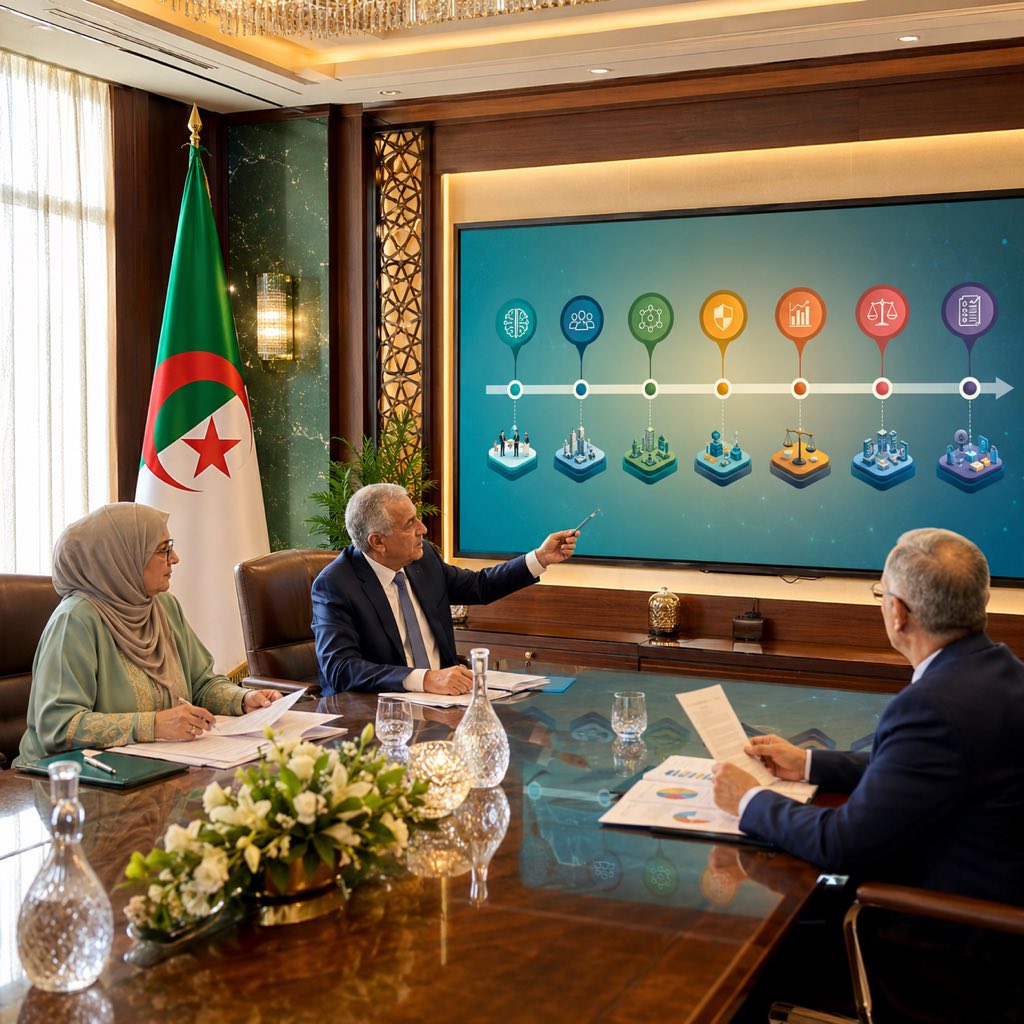
The National AI Strategy is built on six strategic pillars that together cover the full lifecycle from research to deployment. As the dzair-ai.org strategy briefing lays them out, the pillars are:
- Strengthening scientific research in artificial intelligence
- Creating a favourable environment for AI innovation and entrepreneurship
- Developing local capacities through education and training
- Supporting startups to deliver AI-driven solutions for businesses
- Ensuring reliable data centres and digital infrastructure
- Defining priority sectors for AI deployment — agriculture, health, industry, and energy
The framing is deliberate. The stated objective, voiced by Professor Merouane Debbah, is to develop locally-made AI solutions and “reduce dependence on foreign technologies” while positioning Algeria as a technology leader across Africa and the Mediterranean. That sovereignty-first orientation runs through every pillar: research capacity feeds local talent, local talent feeds startups, startups serve priority national sectors, and domestic data centres keep the loop running on Algerian infrastructure.
What makes 2026 the inflection point is that each pillar now has a visible anchor. Research and skills are anchored by the new AI centre and the National School of Artificial Intelligence. Startups are anchored by a dedicated fund and a national startup target. Infrastructure and public-sector deployment are anchored by the Dzair digital services portal. The pillars are no longer abstractions — they map onto things you can name, visit, and apply to.
Institutions Driving Implementation
A strategy is only as durable as the bodies that own it. Algeria’s AI governance now runs through a layered institutional structure.
At the apex sits the Scientific Council for Artificial Intelligence, formed in 2023 as the consultative body that authored and oversees the national strategy. It operates under the joint supervision of the Ministry of Higher Education and Scientific Research, led by Kamel Baddari, and the Ministry of Knowledge Economy, Startups and Micro-Enterprises, led by Noureddine Ouadah. This pairing is intentional: it links the research-and-talent engine to the entrepreneurship-and-commercialization engine inside the same governance frame.
The academic foundation behind the council is substantial. Algeria reports over 57,000 computer science students and 74 master’s programmes in AI across 52 universities, and ranks among Africa’s top five for recognized scientific publications. The National School of Artificial Intelligence and the new AI centre give this talent pipeline a dedicated home.
On the public-service side, the High Commission for Digitalisation, led by Meriem Benmouloud, is building the citizen-facing layer. On May 25, 2026, Prime Minister Sifi Ghrieb chaired a government meeting that reviewed strategy progress and approved the launch of the Dzair Digital Services portal — a single gateway delivering 52 public services spanning civil registry, justice, health, and land registry, with an integrated digital identity system and electronic wallet. The portal passed cybersecurity testing by the Information Systems Security Agency and ran a pilot across seven ministerial sectors with more than 1,700 participants in March and April 2026.
Advertisement
The Funding and the Startup Target
The strategy’s economic ambition is anchored by a concrete number: 20,000 new startups by 2029. Today, Algeria counts more than 7,800 registered startups, with roughly 2,300 holding the formal “Startup Label” — the distinction that unlocks state funding, tax exemptions, and procurement preferences. The 20,000 target frames the gap as a build-out opportunity, and the government is widening the financing channels to close it.
The clearest financial instrument so far is the $11 million (1.5 billion dinar) fund for AI, cybersecurity, and robotics startups, established by state telecom Algérie Télécom and unveiled at the CTO Forum by Minister of Post and Telecommunications Sid Ali Zerrouki. It is paired with a growing roster of specialized sectoral funds designed to broaden the sources of startup capital. The market the strategy is positioning these startups to capture is real: Algeria’s AI market is projected to grow from $498.9 million in 2025 to $1.69 billion by 2030, a 27.67% compound annual growth rate, while the wider ICT sector is targeted to contribute around 7% of GDP by 2027.
What Organizations Should Do Now
The roadmap is taking shape while there is still room to position early. Here is how different Algerian organizations can act on it in 2026.
1. Map your organization to a specific pillar before chasing programs
Each of the six pillars has a different owner, a different instrument, and a different door. A university research lab should orient toward the Scientific Council and the AI centre; a startup founder toward the Startup Label, the Algérie Télécom fund, and the AI and cybersecurity cluster; a public-sector CIO toward the Dzair portal and the High Commission for Digitalisation. Identify which pillar your work actually serves, then pursue the instruments attached to that pillar rather than applying broadly and diluting your case.
2. Secure the Startup Label early to unlock the financing pipeline
The Startup Label is the gate that opens state funding, tax exemptions, and procurement preferences — and the $11 million AI fund and the broader sectoral funds flow through that channel. With only about 2,300 of 7,800-plus registered startups currently labelled, the field is open. Founders building in AI, cybersecurity, robotics, or the priority sectors of agriculture, health, industry, and energy should treat the Label application as the first formal step, not an afterthought.
3. Build talent and data-residency plans around the local infrastructure
The strategy’s sovereignty orientation means the advantage accrues to organizations that anchor on Algerian infrastructure and talent. Universities and employers can plug into the 74 AI master’s programmes and the new AI centre to build pipelines, while CIOs planning AI workloads should factor in domestic data centres and the Dzair digital identity layer. Aligning your roadmap with the local stack now positions you for the procurement preferences and ecosystem support the strategy is designed to channel toward locally-grounded players.
The 2026-2027 Horizon: What to Watch For
The next eighteen months will determine how much of the roadmap becomes routine. The Dzair portal’s rollout of its 52 services across the seven piloted ministerial sectors is the most visible test — a working national services gateway with integrated digital identity would give every other pillar a shared backbone. Watch, too, for the cooperation deal that, beginning September 2026, is set to give vocational trainees instruction in cloud computing, cybersecurity, and AI, culminating in a jointly issued diploma; it signals how the skills pillar scales beyond the universities into vocational training.
The deeper story is coordination. Algeria’s distinction in 2026 is not that it has launched an AI centre, a fund, and a portal — many countries have one of those. It is that all three now sit under a single strategy with a named council, named ministries, and named milestones running to 2030. For Algerian organizations, that coherence is the opportunity: a roadmap with this many visible anchors is one you can plan a multi-year strategy against. The work now is to read the map, find your pillar, and move while the institutions are still being built around you.
Frequently Asked Questions
What are the main pillars of Algeria’s National AI Strategy 2024-2030?
The strategy rests on six pillars: strengthening scientific research, creating a favourable innovation environment, developing local capacities through training, supporting startups, ensuring reliable data centres and infrastructure, and defining priority sectors — agriculture, health, industry, and energy. Together they cover the full path from research to deployment, with a consistent focus on locally-made AI solutions.
What is the $11 million AI fund and who runs it?
State telecom Algérie Télécom established a $11 million (1.5 billion dinar) fund for AI, cybersecurity, and robotics startups, unveiled at the CTO Forum by the Minister of Post and Telecommunications. It is one of a growing set of sectoral funds supporting the national goal of reaching 20,000 startups by 2029, and access flows through the formal Startup Label.
What concrete milestones happened in 2026?
In 2026, Algeria opened its first national AI and virtual learning centre at the Abdelhafid Ihaddaden hub on June 10, reviewed strategy progress at a May 25 government meeting, and approved the Dzair Digital Services portal — a gateway of 52 public services with integrated digital identity, piloted across seven ministerial sectors with over 1,700 participants.
Sources & Further Reading
- Further Reading
- Algeria Announces National AI Strategy 2024-2030 — DzairAI
- Algeria Opens Its First National AI and Virtual Learning Centre, Eyes 20,000 Startups by 2029 — Tech In Africa
- Algeria Reviews National AI Strategy Progress and Approves Dzair Digital Services Portal — iAfrica
- Algeria’s Big AI Bet: Algérie Télécom Establishes USD 11M AI Fund — WAYA
- Algeria Launches National AI Training Programme — Middle East AI News
🔗 Related Intelligence
Algeria’s National AI Strategy: What the 2025-2030 Roadmap Really Means for Tech Companies

AI Governance in Algeria: A Regional Policy Play

Algeria’s 2025-2030 AI Strategy: Implementation Checkpoint at 16 Months

Algeria’s National AI Strategy: 500 Digital Projects and the Implementation Reality in 2026