A Hiring Mandate Meets a New Way to Train
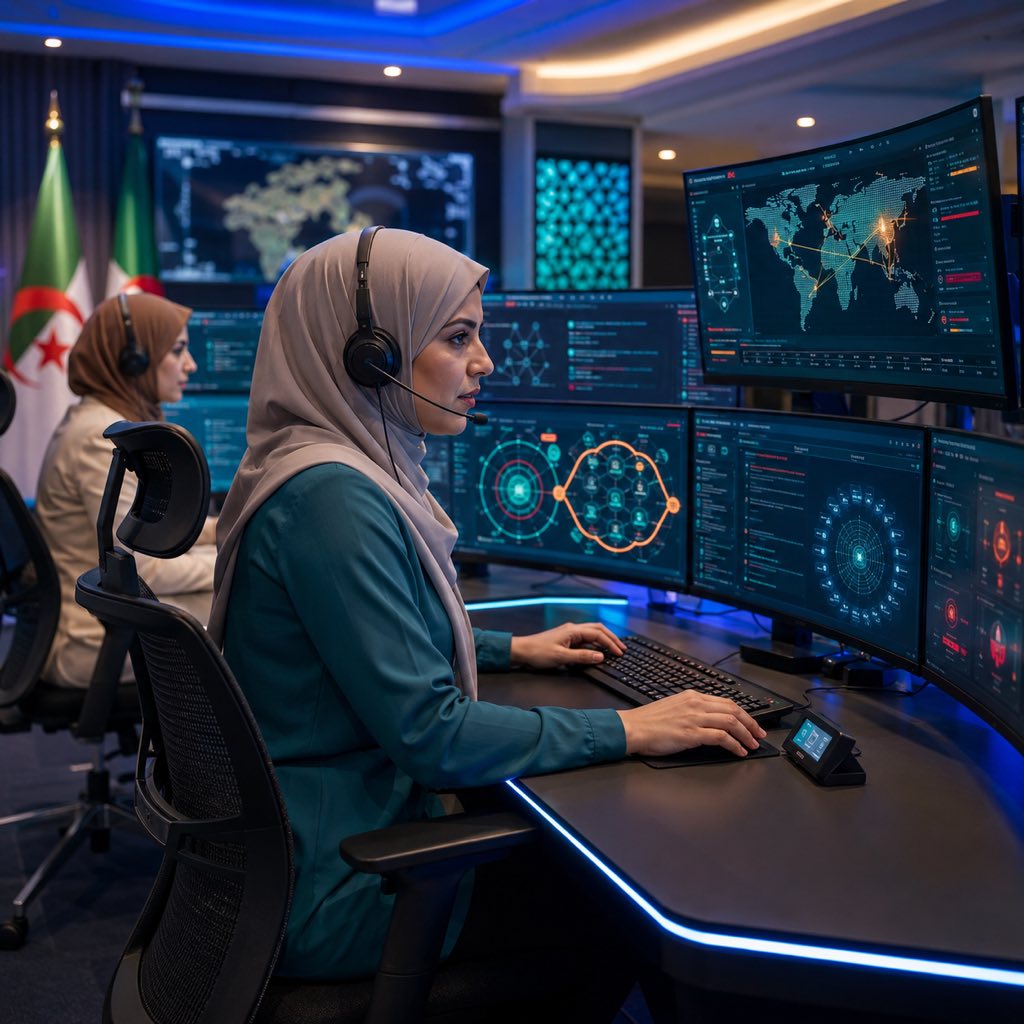
Algeria’s cybersecurity workforce strategy now has two engines turning together. The first is a clear, growing demand signal: Presidential Decree No. 26-07, issued January 7, 2026 and published in the Official Gazette on January 21, 2026, requires every public institution to establish a dedicated cybersecurity unit reporting directly to its leadership, separate from ordinary IT management. Those units do real operational work — continuous monitoring, risk mapping, incident reporting, audits — and that work needs Security Operations Center (SOC) analysts who can read alerts, hunt threats, and respond under pressure on day one.
The second engine is the training model being built to meet that demand. Rather than relying on lecture-hall theory alone, Algeria is investing in hands-on, simulation-based learning anchored by the École Nationale Supérieure de Cybersécurité (ENCS) at Sidi Abdellah and a fast-expanding vocational layer. The shift matters because SOC work is a practitioner’s craft. A graduate who has only read about phishing triage behaves very differently in a live alert queue than one who has spent dozens of hours inside a realistic SOC simulation. That practical environment — a cyber range — is becoming the centerpiece of how the next generation of Algerian defenders is trained.
What a Cyber Range Actually Does for a Trainee
A cyber range is best understood as a flight simulator for security professionals. As one 2026 industry guide to cyber range platforms describes it, it is “a hands-on simulated environment where security practitioners do real work — investigate alerts, analyze malware, hunt threats, respond to incidents — against scripted or live attack scenarios.” The trainee is not memorizing definitions; they are working a realistic incident inside a safe sandbox that mirrors the tools, telemetry, and tempo of a genuine SOC.
The payoff is measurable. The same industry research points to mean-time-to-respond (MTTR) improvements of 30-60% after sustained cyber range training, driven by pattern recognition — trained analysts meet fewer novel situations and apply muscle-memory workflows during real incidents. Modern ranges also fit how operations teams actually work: browser-based modules let analysts complete an exercise in a 30-60 minute window, and team-versus-team “battle” formats put a defending blue team against a live or scripted red team, turning a class into an operational rehearsal.
For Algeria, this format solves a long-standing gap in technical education. Free, browser-based ranges such as CyberExplorer let learners practice SOC analyst skills, incident response, and threat hunting across phishing, malware, ransomware, DDoS, privilege escalation, and lateral movement — the exact attack types facing Algerian institutions. Pairing accessible simulation tools with ENCS infrastructure means a trainee can move from textbook to live-fire practice without ever touching a production system.
The ENCS-and-ASSI Foundation
The strength of Algeria’s model is that the school does not train in isolation. ENCS operates in partnership with the Information Systems Security Agency (ASSI), which provides students with access to its resources and infrastructure. ASSI is the national operational authority for information-systems security; it works with real defensive telemetry and the threat patterns that actually hit Algerian public bodies. Training against that material — rather than generic textbook scenarios — is what produces analysts ready to staff a unit instead of analysts who still need months of on-the-job retraining.
This partnership sits inside a broader, deliberately layered framework. As TechAfrica News reported in January 2026, Algeria’s cybersecurity architecture is built into the 2025-2030 digital strategy, with ASSI operating under the Ministry of National Defense to implement national policy and defend critical infrastructure, and the National Council for Information Systems Security reporting to the President. Decree 26-07 extends that architecture from policy to people: it is the step that turns a national strategy into thousands of working SOC seats across ministries, public banks, hospitals, utilities, and universities.
Advertisement
The Vocational Layer Multiplies the Output
ENCS is the engineer and researcher track. Beneath it, Algeria is rapidly building the operator track that supplies the bulk of front-line analysts. The Ministry of Vocational Training and Education has moved cybersecurity to the front of its agenda: at a February 2026 national conference held with ASSI at the National Army Club in Beni Mesous, the ministry launched certificate-oriented qualification programs built on a Competencies Approach methodology, integrating smart classrooms and remote configuration tooling to broaden access.
The scale here is significant. Algeria’s 2026 vocational intake includes roughly 285,000 new training places, with cybersecurity certification tracks among the priorities. Complementing the formal centers, the Ministry of Post and Telecommunications has been rolling out Skills Centers — beginning in Sétif and expanding to Annaba, Chlef, and Oran — offering free short-term training in cybersecurity, AI, cloud, and IoT, with workshops led by Algerian and international experts. Certification pathways are aligned with internationally recognized standards including ISO 27001, CISSP, and CEH, alongside Capture the Flag competition tracks that double as live-skill assessments. Engineers from ENCS plus technicians from the vocational network is exactly the two-track structure that mature national cybersecurity workforces are built on.
What Algerian Security Teams and Training Centers Should Do
The demand created by Decree 26-07 is immediate, and the supply pipeline is being built right now. Institutions and trainers that align early will fill their SOC seats faster.
1. Make cyber range hours a hard requirement in every hiring and training plan
Treat simulator time the way aviation treats flight hours. When staffing a Decree 26-07 unit, prioritize candidates who can show logged cyber range exercises — phishing triage, ransomware containment, threat hunting — over those with certificates alone. For internal upskilling, allocate every analyst a recurring 30-60 minute range block per week; the MTTR improvements of 30-60% from sustained training compound quickly and translate directly into faster incident response on live systems.
2. Build a partnership with ENCS and the local vocational centers before you need to hire
The institutions that secure analyst talent first will be those with a relationship already in place. Reach out to ENCS at Sidi Abdellah and to the nearest Skills Center to offer internships, real (sanitized) case studies, and mentorship. This gives your future hires range practice against scenarios that mirror your environment, and gives you first look at the strongest graduates as the 2026 vocational cohort of roughly 285,000 places moves through the system.
3. Map roles to the competency framework, not just to certifications
The new programs are built on a Competencies Approach — define your unit’s roles (Tier 1 alert triage, Tier 2 investigation, threat hunting, incident response) against demonstrable skills, then recruit and develop to that map. Stack internationally recognized credentials such as ISO 27001, CISSP, and CEH on top of proven range performance, and use Capture the Flag results as a fast, practical screen. This produces a unit where every seat has a clear skills profile and a clear growth path.
Building a Sovereign Cyber Defense Capability
What is taking shape in Algeria is more than a hiring drive — it is the deliberate construction of a self-sustaining defensive capability. A decree creates the demand, a national school and a vocational network create the supply, a cyber range turns theory into reflexes, and ASSI grounds all of it in real operational reality. Each piece reinforces the others, and together they move the country from importing cybersecurity expertise toward growing it at home.
The advantage of this design is durability. Skills built on simulation and real telemetry do not evaporate when a vendor contract ends or a foreign consultant leaves; they stay inside Algerian institutions and compound year over year. As the 2026 cohorts move from training centers into the SOC seats that Decree 26-07 calls for, Algeria is laying the foundation for a defensive workforce that is genuinely its own — measured not in certificates issued, but in analysts who can sit down at a live alert queue and know exactly what to do.
Frequently Asked Questions
What is a cyber range and why does it matter for SOC analyst training?
A cyber range is a hands-on simulated environment where trainees do real defensive work — investigating alerts, analyzing malware, hunting threats, and responding to incidents — against scripted or live attack scenarios in a safe sandbox. It matters because SOC work is a practitioner’s craft: industry research links sustained cyber range training to mean-time-to-respond improvements of 30-60%, because analysts build pattern recognition and muscle-memory workflows they can apply during real incidents.
How does Decree 26-07 connect to cybersecurity training in Algeria?
Presidential Decree 26-07, published in Algeria’s Official Gazette on January 21, 2026, requires every public institution to establish a dedicated cybersecurity unit reporting directly to its leadership. These units need SOC analysts to staff them, which creates large, immediate demand. The École Nationale Supérieure de Cybersécurité (ENCS) and the expanding vocational training network are the supply side built to produce those analysts.
What training pathways are available for aspiring SOC analysts in Algeria?
Algeria offers a two-track model. The engineering and research track runs through the École Nationale Supérieure de Cybersécurité (ENCS) at Sidi Abdellah, which partners with ASSI for access to real infrastructure. The operator track runs through vocational training — roughly 285,000 new places in 2026, certificate programs built on a Competencies Approach, and free Skills Centers in cities including Sétif, Annaba, Chlef, and Oran — with pathways aligned to ISO 27001, CISSP, and CEH.
Sources & Further Reading
- Further Reading
- Algeria Orders Cybersecurity Units in Public Sector Amid Surge in Cyberattacks — Ecofin Agency
- Algeria Expands Vocational Training to Meet Growing Cybersecurity Demand — TechAfrica News
- Algeria Strengthens Cybersecurity Framework to Protect National Infrastructure — TechAfrica News
- Top 5 Cyber Range and Hands-On Training Platforms for 2026 — Deepak Gupta
- Cybersecurity Attack & Defense Explorer: Free SOC Analyst Training — CyberExplorer
🔗 Related Intelligence

From DZ-CERT to the Private Sector: Building Algeria’s SOC Analyst Talent Pipeline
The Global Cybersecurity Skills Crisis: What Algeria Must Teach Now

Algeria’s RSSI Push: Inside the National CISO Training Wave at ENSCS

Algeria Cybersecurity Certifications: From New National School to CISSP Pipeline