What Algérie Télécom Brought Home From Geneva
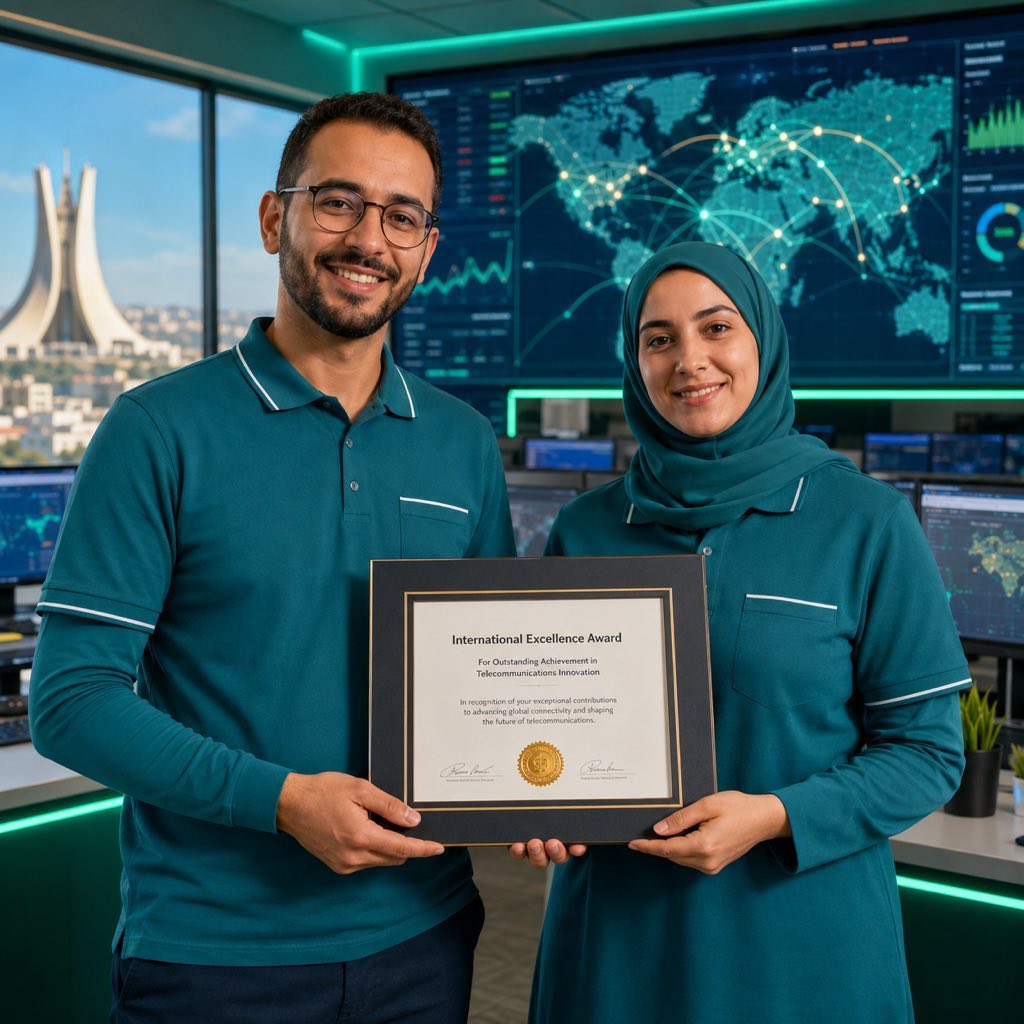
At the World Summit on the Information Society (WSIS) Forum — held in Geneva from July 6 to 10, 2026 — Algérie Télécom’s “AI for Digital Inclusion” project, known as AIDI, received an ITU Certificate of Recognition in the Information and Communication Technology (ICT) Infrastructure category. Algérie Presse Service reported the award was presented on July 9, and Algerian Radio confirmed the certificate carries the signature of ITU Secretary-General Doreen Bogdan-Martin. Minister of Post and Telecommunications Sid Ali Zerrouki attended the ceremony.
The WSIS Prizes are the International Telecommunication Union’s annual recognition of projects that advance the UN Sustainable Development Goals through digital technology. Selection is a two-stage process: a public online vote — which closed on May 5, 2026 — narrows the field to the top five projects per category, after which an ITU expert committee reviews finalists and confirms the honorees announced during the Forum. Coming through that funnel places AIDI among an internationally vetted group of digital-development initiatives rather than a purely national showcase.
AIDI was not Algeria’s only entry. According to a notice published by Abbes Laghrour University Khenchela, four Algerian projects were nominated for the WSIS Prizes 2026: DigiTrust Network (in the ICT-for-development governance category), AIDI (ICT infrastructure), an AI-Driven Building Footprint tool for FTTH planning (access to information and knowledge), and DZ-CheckNews (media). That spread — governance, infrastructure, network planning, and media integrity — signals that AI experimentation inside Algeria’s public and telecom institutions has moved well beyond a single flagship.
Why AIDI’s Data-First Approach Matters
The value of AIDI is not that it is “an AI project” — those are now common — but what it points the AI at. The initiative applies machine learning to citizen-generated data to identify where digital inclusion gaps persist and to support evidence-based policy for equitable digital participation. In plain terms, instead of guessing where connectivity, affordability, or digital-skills shortfalls are worst, AIDI builds a measurable map of them.
That matters because Algeria’s connectivity story in 2026 is one of fast averages hiding uneven realities. The country had 37.8 million internet users at the end of 2025 — a 79.5% penetration rate, according to DataReportal’s Digital 2026 Algeria report. Fiber is scaling quickly too: Algeria passed three million FTTH households in February 2026, up from roughly two million subscribers a year earlier. But national averages say little about the roughly 24% of Algerians in rural and remote areas — from the Atlas foothills to Saharan communities — where a household may still rely on a 3G signal delivering 1–2 Mbps while an urban neighbor streams over a 100+ Mbps fiber line.
Closing that last stretch is precisely where data-driven targeting pays off. Algérie Télécom has already leaned in this direction operationally: in mid-2025 it launched a survey to map fiber network gaps and prioritize under-served zones for its 2026 rollout plan. AIDI is the analytical layer that can make such prioritization systematic — ranking areas by inclusion deficit rather than by whichever request arrives first. An ITU nod to that model is, in effect, external validation that Algeria is building connectivity strategy on evidence.
Advertisement
What Algeria’s Digital Teams Should Do Next
An international certificate is a headline; the follow-through is where value is created or lost. For public-sector IT directors, telecom planners, and startup founders watching this win, here is how to convert AIDI’s recognition into momentum.
1. Treat AIDI as a reusable data asset, not a one-off award submission
The instinct after a prize is to celebrate and move on. Resist it. AIDI’s core deliverable — a machine-learning model that ranks localities by digital-inclusion deficit against citizen-generated data — is an asset that other agencies can query. Public-sector teams planning e-government rollouts, digital-literacy programs, or subsidy schemes should ask whether AIDI’s inclusion maps can feed their own targeting, rather than commissioning parallel surveys. The four separate WSIS entries this year suggest institutions are still building AI in silos; the higher-leverage move is to share the underlying datasets and models across ministries.
2. Publish the methodology so the model can be trusted and audited
Evidence-based policy only works when the evidence is inspectable. If AIDI ranks a wilaya as under-served, the officials acting on that ranking — and the citizens affected — need to understand which signals drove it. Algérie Télécom and its partners should document AIDI’s data sources, model features, and known limitations in an accessible technical note. This is not bureaucratic overhead: it is what separates a defensible planning tool from a black box. It also lets universities and startups build on the work rather than reverse-engineer it, multiplying the return on a single model.
3. Anchor procurement and rollout budgets to inclusion metrics, not just coverage counts
“Households passed by fiber” is the metric everyone reports, but it rewards the easiest connections. Digital teams should push for at least one AIDI-derived inclusion indicator — a deficit score, an affordability gap, or a skills-access measure — to sit alongside coverage counts in 2026–2027 planning documents and vendor contracts. When a rollout is judged partly on whether it narrows the measured inclusion gap, budgets naturally tilt toward the rural and remote zones that raw coverage counts tend to skip. The ITU recognition gives internal champions the external credibility to argue for exactly this shift.
4. Use the WSIS profile to recruit and retain AI talent inside public institutions
Algeria’s hardest constraint in public-sector AI is rarely the algorithm — it is keeping the people who can build and maintain it. A visible, internationally recognized project is a recruiting instrument. Teams should point to AIDI when hiring data scientists and ML engineers who might otherwise default to private tech or the diaspora, and should create defined career paths so the specialists who built AIDI are retained to iterate on version two. A prize that leads to a talent exodus six months later is a missed opportunity; one that anchors a standing analytics team compounds for years.
Where This Fits in Algeria’s 2026 Digital Push
AIDI’s Geneva recognition lands in the middle of Algeria’s most active connectivity year to date — three million fiber homes, a nationwide gap-mapping survey, and a policy emphasis on reaching communities outside the FTTH footprint. Read together, these are not isolated announcements but the outline of a strategy that is starting to measure itself. The significance of an ITU certificate is less the trophy than the signal it sends internally: that building digital policy on data, and pointing AI at the country’s own inclusion gaps, is an approach worth institutionalizing.
The opportunity now is to make AIDI durable. The projects that change outcomes are the ones that outlive their launch ceremonies — shared across agencies, documented for scrutiny, wired into budgets, and staffed by teams that stay. If Algérie Télécom and its public-sector partners treat this recognition as a foundation rather than a finish line, AIDI could become the template for how a mid-income country closes its digital divide deliberately rather than incidentally. That would be the version of this story worth telling at the next WSIS Forum.
Frequently Asked Questions
What is Algérie Télécom’s AIDI project?
AIDI (“AI for Digital Inclusion”) is an Algérie Télécom initiative that applies artificial intelligence and citizen-generated data to identify where digital inclusion gaps persist and to support evidence-based policy for equitable digital participation. It won an ITU Certificate of Recognition in the ICT Infrastructure category at the WSIS Forum in Geneva on July 9, 2026.
What are the WSIS Prizes and how are winners chosen?
The WSIS Prizes are the International Telecommunication Union’s annual recognition of digital projects that advance the UN Sustainable Development Goals. Selection runs in two stages: a public online vote (which closed May 5, 2026) narrows each category to its top five projects, then an ITU expert committee reviews the finalists and confirms the honorees announced during the Forum.
Why does AIDI matter for Algeria’s digital divide?
Algeria reached 79.5% internet penetration and passed three million fiber households by early 2026, but roughly 24% of the population in rural and remote areas still faces far weaker connectivity. AIDI turns closing that gap into a measurable target by ranking areas by inclusion deficit, letting planners prioritize the zones that raw coverage counts tend to skip.
Sources & Further Reading
- Algérie Télécom wins international award at WSIS Forum — Algérie Presse Service
- Algeria’s Algérie Télécom Wins ITU Recognition for AI-Driven Digital Inclusion Initiative — DzairTube
- WSIS Forum: Algérie Télécom Wins International Award in Geneva — Algerian Radio
- Algeria’s four nominated projects for the WSIS Prizes 2026 — Abbes Laghrour University Khenchela
- Digital 2026: Algeria — DataReportal
- Algeria reaches 3 million households connected to fiber-optic internet — SAMENA Daily News
- Algérie Télécom Launches Survey to Map Fiber Network Gaps — Ecofin Agency
🔗 Related Intelligence

Algerie Telecom’s $11M AI Fund: How Algerian Startups Can Qualify in 2026

Algérie Télécom’s 1.5 Billion Dinar AI Fund: How Algerian Startups Can Access the $11M Pool

Free 100 Mbps for Algeria: What the FTTH Speed Upgrade Unlocks for Cloud

Algerie Telecom’s 1.5B DZD Fund One Year In: Deployment Signals and the Labeled-Startup Pipeline