The National Instant Switch That Moves Money in Seconds
When someone in Algiers sends money to a relative in Oran and it lands before the call ends, that speed is not the bank’s app — it is the rail underneath it. In early 2025, SATIM, the country’s only interbank electronic-payment operator, was upgraded with a national instant switch that moves beyond the traditional card-and-ATM model to support immediate account-to-account transfers between any two banks or Algérie Poste accounts. According to ProgressSoft, which connected institutions to the switch through its Mobile Payments Platform, the rail supports person-to-person, person-to-business and business-to-person payments, QR-code scanning, transfers by alias or account number, instant mobile top-ups from a bank account, and a “Request to Pay” flow that lets a payee pull an approved transfer.
This is a different layer of the payment stack from the card network most Algerians already know. A card transaction authorizes against a line of credit or a stored balance and settles later in batch; an instant transfer moves cleared funds directly between two accounts and confirms in seconds, any hour of any day. That distinction matters because it removes the float, the settlement delay and the merchant’s wait for money — the frictions that keep small traders anchored to cash. SATIM founded this network in 1995 at the initiative of the banking community, and it now interconnects 18 banks plus Algérie Poste, giving the instant rail a ready-made national footprint the moment banks switch it on.
DZ Mob Pay and the Interoperability Milestone
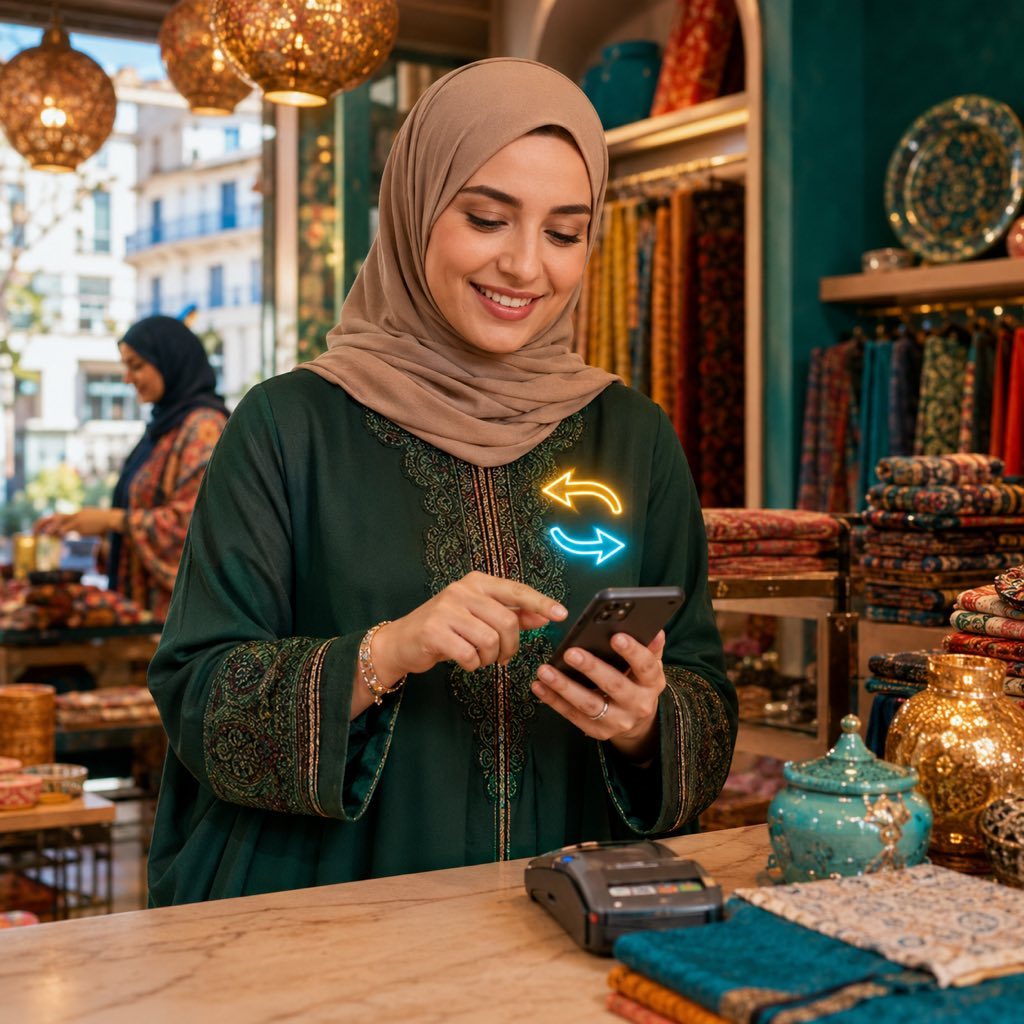
The consumer face of the instant switch is DZ Mob Pay, the mobile payment system introduced in January 2025 by ABEF, the association of banks and financial institutions. As AL24 News reported at launch, it lets citizens pay merchants and transfer money by smartphone, with SATIM guaranteeing that a transfer initiated on one bank’s app arrives cleanly in another bank’s — or Algérie Poste’s — account. The interoperability foundation was laid earlier, when SATIM’s Switch Mobile platform went live in June 2024; DZ Mob Pay is what rides on top of it.
Adoption in year one was modest but real, and the shape of it is instructive. By December 2025, DZ Mob Pay counted 95,014 personal accounts and 14,283 merchant accounts, and had processed 44,369 P2P transfers and 12,682 QR-code transactions. Seven banks plus Algérie Poste were live at the start — BNA, CPA, BDL, BEA, CNEP-Banque, AGB and Al Salam Bank — and Algerie Eco reports the interoperability network is set to widen to 15 banks in 2026. Gulf Bank Algérie was among the first to leverage the capability. Those numbers are small against a country of more than 40 million mobile users, but the trajectory — doubling the connected-bank count in a single year — is the signal to watch, because interoperability is what turns a bank-by-bank app into a genuine national rail.
Advertisement
Why Real-Time Rails Change the Cashless Math
The macro backdrop makes the case for why instant matters. According to GIE Monétique figures relayed by Algeria Invest, electronic payments in Algeria reached 939 billion dinars in 2025, up 46% in a single year, with online payments alone generating more than 145 billion dinars across over 27 million transactions. The card base kept pace: We Are Tech Africa notes Algeria passed 22 million payment cards — roughly 17.6 million Edahabia and 4.2 million CIB — while the terminal fleet climbed past 104,000 units from about 68,000 at the end of 2024.
Yet cards and terminals mostly digitize the retail checkout. Real-time transfers digitize everything the terminal never touched: paying a plumber, splitting a bill, settling a supplier, sending money home. As Transfi’s overview of Algeria’s payment rails observes, cash has always been the default in the informal economy, and electronic payment remains small relative to that base — which is precisely the room the instant switch is built to capture. A merchant who receives cleared funds in seconds has no reason to prefer cash for its speed; a household that can send money instantly at no branch visit has one fewer reason to withdraw. Every account brought onto the rail raises the velocity of the whole system, and velocity — not just card count — is what a cashless economy actually runs on.
What Algerian Banks, Merchants and Fintechs Should Do
The instant switch is live, but the value only materializes if the institutions around it move at the same pace. Here is where banks, merchants and fintechs should focus.
1. Banks: turn on instant transfers as a headline feature, not a back-office upgrade
Do not treat instant payment as a plumbing change buried in the app. Banks connected to SATIM should surface real-time P2P and P2B transfers as a named, front-and-center capability, because that is the feature that pulls a cash user across for the first time. With the interoperability network expanding toward 15 banks in 2026, the competitive window is now: the bank whose customers can instantly reach any other bank’s account — not just its own — wins the everyday-transfer habit. Prioritize onboarding to DZ Mob Pay’s alias and account-number flows, and market the “arrives in seconds, any bank, any hour” promise directly. The 44,369 first-year P2P transfers are a floor, not a ceiling.
2. Merchants: adopt QR acceptance alongside the terminal, and promote instant settlement
With the terminal fleet past 104,000 units but most retail still cash-only, the opportunity sits in the unequipped middle of the market. Merchants should add DZ Mob Pay QR acceptance next to — or instead of — a physical terminal, because a printed QR code costs nothing and settles funds in seconds without a card being present. The concrete step: register a merchant account (14,283 existed by December 2025, a number that should be far higher), display the QR at the point of sale, and tell customers the payment clears immediately. A bakery or pharmacy that visibly accepts instant mobile payment removes friction for the 22 million cardholders — and the many more phone owners — who would rather not carry cash.
3. Fintechs: build on the interoperable instant rail instead of around it
The historical pattern in Algerian fintech was to route around gaps with custom, bilateral bank integrations. The national instant switch changes that equation. Fintechs should design products that consume SATIM’s real-time interfaces directly — instant transfers, Request-to-Pay, QR and alias resolution — rather than maintaining brittle one-off links to individual banks. This is also the path that keeps a product license-ready: building on the certified switch aligns with the Bank of Algeria’s payment-services framework. Do not re-engineer a parallel rail; the leverage is in composing new experiences — payroll disbursement, marketplace payouts, bill aggregation — on top of a shared, interoperable backbone.
4. Public-sector billers: route utility and administrative payments onto the instant rail
Public services and utility billing were among the largest drivers of the 2025 e-payment surge, and instant settlement compounds that advantage. Agencies collecting for water, electricity, telecom or administrative fees should offer DZ Mob Pay and instant-transfer options at every payment point, because real-time confirmation eliminates the reconciliation lag that makes cash counters necessary. The action is to publish a payment alias or QR for each service and confirm receipt instantly to the payer — closing the loop that currently sends citizens to a physical window. Every public biller that goes instant normalizes the rail for millions of routine, recurring transactions.
Where This Fits in Algeria’s 2026 Cashless Trajectory
The instant switch is not a single product launch; it is the moment Algeria’s payment system gained a second gear. For a decade the cashless story was told in cards and terminals — a stock of plastic and a count of POS machines. Real-time interbank transfers reframe it as a story of flow: how fast cleared money can move between any two accounts, and how many of the country’s everyday, person-to-person and person-to-business payments migrate off cash as a result. The 939-billion-dinar figure and the 46% jump show the demand is already there; the instant rail is what lets that demand keep compounding without a card or a terminal in the loop.
The near-term test is interoperability breadth. Seven banks at launch and a path to 15 in 2026 is progress, but the rail only reaches its potential when a transfer from any account to any other is as unremarkable as a phone call. If banks market it, merchants accept it, fintechs build on it and public billers route through it, the instant switch becomes the connective tissue of a genuinely cashless everyday economy — and the next stat to watch will not be the number of cards, but the share of payments that never needed one.
Frequently Asked Questions
What is Algeria’s national instant payment switch?
It is an upgrade to SATIM, the country’s interbank electronic-payment operator, that settles account-to-account transfers in seconds between any two banks or Algérie Poste accounts. Introduced in early 2025, it supports P2P, P2B and B2P payments, QR codes, transfers by alias or account number, instant top-ups and a Request-to-Pay flow — moving beyond the traditional card-and-ATM model to real-time settlement.
How is DZ Mob Pay different from a CIB or Edahabia card?
A card authorizes against a balance or credit line and settles later in batch, mainly at a retail checkout. DZ Mob Pay uses the instant rail to move cleared funds directly between accounts in seconds, any hour, and covers payments cards never touched — sending money to a person, paying a supplier or splitting a bill. By December 2025 it had 95,014 personal accounts and 14,283 merchant accounts across seven banks plus Algérie Poste.
Why does real-time settlement matter for Algeria’s cashless shift?
Cash is still the default in much of the economy, and its main advantage is instant, final payment. Real-time transfers remove that edge by clearing funds in seconds with no float or branch visit. With electronic payments up 46% to 939 billion dinars in 2025 and interoperability set to reach 15 banks in 2026, instant rails let digital payment compound without needing a card or a terminal in the loop.
Sources & Further Reading
- ProgressSoft Accelerates Connectivity to Algeria’s National Instant Switch — ProgressSoft
- Algeria Set to Launch Mobile Payment System “DZ MOB PAY” in January 2025 — AL24 News
- E-payments: 939 billion dinars in 2025, up 46% — Algeria Invest
- Mobile payment interoperability widened to 15 banks in 2026 — Algerie Eco
- Algeria’s Electronic Payment Market Surpasses 22 Million Cards — We Are Tech Africa
- Algeria’s Payment Rails & How They Work — Transfi
🔗 Related Intelligence
From 95% COD to Digital Trust: How Algerian Platforms Are Shifting Payments

Algeria Digital Wallets: Interoperability Hits 15 Banks on the Switch Mobile in 2026
Algeria SME Payments: The Operational Playbook for Converting COD Orders to Digital Rails
BaridiMob’s Bank Bridge: Algeria’s Postal Wallet Finally Connects to the Banking System