From Pilot to Production: What Is Actually Happening on the Factory Floor
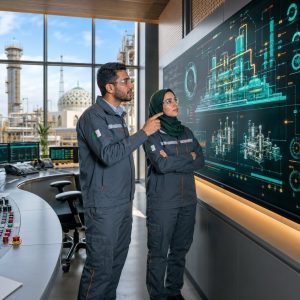
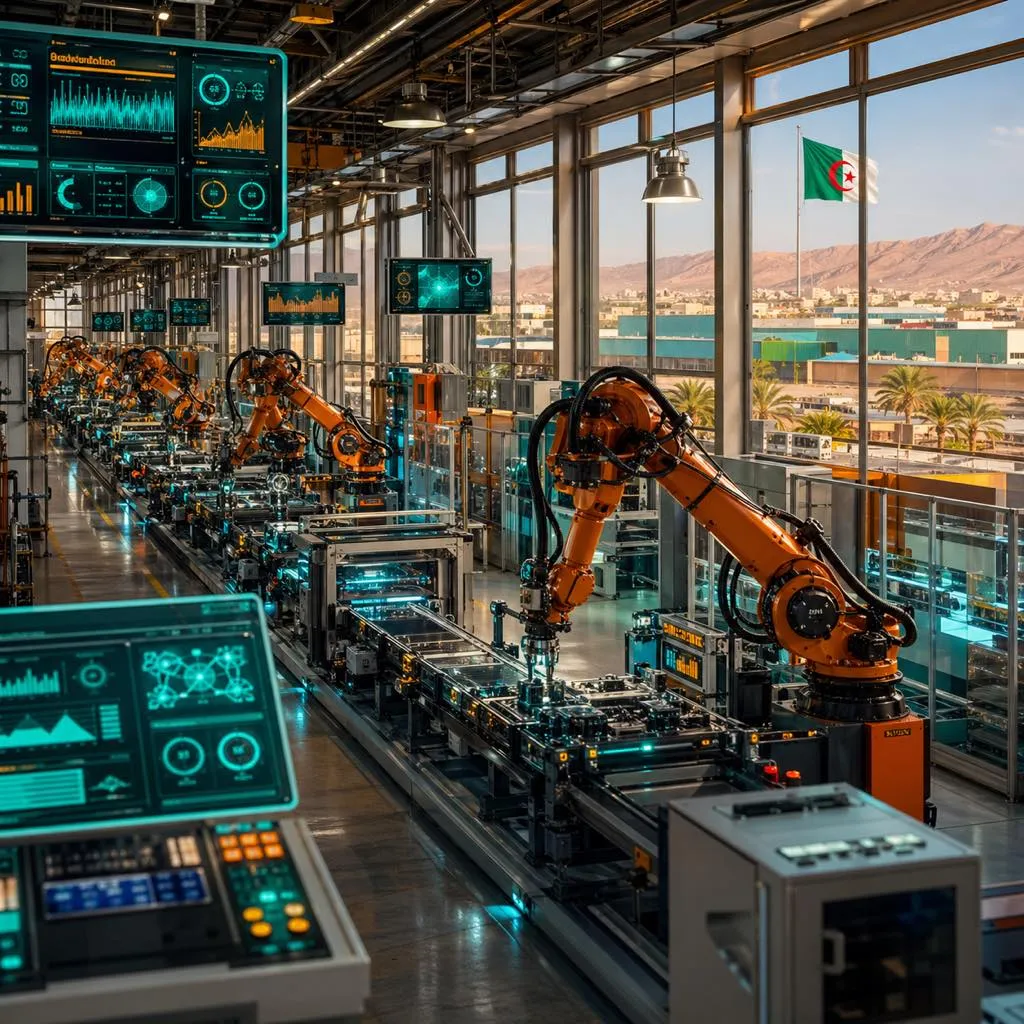
Algeria’s industrial base is not waiting for a perfect digital environment. Across the country’s economic zones — Rouiba, Sidi Bel-Abbès, Sétif, and the newer industrial parks in Biskra — a first generation of automation pilots is running. These are not aspirational PowerPoint strategies. They are live deployments of predictive maintenance sensors, AI-driven quality-control cameras, and early-stage process-optimization loops, mostly in the food processing and pharmaceutical sectors.
The national context matters here. Algeria’s AI strategy, announced on December 7, 2024 at the 3rd African Start-up Conference in Algiers and championed by Merouane Debbah, head of the Scientific Council for Artificial Intelligence, explicitly names manufacturing digitization as one of six strategic pillars. The government’s goal of “500+ digitalization projects by 2026” across infrastructure, training, and digital governance has given industrial actors a policy signal that AI investment will be supported rather than penalized.
Yet Algeria ranks 120th globally in the Oxford Insights Government AI Readiness Index, scoring 35.99 out of 100 against a 50-point global average. That gap between policy ambition and operational readiness is precisely the terrain that forward-looking manufacturers are navigating right now.
The Three Industrial Segments Seeing Real Movement
Not every sector is moving at the same pace. Three segments stand out as genuine adoption fronts in 2026.
Food and beverage processing leads because the ROI case is fastest. Algerian food manufacturers — including large names in pasta, dairy, and vegetable oil — face high reject rates on production lines optimized for volume rather than precision. AI vision systems for quality inspection, now commercially available from Algerian integrators, reduce waste by identifying contamination and sizing defects in real time. The payback period for a single camera-based inspection line is typically 12–18 months on a volume production run, which fits the investment appetite of medium-sized Algerian food companies.
Pharmaceutical manufacturing is the second front. SAIDAL, Algeria’s state pharmaceutical group, has been under pressure to raise production yields and reduce batch failures since the 2020 drug shortage crisis. Predictive quality analytics — using sensor data to flag process drift before it contaminates a batch — has become a boardroom priority. SAIDAL’s Annaba and Cherchell plants are reportedly deploying sensor arrays integrated with analytics dashboards, though public disclosure on specific vendors and performance results remains limited.
Petrochemical and downstream oil and gas represents the third segment, primarily through Sonatrach’s operational technology (OT) modernization programme. Predictive maintenance on compressors, pumps, and heat exchangers is the immediate application, with AI-assisted anomaly detection reducing unplanned downtime on aging infrastructure. The economic stakes are significant: a single unplanned outage at a compressor station can cost several million dollars in deferred production.
Advertisement
What Algerian Industrial Managers Should Do About It
Industry 4.0 adoption in Algeria is not blocked by technology unavailability — the tools exist, are increasingly affordable, and have documented ROI in comparable markets. It is blocked by three organizational and infrastructure conditions that managers can address now.
1. Start with a Data Audit Before Buying Any AI Tool
The most consistent failure pattern in early Algerian industrial AI pilots has been deploying machine-learning models on unstructured, inconsistent operational data. AI quality-control and predictive maintenance systems require clean, labeled historical data to establish baselines. A factory running legacy PLCs (programmable logic controllers) with no data historian is not ready for AI — it is ready for the data infrastructure layer that makes AI possible. Managers should commission a 4–6 week data audit: map every sensor, every PLC output, every quality log, and assess completeness and labeling quality. This audit costs a fraction of an AI deployment and determines whether you are 6 months or 2 years away from a viable ML pilot.
2. Source Locally Integrated Solutions, Not Imported Platforms
The global SCADA and MES (Manufacturing Execution System) vendors — Siemens, Honeywell, ABB — all have local representatives in Algeria, but their platforms are designed for high-data-volume environments with dedicated IT staff. Algerian SME manufacturers typically lack both. A growing ecosystem of local AI integrators — companies operating in the Sidi Abdellah cluster and within the DTTN digital transformation network — are packaging pre-built models for food and pharmaceutical inspection that run on affordable edge hardware (NVIDIA Jetson-class devices, available locally through the Ooredoo NVIDIA partnership announced in 2024). Sourcing from locally supported integrators reduces implementation risk significantly versus a direct import of a tier-1 platform.
3. Register for ANDPME’s Digital Transformation Co-Financing Scheme
The Agence Nationale de Développement de la PME (ANDPME) administers co-financing instruments for SME digital transformation projects, including automation and AI pilot deployments. Eligible manufacturers can recover up to 50% of project costs through these instruments, bringing the net investment for a first AI pilot to a level accessible even for mid-scale manufacturers. The application requires a feasibility study and a local integrator declaration — both of which are available from ANDPME’s regional offices. Manufacturers that wait for a “national industrial AI programme” to materialize are leaving available co-financing on the table.
4. Build an Internal AI Champion Role Before Scaling
The companies that have sustained their pilots beyond the first 6 months share one trait: they designated an internal “AI champion” — typically a senior production engineer or quality manager — who owns the relationship with the external integrator, monitors model performance, and escalates drift when the model’s accuracy degrades. Without this internal role, pilots stall when the external integrator’s engagement ends. The AI champion does not need a machine-learning PhD: they need operational domain knowledge and a basic understanding of model performance metrics (precision, recall, false-positive rate). A 5-day upskilling workshop — offered by CERIST and several Algerian engineering schools — is sufficient to equip this role.
The Structural Lesson
Algeria’s Industry 4.0 moment is not a question of “if” but of sequencing. The country has the engineering talent — 30,000 graduates per year — the policy framework formalized in December 2024, and the sectoral motivation (food safety, pharmaceutical yield, energy reliability) to sustain real deployments. What it does not yet have is the industrial data infrastructure and the organizational readiness culture that transforms pilots into scaled programs.
The lesson from comparable markets — Vietnam’s textile sector, Morocco’s automotive supply chain — is that the gap between “we have an AI pilot” and “AI is embedded in our production process” takes 3–5 years to close, and it closes fastest in companies that treat data as a production input, not a reporting byproduct. Algerian manufacturers that start the data infrastructure work today will be the ones running scaled AI systems by 2028–2029, when the national strategy’s 500-project target matures into procurement pipelines and skills ecosystems.
The window for first-mover advantage inside Algeria’s industrial base is open. It will not stay open indefinitely.
Frequently Asked Questions
What AI applications are most practical for Algerian manufacturers today?
AI vision systems for quality inspection and predictive maintenance on mechanical equipment offer the fastest return on investment for Algerian factories in 2026. Both applications are commercially available from local integrators using edge hardware (NVIDIA Jetson-class devices), and payback periods of 12–18 months are achievable on volume production lines in food and pharmaceutical sectors.
How does Algeria’s ranking of 120th in AI readiness affect industrial deployment?
The Oxford Insights Government AI Readiness Index score of 35.99 (120th globally) reflects public-sector readiness, not private-sector capacity. Algerian manufacturers can and do deploy AI independently of government readiness — the constraint is internal data quality and IT maturity, not regulatory permission. That said, the low score signals that government-facing data-sharing programmes and standardized OT protocols will take longer to materialize.
What funding is available for Algerian SME manufacturers pursuing AI pilots?
ANDPME administers co-financing instruments covering up to 50% of digital transformation project costs for eligible SMEs. Applications require a feasibility study and a declared local integrator. The DTTN network and the Sidi Abdellah cluster also offer pre-commercial testing environments where manufacturers can run small-scale AI pilots before committing to a full deployment.
—