A $7 Billion Market Running on Cash
Algeria’s online retail sector has arrived at a structural inflection point. The market is large — approximately $7 billion in total value — and growing fast at 25% annually, outpacing most MENA peers. According to US Trade.gov’s Algeria e-commerce guide, the country has 44 million residents, over 30 million internet users, and near-universal smartphone penetration among urban under-35s. The ingredients for a thriving digital commerce ecosystem are present.
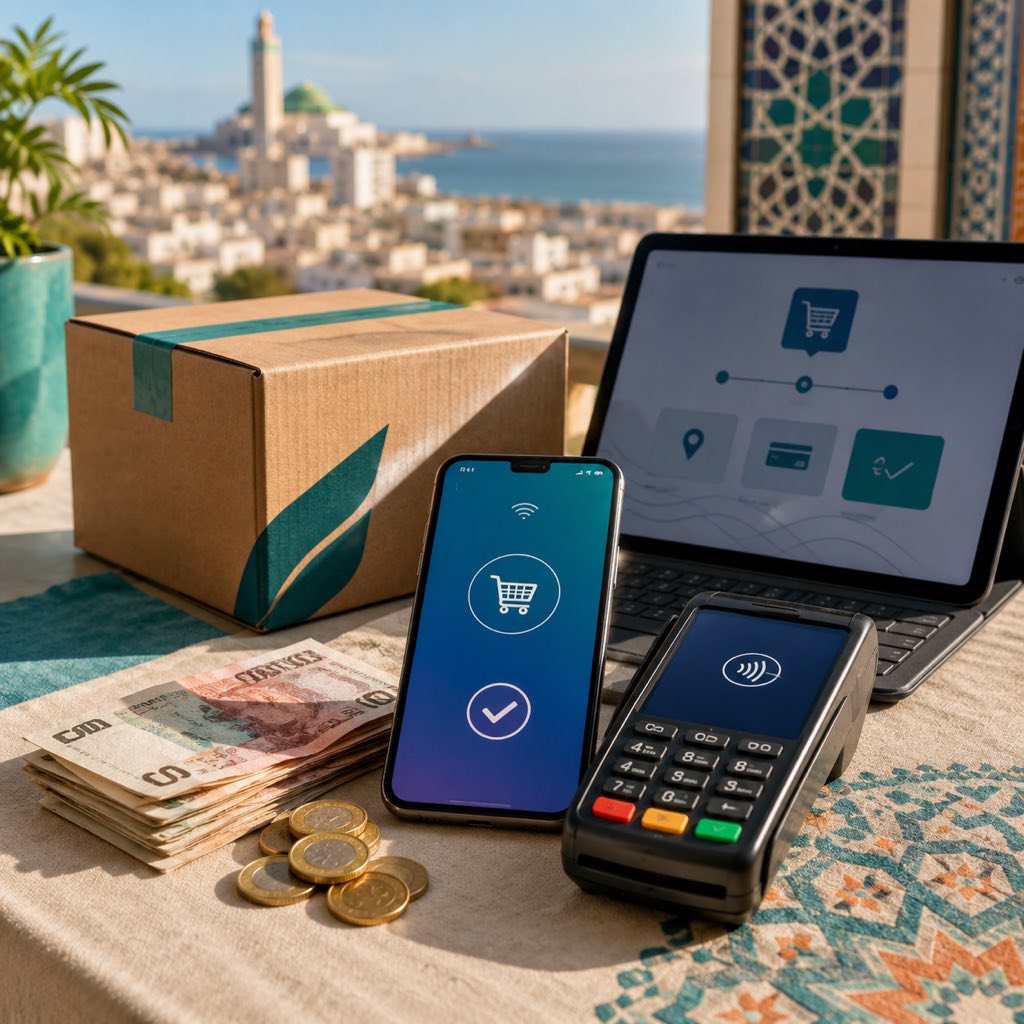
What remains is a payment infrastructure gap that defines the Algerian e-commerce experience: 95% of all online orders are fulfilled via Cash on Delivery. The buyer orders, the courier delivers, cash changes hands. This system works — it has enabled a booming informal e-commerce sector operating largely through Facebook and Instagram — but it creates hard ceilings for merchant economics, logistics efficiency, and the formalization of Algeria’s retail trade.
Credit card penetration at under 5% explains part of the picture. But the deeper issue is trust: Algerian consumers who have never experienced a reliable digital refund mechanism default to cash, because cash is the only payment they can contest by refusing delivery. As Algeria’s e-commerce consumer protection regulation builds out stronger digital dispute mechanisms, this trust calculus is beginning to shift.
The Infrastructure Now in Place to Drive the Shift
Payment Rails: EDAHABIA, CIB, and QR
Three payment rails now provide national coverage for digital commerce:
- EDAHABIA (Algérie Poste network): 14.3 million active cards by end-2024 — the largest card base in Algeria and the primary payment credential for non-banked users. Direct to wallet, QR-compatible via Baridi Pay.
- CIB (Carte Interbancaire, managed by GIE Monétique): The interbank scheme connecting commercial bank accounts to merchant terminals. Accepted by platforms including SofizPay and ALPAY.
- SATIM QR standard: The national QR code payment standard enables any merchant with a smartphone to accept digital payments without a card terminal, dramatically lowering the entry barrier for the 200,000 online merchants who currently operate outside formal payment infrastructure.
SofizPay and ALPAY: The Merchant Payment Gateways
Two platforms have emerged as the primary digital payment infrastructure for Algerian e-commerce merchants:
SofizPay is Algeria’s most broadly integrated payment gateway. It processes Dahabia and CIB card payments and holds direct partnerships with BNA, Badr Bank, SATIM, Algeria Post, and GIE Monétique. SofizPay’s platform reports 10,000+ active merchants and offers API uptime of 99.99% with sub-2-second settlement — metrics that match international payment infrastructure benchmarks. It also processes mobile recharge (Djezzy, Ooredoo, Mobilis, Idoom) and utility bills, broadening its use case beyond pure commerce.
ALPAY operates as an integrated payment and wallet platform charging 2.3% per transaction (with a 25 DZD minimum) across retail, hospitality, healthcare, logistics, and e-commerce. Its QR-based payment acceptance and identity verification layer serve merchants from freelancers to mid-market enterprises. Both SofizPay and ALPAY accept the core Algerian card rails and are Instruction 06-2025 compliant, meaning they meet the Bank of Algeria’s new PSP capital and fund segregation requirements.
The Instruction 06-2025 Unlock
The Bank of Algeria’s Instruction 06-2025 does more than regulate PSPs — it creates the wallet infrastructure that enables e-commerce digital payments at scale. The Level-1 wallet (opened with a national ID only) gives 20.7 million unbanked Algerians a digital payment credential for the first time. When those wallets are linked to e-commerce checkout flows, they convert previously cash-only buyers into digital payers without requiring a bank account. Ecommaps’ 2026 Algeria research confirms that the government’s digitization target of 20% digital economy contribution to GDP by 2030 is contingent on exactly this conversion.
Advertisement
What Merchants Should Do to Capture the Digital Shift
1. Integrate Both SofizPay and ALPAY — Not Just One
The Algerian payment landscape is not winner-take-all. Different customer segments use different credentials: Baridi Pay / EDAHABIA users skew toward younger, mobile-first buyers; CIB card users tend to be employed professionals; ALPAY wallet users include the emerging gig and freelance economy. A checkout flow that offers only CIB card payment loses Baridi Pay users; one that offers only QR loses card users. The baseline for 2026 is multi-rail acceptance — SofizPay + Baridi Pay QR + ALPAY wallet — as parallel checkout options.
2. Build COD-to-Digital Conversion Into the Post-Order Flow
The highest-leverage COD reduction strategy is not eliminating COD upfront — it is converting successful COD customers into repeat digital payers on their second purchase. The mechanism: send a post-delivery message with a small digital-payment incentive (5-10 DZD cashback, a discount code) redeemable only via Baridi Pay or SofizPay. Customers who have confirmed trust in your platform through one successful COD transaction are far more likely to try a digital credential than first-time buyers. This is the conversion funnel that Southeast Asian e-commerce operators used to compress COD from 70% to under 30% over three years.
3. Leverage the Terminal Tax Incentive Before December 2027
The 2025 Finance Law waiver on VAT and customs duties for electronic payment terminal kits expires at the end of 2027. For merchants operating physical pickup points or hybrid offline-online retail, this is the window to deploy SoftPOS (software-based terminal on any smartphone) infrastructure at minimal hardware cost. Merchants who deploy terminals now build a digital payment habit with their offline customer base that feeds directly into online digital payment adoption.
4. Register Formally with CNRC to Access PSP Rails Directly
A major structural cause of COD prevalence is informal merchant status. The 200,000 online merchants in Algeria include a large cohort operating without CNRC trade registration, which prevents them from directly connecting to SofizPay or ALPAY settlement accounts. Instruction 06-2025 and the regulatory sandbox both require a registered legal entity as a prerequisite. Algeria’s e-commerce law 18-05 compliance framework — requiring CNRC registration and .dz domain hosting for compliant operators — is now being actively enforced.
The Scale of the Opportunity When COD Declines
The arithmetic of COD-to-digital conversion is compelling for every stakeholder. For the merchant: digital payment eliminates return logistics for refused COD orders (currently estimated at 20-30% of deliveries in some categories), reduces cash-handling fraud, and cuts working capital requirements. For logistics operators: digital payment enables pre-paid order confirmation, reducing “will the customer be home?” uncertainty that drives last-mile costs. For the broader economy: each digital transaction generates a data trail that supports formal credit scoring — the foundation for Algeria’s nascent digital lending market.
According to UNCTAD’s Algeria eTrade Readiness Assessment, electronic payments for goods and services tripled between 2020 and 2024, with an 87% annual growth rate over those five years. The structural shift is not hypothetical — it is measurable and accelerating. The 25% e-commerce market growth rate is driven partly by volume, but the value-per-order growth that will come from digital payment acceptance (higher basket sizes, cross-sell capability, subscription models) has barely started.
Frequently Asked Questions
Why is 95% cash on delivery so persistent in Algeria’s e-commerce market?
COD dominates because of a trust gap between Algerian consumers and digital payment systems. Credit card penetration is under 5%, and consumers who lack formal refund mechanisms default to cash — the one payment they can dispute by refusing delivery. This is changing as EDAHABIA cards reach 14.3 million holders, digital dispute mechanisms develop, and platforms like SofizPay and ALPAY offer wallet-based payments that don’t require a bank account.
What payment gateways can Algerian e-commerce merchants use in 2026?
SofizPay and ALPAY are the two primary payment gateways serving Algerian merchants in 2026. SofizPay processes Dahabia and CIB payments with 10,000+ merchant integrations and partnerships with BNA, SATIM, and Algeria Post. ALPAY offers QR-based payments at 2.3% per transaction, serving freelancers to mid-market businesses. Both are Instruction 06-2025 compliant, meaning they meet the Bank of Algeria’s capital and fund segregation requirements for licensed PSPs.
How much does COD cost e-commerce merchants in Algeria?
Refused COD deliveries — where the buyer isn’t home or simply declines — typically run 20-30% of deliveries in high-return categories like fashion and electronics. Each refused delivery means return logistics cost, courier time wasted, and inventory back in stock. Digital pre-payment eliminates this category of operational cost entirely. The conversion to digital payment effectively lowers the true cost-per-successful-order even after accounting for the 2-2.3% gateway fee.
Sources & Further Reading
- Algeria E-Commerce COD Complete Guide 2026 — CODRocket
- SofizPay Algeria Payment Gateway — SofizPay
- The Digitization of E-Commerce in Algeria — Ecommaps
- Algeria’s New Digital Payment Law: 57% Unbanked at Stake — AlgeriaTech
- Algeria — eTrade Readiness Assessment — UNCTAD
- Algeria E-Commerce — US Trade.gov
🔗 Related Intelligence
Algeria’s Payment Shift: How Merchants Are Moving from COD to Digital Checkout

The COD Trap: How Cash on Delivery Is Strangling Algeria’s E-Commerce

Algeria’s E-Commerce Boom: 92% Annual Growth and What Comes Next for Digital Merchants

Algeria’s Digital Payment Infrastructure: 78K Terminals, 644 Online Merchants, and a 46% Surge