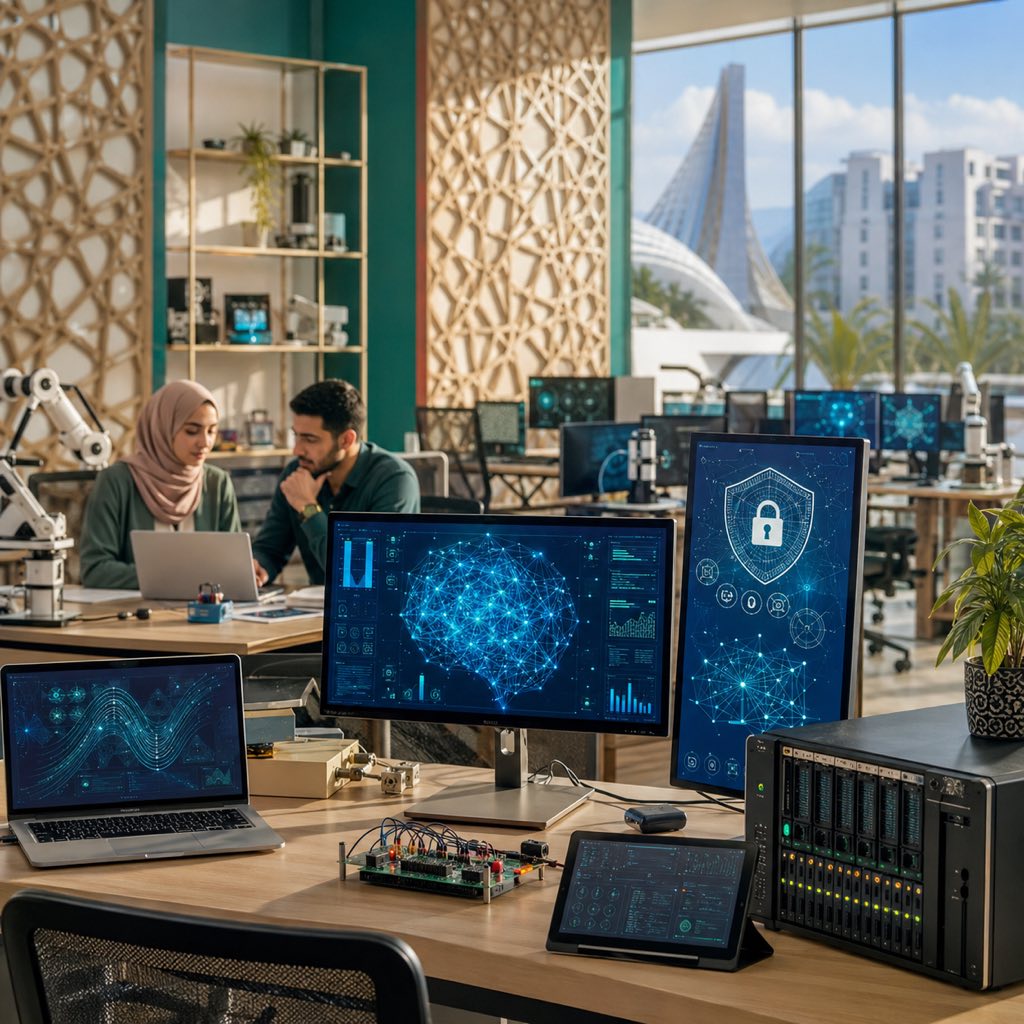
What Launched at Sidi Abdellah on April 18, 2026
Algeria’s Pôle Scientifique et Technologique “Chahid Abdelhafidh Ihaddaden” at Sidi Abdellah has been the country’s flagship science city since its founding — a dedicated innovation district on Algiers’ western edge hosting national schools in mathematics, nanotechnology, autonomous systems, and artificial intelligence. On April 18, 2026, three ministers inaugurated the first structured startup cluster built on top of this academic base: Minister of Higher Education and Scientific Research Kamel Baddari, Minister of Knowledge Economy and Startups Noureddine Ouadah, and Minister of Post and Telecommunications Sid Ali Zerrouki.
According to reporting by Ecofin Agency, the cluster is “an integrated platform” designed to accelerate the transition from research projects to real-world applications. It is led jointly by the three ministries and is specifically targeting AI, cybersecurity, and smart digital services. This is the first time Algeria has co-located a formal startup cluster inside an active science campus with institutional research infrastructure — rather than building a standalone incubator separate from university labs.
The pôle’s physical scale matters for startups: 87 hectares, four national schools, 20,000 student seats, and accommodation for 11,000 residents. The cluster adds structured commercialization support — mentoring, pilot programs, accelerator access — to what was previously a strong research base without a clear startup-to-market pathway.
The Research-to-Market Infrastructure Startups Can Now Access
Before April 2026, Algerian AI and cybersecurity founders had limited structured ways to access national research infrastructure. CERIST (Centre National de Recherche Appliquée en Informatique) ran its own programs, and ENSIA (École Nationale Supérieure d’Informatique) had active AI research labs, but there was no formal co-location framework allowing commercial startups to work alongside these institutions.
The Sidi Abdellah cluster changes this. Startups accepted into the cluster gain:
Co-location with ENSIA and national research labs. ENSIA is Algeria’s primary institution for computer science and AI research. Its faculty includes researchers working on computer vision, natural language processing for Arabic, and applied cybersecurity. For startups building AI products for the Algerian market — particularly those requiring Arabic-language models, North African training data, or locally-validated algorithms — proximity to these research teams is a direct competitive advantage that would otherwise require foreign partnerships.
Access to the knowledge economy and startup ministry’s support programs. The Ministry of Knowledge Economy and Startups has co-sponsorship of the cluster, meaning approved resident startups can access the formal Startup Label pathway with institutional endorsement from the cluster itself, streamlining Phase 2 of the label process described in the startup.dz registration framework.
Visibility to international tech events. Algeria hosted the Global Africa Tech 2026 conference, positioning the country as a continental digital innovation hub. Startups based at Sidi Abdellah are positioned to participate in the national delegation at such events, which has historically provided early-stage companies with access to Pan-African investor networks.
Advertisement
What Kinds of Startups Fit the Sidi Abdellah Profile
Not every startup type is equally well-positioned to benefit from co-location at Sidi Abdellah. The cluster’s founding focus on AI, cybersecurity, and smart digital services creates a specific gravity that benefits certain company profiles more than others.
Deeptech AI founders. If your product relies on custom model training, computer vision, NLP for Arabic or Darija, or signal processing, Sidi Abdellah offers proximity to the research infrastructure that can close capability gaps without requiring expensive cloud compute or foreign partnerships. According to MagStartup’s 2026 startup analysis, Qareeb — an IoT/edge computing startup using LoRa technology for precision agriculture — won a Greentech Challenge operating partly through university research partnerships. The cluster formalizes what Qareeb did informally.
Cybersecurity product companies. Algeria’s digital infrastructure is expanding rapidly: the AventureCloudz sovereign cloud platform launched April 30, 2026, and AYRADE SPA is floating 20% of its capital on the Algiers Stock Exchange in June 2026 — the first sovereign cloud sector listing. This expanding infrastructure creates genuine domestic demand for security tooling: identity and access management, endpoint detection, compliance monitoring. Startups building in this space benefit from the cluster’s cybersecurity lab access and the ministry-level visibility that comes with physical presence inside the cluster.
Smart services and govtech founders. The cluster explicitly targets “smart digital services” as a third pillar alongside AI and cybersecurity. Given the SNTN-2030 strategy targeting 500+ digital projects across 2025–2026 and the government’s push for digital-first public services, startups building govtech, urban IoT, or e-government solutions have a natural fit with the institutional network that the three-ministry co-sponsorship provides.
What Founders Should Do to Position for the Cluster
1. Secure the Startup Label before applying for cluster residency
The Sidi Abdellah cluster operates within the broader startup ecosystem governed by the Ministry of Knowledge Economy and Startups. All evidence from similar ministry-sponsored programs in Algeria indicates that the Startup Label is the baseline credential for institutional co-location. Founders who have not yet completed the label pathway — startup.dz registration, support structure endorsement, Interministerial Committee review — should prioritize label acquisition in Q2–Q3 2026 before targeting cluster residency. The label process takes 60–90 days when documentation is well-prepared, and it unlocks ASF funding access that can fund the working capital needed during an accelerator residency period.
2. Map your research gap before applying — and name the ENSIA lab you want to work with
The cluster’s value proposition for a startup depends on the quality of the research connection. A vague application stating “we want to use AI” will not distinguish you from the hundreds of teams that will apply. Founders should identify the specific ENSIA research group or national lab whose work is adjacent to their technical problem, read their recent publications (available through CERIST’s digital library), and name the specific capability they need — whether that is access to labeled Arabic training data, guidance on adversarial robustness for production systems, or a validated cryptographic protocol for their security product. This specificity signals to the cluster’s selection committee that the startup will produce real collaborative outputs, not just occupy desk space.
3. Connect the cluster residency to an export or scale-up thesis
The Sidi Abdellah cluster is part of Algeria’s national strategy to build internationally competitive tech companies — not just domestic service providers. Startups that frame their application around an export thesis (reaching Francophone African markets, building pan-Arab language AI, or developing cybersecurity products for regional governments) are more likely to receive the full package of ministerial visibility, international event participation, and potential referrals to Pan-African accelerators. Algeria ranked 4th in North Africa for startup activity in 2025 per Tracxn data cited by MagStartup, but the gap to Egypt’s equity funding ($8M vs approximately $360M) shows that regional scaling ambition must be built into the product thesis from day one.
4. Use the cluster as a proof-of-concept environment for public sector pilots
The three-ministry co-sponsorship of the cluster creates a direct channel to public sector pilot agreements. Algeria’s government has signaled through the SNTN-2030 strategy that it intends to procure digital services from labeled startups, and the preferential public procurement access that comes with the label is even more actionable when a startup has an institutional address inside a government-co-sponsored cluster. Founders should explicitly propose one specific public sector use case as part of their cluster application — this activates the procurement pathway and creates a reference client scenario that makes subsequent commercial scaling faster.
The Bigger Picture: Sidi Abdellah as a Replicable Model
Algeria’s explicit intention is to replicate the Sidi Abdellah model in other regions. The cluster’s three-ministry structure and its placement inside an existing science campus — rather than a greenfield build — makes it faster to scale. Wilayas with strong university infrastructure (Oran, Constantine, Annaba, Béjaïa) are natural candidates for follow-on cluster launches.
For founders, this means that the competitive landscape for cluster residency will be national even if physical locations multiply. Being among the first cohort at Sidi Abdellah carries the same first-mover advantage as being in an accelerator’s inaugural batch — alumni networks are disproportionately connected, and early residents shape the programming culture. The April 2026 launch opens a narrow window for founders to position themselves as founding cohort members of Algeria’s first structured AI cluster. That positioning will matter for the next decade.
Frequently Asked Questions
What types of startups are eligible for the Sidi Abdellah AI and cybersecurity cluster?
The cluster targets startups in AI, cybersecurity, and smart digital services. Eligible companies should have an active Startup Label (or be in the process of obtaining one) and a technical roadmap that benefits from co-location with ENSIA researchers or national lab infrastructure. Deeptech AI, cybersecurity product companies, and govtech startups building for Algerian and regional public sector clients have the strongest fit.
How does the Sidi Abdellah cluster differ from a standard incubator?
The key difference is institutional co-location: the cluster is built inside Algeria’s 87-hectare Sidi Abdellah science campus alongside ENSIA and four national specialized schools, not in a standalone building. This gives resident startups direct access to research labs, faculty expertise, and computing resources that a standalone incubator cannot provide. The three-ministry co-sponsorship also creates a direct channel to public procurement opportunities and national visibility at events like Global Africa Tech.
Is the cluster accessible to founders outside Algiers?
Yes. The cluster welcomes startups from academic and entrepreneurial backgrounds nationwide. Founders based in Oran, Constantine, Sétif, or other wilayas can apply for residency — the science campus has accommodation for 11,000 residents, making relocation feasible for serious teams. The Ministry of Knowledge Economy and Startups has explicitly framed the Sidi Abdellah model as the first in a series of regional clusters, with replication in major university cities planned as the program matures.
Sources & Further Reading
🔗 Related Intelligence
Algeria’s AI & Cybersecurity Cluster: How Startups Can Join and Benefit

Sidi Abdellah Opens Its Doors: Algeria’s First AI & Cybersecurity Startup Cluster

Algeria’s First AI Security Cluster: Why the Startup Stack Is Finally Connecting
Algeria’s First AI Cluster: Inside the Sidi Abdellah Tech Hub Launch