A Three-Ministry Bet on Deep-Tech Verticals
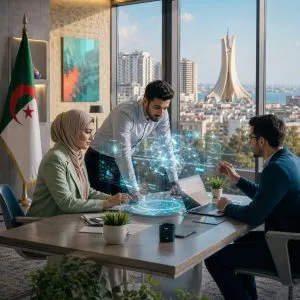
Algeria’s first startup cluster dedicated specifically to artificial intelligence and cybersecurity officially opened on April 21, 2026, inside the Chahid Abdelhafid-Ihaddaden Scientific and Technological Pole in Sidi Abdellah, west of Algiers. The inauguration was co-led by three ministers: Kamel Baddari (Higher Education and Scientific Research), Noureddine Ouadah (Knowledge Economy and Startups), and Sid Ali Zerrouki (Post and Telecommunications).
The tri-ministry governance is unusual and deliberate. It signals that AI and cybersecurity are being treated as cross-cutting national priorities rather than the remit of a single agency — a design choice that mirrors how successful innovation clusters in other small, ambitious economies (Singapore’s Biopolis and One-North districts come to mind) were structured around multi-agency mandates from the start.
What the Cluster Actually Is
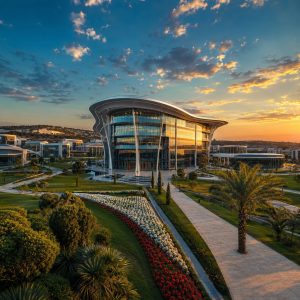
The Sidi Abdellah pole is a 87-hectare technology campus that already houses four specialized national schools: mathematics, nanosciences, autonomous systems, and — most relevantly — the École Nationale Supérieure d’Intelligence Artificielle (ENSIA). The full pole provides roughly 20,000 educational places and 11,000 student residences, making it the largest concentration of advanced STEM talent in the country.
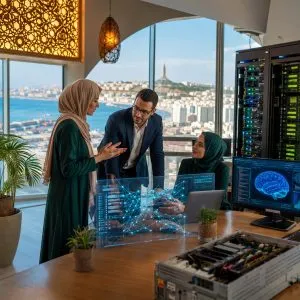
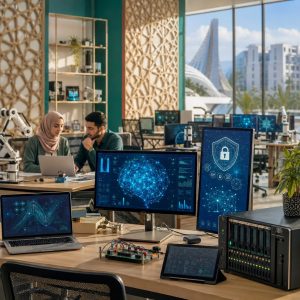
The new cluster adds a startup layer on top of this academic base. Rather than a standalone incubator building, it is an operational framework designed to pull founders, researchers, and labeled startups into the same physical and programmatic space. The government’s official framing — “a qualitative step in building an integrated national innovation ecosystem” — reflects the intent: bridge academic research and commercial venture creation in AI, cybersecurity, and adjacent verticals such as health-tech, agri-tech, energy, and digital services.
Advertisement
The Talent and Capital Context
The cluster does not land in a vacuum. Two complementary data points frame the opportunity:
- The startup base: Algeria’s official startup platform counts more than 7,800 registered companies, with 2,300 currently holding the state-issued “startup” label that unlocks tax exemptions and financing access. University-led innovation projects grew from 6,000 in 2023 to around 9,000 in 2024 — a 50% jump that broadly tracks the growth of campus entrepreneurship programs.
- The capital layer: In 2025, Algérie Télécom seeded an AI and cybersecurity investment vehicle worth 1.5 billion dinars (roughly $11 million). For comparison, this is small by Gulf or Southeast Asian standards but meaningful locally, especially when paired with the tax incentives attached to the startup label.
The 20,000 labeled-startup target by 2029 implies Algeria needs to add roughly 5,900 new labeled firms per year between now and 2029. The Sidi Abdellah cluster is one of the mechanisms meant to accelerate that flow in the deep-tech segment — which historically has been harder to scale than e-commerce or fintech plays.
What Algerian AI and Cybersecurity Founders Should Do Now
The cluster is live. The advantage goes to founders who map the three entry points in the first quarter rather than waiting for a formal onboarding cohort announcement.
1. Recruit From ENSIA Before the Labor Market Does
ENSIA’s five-year engineering cycle produces graduates trained specifically on modern AI tooling — a profile that is genuinely rare in the broader Algerian tech market. Algeria’s startup ecosystem ranked 4th in North Africa on StartupBlink’s 2025 index, with year-on-year growth of 7.2 percent, but talent density in applied AI and critical-infrastructure cybersecurity remains the binding constraint for most deep-tech ventures. Founders should engage ENSIA’s final-year project program (projets de fin d’études) now, before graduation season, by proposing sponsored capstone projects aligned with a specific product problem. A sponsored PFE converts a four-month thesis into a funded technical exploration on a real use case — and gives the founder first-look access to graduates before competing Algerian and regional employers do.
2. Surface Licensable IP in Computer Vision, Arabic NLP, and Infrastructure Security
The cluster’s mandate to accelerate the “transformation of ideas into viable businesses” implies a pipeline from faculty research into licensable IP. The three verticals where Algerian academic output has been most consistent — computer vision (inspection and remote sensing), Arabic NLP (dialect classification and government document processing), and critical-infrastructure cybersecurity — all have identifiable commercial buyers: agricultural operators, public-sector agencies, and telecom and energy groups respectively. Founders should request a briefing from each partner lab on recent publications and un-commercialized prototypes, then assess which outputs could form the core of a productizable IP agreement with the university. The 1.5-billion-dinar Algérie Télécom fund is the natural anchor investor for IP-backed ventures in these verticals.
3. File the Startup Label Before Approaching External Investors
The startup-labeling pipeline co-located with the cluster is not a bureaucratic formality — it is the access mechanism for the fiscal and financing advantages that make early Algerian fundraising economically viable. Tax exemptions, financing access, and reduced administrative risk in enterprise procurement are all tied to the label. For founders planning a 2026 seed round, the sequence should be: startup label first, domestic capital anchor via the Algérie Télécom fund or Algeria Venture second, international co-investor third. Arriving at an international investor without a startup label and without domestic capital already committed signals that the founder has not engaged the local ecosystem seriously — which raises due-diligence risk in the eyes of a regional fund that expects local validation before writing a check. The 20,000 labeled-startup target by 2029 means the labeling process is under active ministry pressure to run efficiently; founders who engage the cluster’s onboarding team directly are more likely to see a fast-tracked administrative timeline than founders applying through general government channels without an institutional relationship.
The Bigger Picture
For the Algerian ecosystem, the Sidi Abdellah cluster matters less for its ribbon-cutting ceremony and more for what it signals over the next two years: AI and cybersecurity are being treated as strategic economic verticals, not research curiosities. The three-ministry structure, the co-location with four national schools, and the growing capital pool are the three legs of a stool that can support durable venture creation — if the operational execution matches the ambition.
The next 18 months will reveal whether the cluster generates its first signature exits, attracts international co-investors, and produces research IP that gets successfully spun into new companies. Founders and research teams who engage with the cluster’s onboarding process early will have a disproportionate claim on these outcomes and on the initial compute and financing allocations.
Frequently Asked Questions
What is the Sidi Abdellah AI and cybersecurity startup cluster?
It is Algeria’s first dedicated deep-tech startup cluster, opened on April 21, 2026, inside the Chahid Abdelhafid-Ihaddaden Scientific and Technological Pole. The 87-hectare campus already houses four national schools — including ENSIA — and roughly 20,000 educational places, and now adds a startup layer aimed at AI and cybersecurity ventures.
How can an Algerian startup plug into the cluster?
Founders should pursue the state-issued startup label (which unlocks tax incentives and financing access), coordinate with ENSIA for engineering recruiting, and engage with the Knowledge Economy ministry’s onboarding pipeline. Early movers should also track the Algérie Télécom 1.5 billion dinar AI and cybersecurity investment fund launched in 2025.
Why is this cluster significant for Algeria’s digital economy?
Algeria targets 20,000 labeled startups by 2029, up from roughly 2,300 today. Concentrating deep-tech founders, academic researchers, and capital in one physical site is a proven pattern for accelerating venture formation, and the three-ministry supervision signals sustained state commitment to AI and cybersecurity as strategic verticals.
Sources & Further Reading
- Algeria launches its first startup cluster dedicated to AI and cybersecurity — Tech in Africa
- Algeria launches first AI & cybersecurity startup cluster — Horizons
- Algeria builds talent pipeline through AI and cybersecurity cluster — Ecofin Agency
- Why Algeria is positioned to become North Africa’s AI leader — New Lines Institute
- The School — ENSIA