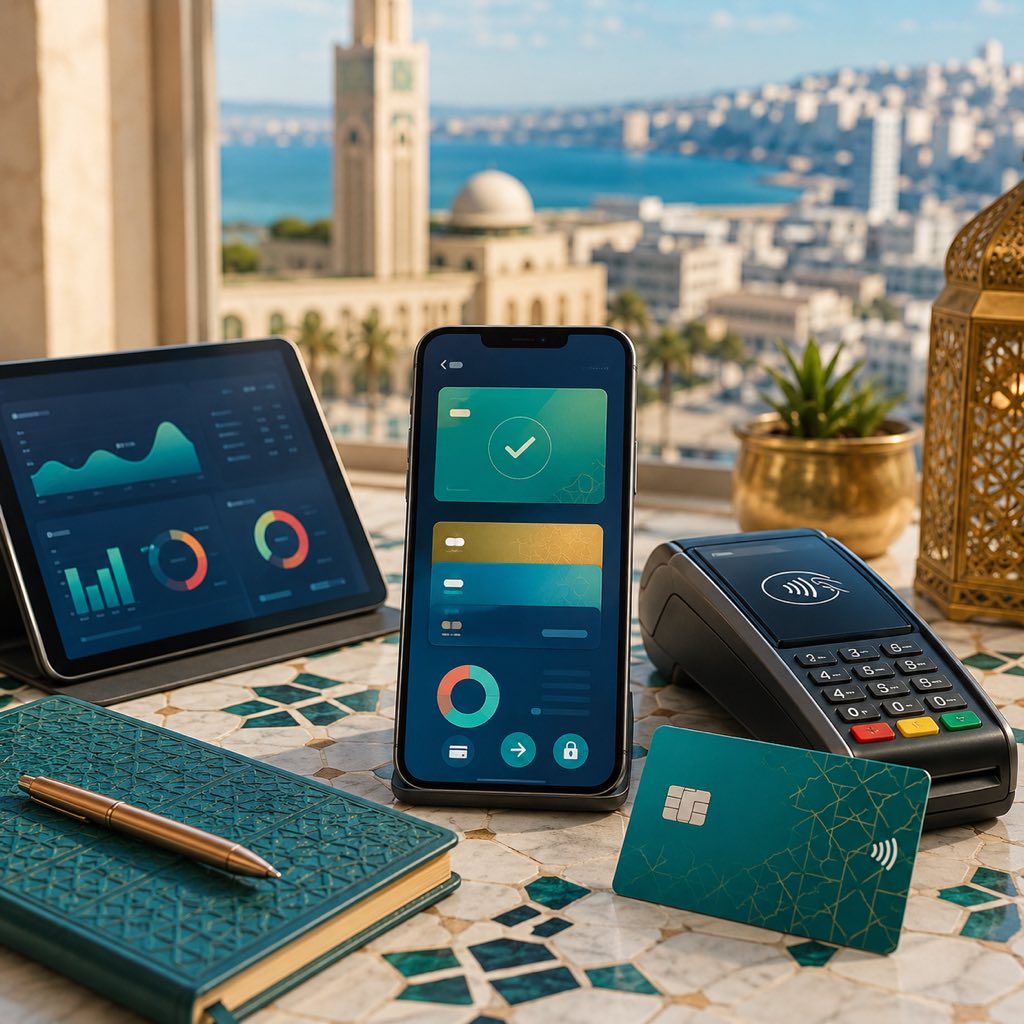
The Architecture Behind Algeria’s Cashless Ambition
Algeria’s push toward a cashless economy is not a single policy decree — it is a layered infrastructure project years in the making, now reaching operational maturity. The Bank of Algeria’s Fintech Strategy 2024-2030 sets the headline target: at least 50% of all transactions to be cashless by 2030. The more ambitious internal objective, articulated by the Bank’s governor, is a fully cashless society by 2028.
The strategic logic starts with scale. Algeria has an adult population of 32 million, of which an estimated 20.7 million — roughly 57% — remain unbanked according to World Bank Findex data. Traditional branch-based banking has not reached these citizens; neither has the credit card network, which sits at under 5% penetration. The strategy’s answer is a tiered-wallet framework that bypasses branch infrastructure entirely.
How the Tiered Wallet System Works
Instruction 06-2025, issued by the Bank of Algeria and already in effect, formalises three tiers of payment service provider (PSP) wallets, each with different KYC requirements and transaction limits:
- Level 1 (Minimal KYC): Opened with a national ID number only, no in-person verification. Designed specifically for the unbanked majority. Transaction ceilings keep risk manageable while allowing everyday payments: groceries, utilities, mobile recharge.
- Level 2 (Standard KYC): Requires document verification, often completed via app using selfie + scan. Unlocks higher limits, merchant payments, and cross-border remittances.
- Level 3 (Full KYC): Equivalent to a full bank account onboarding, enabling credit access and investment products. Targeted at MSMEs and wage earners.
This architecture mirrors what Southeast Asian markets used to drive rapid digital payment adoption in the 2010s — removing the friction of branch visits for basic use cases, then upgrading users through the tiers as trust and capability grow.
The EDAHABIA and CIB Rails Underneath
Any wallet strategy depends on the card rails and interoperability layer beneath it. Algeria’s two primary card networks — EDAHABIA (the Algérie Poste network) and CIB (the bank-issued card scheme managed by GIE Monétique) — form the backbone. By end-2024, the EDAHABIA card base had more than doubled to 14.3 million active cards, a sign that base-layer adoption is outpacing earlier projections. The 2025 Finance Law sweetened adoption further by introducing stamp duty exemptions for electronic payments and waiving VAT and customs duties on electronic payment terminal kits through December 2027.
In 2025, the Bank of Algeria formally joined PAPSS — the Pan-African Payment and Settlement System, enabling direct DZD settlement with other African currencies. This positions Algerian fintech operators to tap intra-African trade corridors under the African Continental Free Trade Area framework — a market where cross-border fees currently run at 6–10%, creating a structural opportunity for lower-cost digital rails.
The Regulatory Sandbox: Where New Products Get Tested
The 2024-2030 strategy reserves a specific mechanism for innovation: a regulatory sandbox targeting at least 20 fintech startups annually. The sandbox, expected to become fully operational in 2026 following the implementation of Instruction 06-2025, allows licensed PSPs and early-stage fintechs to test products under Bank of Algeria supervision without full licensing overhead. This is the pathway for use cases beyond basic payments — digital lending, Islamic finance products, insurance micro-payments — that sit in regulatory grey areas today.
The capital requirements codified in Instruction 06-2025 ensure sandbox participants are capitalised above a minimum threshold, reducing systemic risk from experimental products while keeping the bar low enough for well-funded startups. PSPs must also comply with fund segregation rules that ring-fence customer balances from operating capital — a protection that builds consumer trust over time.
Advertisement
What This Means for Algerian Businesses and Fintechs
1. Treat Level-1 Wallets as Your Largest Addressable Customer Segment
The 20.7 million unbanked adults are not unconnected — Algeria’s internet penetration exceeds 77%, and smartphone ownership among under-35s is near-universal. What they lack is a payment credential, not a device. For merchants, logistics operators, and gig platforms, a customer base that can pay via a Level-1 wallet represents a step-change in addressable market. Build checkout flows that accept QR payments (supported by SATIM’s national QR standard) and Baridi Pay, not just CIB card links.
2. Comply with Instruction 06-2025 Now — The Grace Period Is Closing
Instruction 06-2025 is already in effect. PSPs that have not yet completed capital adequacy certification, implemented fund segregation, and mapped their KYC tiers to the regulatory framework face enforcement risk. The Bank of Algeria’s supervisory posture has shifted from advisory to audit-oriented in 2026. Compliance is not a 2027 task.
3. Position for the Sandbox Cohort — Applications Open in 2026
For fintech startups not yet licensed as full PSPs, the sandbox is the fastest route to market. The 2026 cohort target of 20 startups is not large; competition for slots will be real. Startups with working prototypes for digital micro-lending, embedded insurance for logistics, or MSME payroll tools should begin sandbox application preparation now. Documentation requirements follow the PSP licensing framework: business plan, compliance audit, capital evidence.
4. Invest in Merchant Terminal Infrastructure
The 2025 Finance Law waiver on terminal kits (VAT and customs duty exempted through December 2027) makes this the optimal window to deploy SoftPOS and QR-terminal infrastructure. The trade.gov Algeria digital economy guide identifies merchant terminal density as a critical bottleneck — a merchant who accepts digital payments becomes an onramp for their customer base to start transacting digitally.
What the 2028 Cashless Target Really Requires
The Bank of Algeria’s more aggressive 2028 target is achievable if two conditions are met: first, that the Level-1 wallet rollout reaches Tier 3 and Tier 4 cities — the wilayate where cash dependency is highest; second, that interoperability between wallet providers is enforced, not merely encouraged. A fragmented wallet landscape where SofizPay balances cannot pay an ALPAY merchant, or a Banxy account cannot receive a Baridi transfer seamlessly, will slow adoption faster than any regulatory barrier.
The good news is that GIE Monétique’s interoperability mandate and SATIM’s national QR standard already create a technical foundation for cross-wallet payments. The remaining gap is commercial — PSPs competing for wallet share may resist interoperability that commoditises their product. Regulatory pressure to enforce the interoperability standard is likely to be the defining policy test of 2026-2027.
For businesses, the short-term read is straightforward: the infrastructure is building faster than the commercial adoption. The merchants and platforms that build digital-payment acceptance today will be positioned ahead of the consumer adoption curve that follows.
Frequently Asked Questions
What is Algeria’s 2030 cashless target and is it realistic?
Algeria’s Fintech Strategy 2024-2030 targets 50% of all transactions being cashless by 2030, with a more ambitious internal goal of achieving a cashless society by 2028. Given that digital financial transactions grew 71% in Q1 2024 and the EDAHABIA card base doubled to 14.3 million by end-2024, the trajectory is achievable — but requires rapid merchant terminal deployment and interoperability enforcement between wallet providers.
What is Instruction 06-2025 and who does it affect?
Instruction 06-2025 is the Bank of Algeria’s regulation that formalises the operating rules for Payment Service Providers (PSPs) and digital wallets. It defines the three-tier KYC wallet framework, sets minimum capital requirements for PSPs, and mandates fund segregation between customer balances and operating capital. It is already in effect in 2026 and applies to all licensed and aspiring PSPs, digital wallet providers, and fintech startups seeking Bank of Algeria authorisation.
How does a Tier-1 wallet help reach unbanked Algerians?
A Level-1 wallet under Instruction 06-2025 requires only a national ID number to open — no branch visit, no income documentation. Because Algeria has more than 77% internet penetration and near-universal smartphone ownership among young adults, the Level-1 wallet serves as the entry credential for the 20.7 million adults who currently lack formal banking access. Merchants who accept QR and wallet payments automatically become accessible to this population for the first time.
Sources & Further Reading
- Algeria’s Fintech Ecosystem in 2026: Building Momentum — The Fintech Times
- Algeria Launches First Fintech Regulation for PSPs — Startup Researcher
- Algeria Digital Economy Commercial Guide — US Trade.gov
- Algeria — Global Snapshot of Digital Finance Indicators — World Bank
- MENA Fintech Market Analysis Report 2026-2031 — GlobeNewswire
🔗 Related Intelligence
Algeria Fintech Strategy 2024-2030: Cashless Targets, Sandbox Launch, and What Comes Next
Algeria’s Cash Ban: How the Finance Act 2025 Is Forcing a Digital Payment Revolution

Algeria’s Unbanked Opportunity: How the Three-Tier Wallet Framework Can Reach 57% of Adults
Algeria’s Digital Payment Services Law: New Consumer Protections for the Cashless Economy