A Market Held Back by One Constraint
Africa has everything a data center market needs except reliable, affordable grid power. The demand is real: 1.5 billion people, rapidly growing internet penetration, cloud adoption accelerating across financial services, government, telecoms, and manufacturing. The investment is arriving: Digital Realty acquired Teraco for $3.5 billion, Microsoft and G42 committed $1 billion to a Kenya project, and the Africa Data Center Association forecasts capacity growing from 1.17 thousand MW to 3.46 thousand MW by 2030. The continent currently holds less than 1% of global data center capacity — making it one of the most significant supply deficits in the global infrastructure landscape.
The bottleneck is power. Nigeria’s 17 data centers require approximately 137 MW collectively but receive only around four hours of grid power per day, forcing reliance on costly diesel generators that add roughly $0.20–0.35 per kWh to operating costs. South Africa’s grid faces structural load-shedding that peaked at Stage 6 (equivalent to 6,000 MW of rolling blackouts) in 2023 before improving. Even in Kenya, which benefits from strong geothermal capacity, grid reliability varies by region and season.
The response from leading operators is not to wait for government grid improvements — it is to go around the grid entirely through renewable PPAs, on-site solar installations, and direct geothermal supply agreements. This approach does not just solve the reliability problem; it resolves the ESG problem simultaneously. Hyperscalers operating in Africa — AWS, Microsoft, and Google — each have global net-zero or 100%-renewable commitments that require any African facility to be powered by clean energy. Diesel-backed infrastructure simply does not qualify, which means operators who cannot offer renewable power access lose the hyperscaler anchor tenants that anchor the economics of large data center investments.
The Deals That Define the New Model
Three deal structures have emerged as the templates for African renewable data center power:
Solar wheeling (South Africa model): Teraco, South Africa’s dominant colocation operator acquired by Digital Realty, has developed a 120 MW solar farm to supply its facilities through a wheeling arrangement — power generated at the solar site is transferred through the grid to the data center location under a bilateral agreement with Eskom. This model works in markets where wheeling regulations exist and grid reliability is sufficient to enable power transfer. It allows operators to procure large-scale renewable capacity without building it adjacent to the data center.
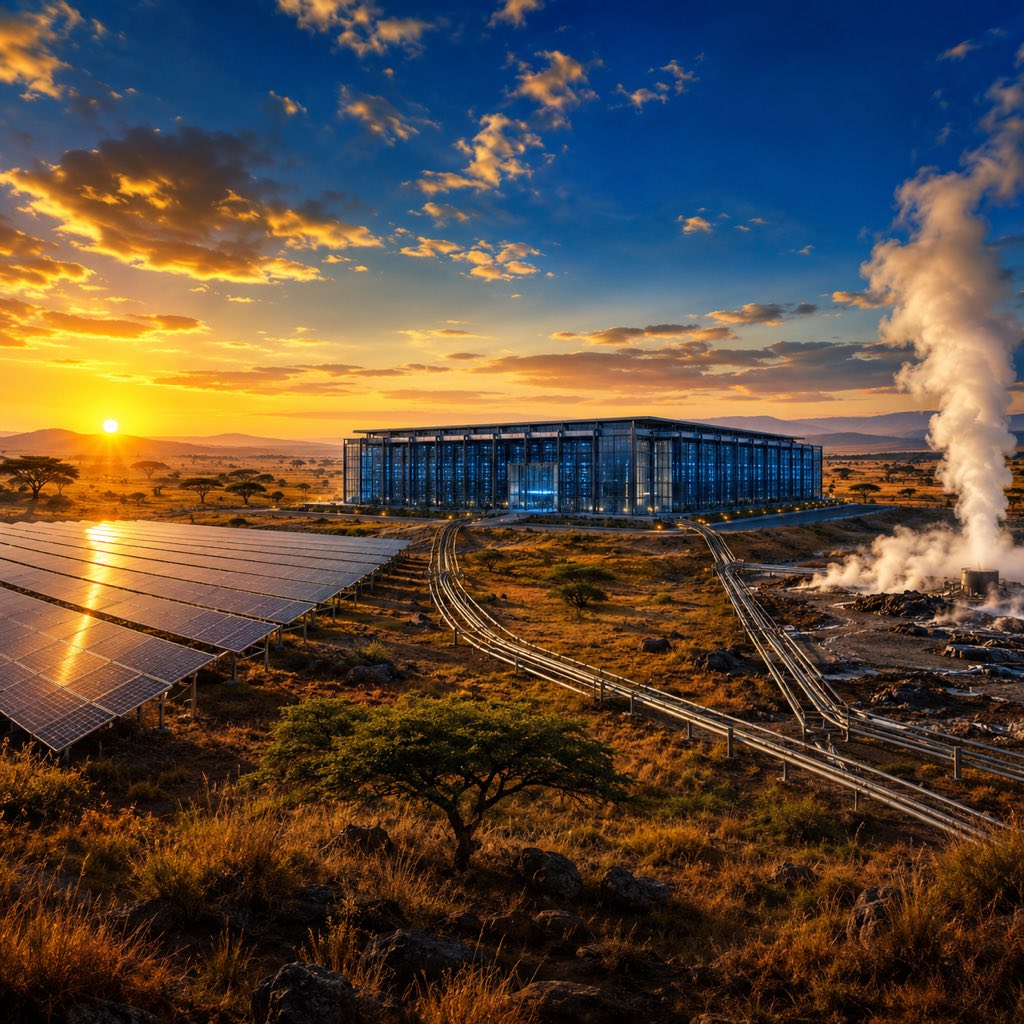
Direct geothermal supply (Kenya model): Microsoft and G42 committed $1 billion to a geothermal-backed data center in Kenya’s Naivasha geothermal zone, where Kenya’s national utility KenGen operates geothermal plants providing approximately 48% of the country’s total generation. Kenya’s geothermal resource is among the world’s largest undeveloped reserves, and the combination of 24/7 baseload reliability (unlike solar or wind), competitive pricing, and genuinely zero-carbon generation makes it the gold standard for African data center power. Although the project has faced delays in its construction timeline, the long-term commitment of a $1 billion investment signals that the model is sound even when execution timelines slip.
On-site solar with battery storage (West and East Africa model): For markets without developed wheeling regulations or geothermal resources, the emerging model is hybrid on-site solar with battery storage and minimal diesel backup for emergency-only use. Africa Data Centres and Distributed Power Africa are developing a 12 MW solar farm to supply South Africa facilities, while Senegal’s Taiba N’Diaye Wind Farm supports seven data centers in the region. The Senegal wind model demonstrates that wind PPAs are viable for data center power in high-resource corridors, adding a third renewable technology to the toolkit alongside solar and geothermal.
Advertisement
What Enterprise and Infrastructure Teams Should Take From This
1. Require Renewable Power Provenance in Data Center Procurement
For enterprise cloud and infrastructure procurement teams, the shift from “does the facility have reliable power?” to “what is the renewable provenance of that power?” is now a contractual necessity, not aspirational ESG signaling. Major cloud hyperscalers’ net-zero commitments cascade to their colocation and hosting contracts — a facility running on diesel-backed grid power cannot be used to satisfy a corporate renewable energy procurement commitment. Procurement contracts should specify: (a) the renewable energy certificate (REC) or equivalent for 100% of purchased power, (b) the generation source (solar, geothermal, wind — not unbundled RECs from a different geography), and (c) the backup power protocol (battery storage with diesel emergency-only, not routine diesel operation). The Africa-specific standard is the Africa Data Centre Association’s 2026 Facilities Report, which benchmarks renewable power provision across African operators.
2. Evaluate Power Purchase Agreement Structures Before Market Entry
For operators planning new African data center capacity, the most consequential early decision is the power procurement model. The three models above have different economics and timelines: solar wheeling requires regulatory approval and grid capacity assessment (6–18 months to implement), direct geothermal requires proximity to resource zones and direct utility negotiation (18–36 months, but delivers the lowest long-term power cost), and on-site solar with battery requires capital investment upfront but delivers operational independence. A market-entry analysis should map each target country against these three dimensions: wheeling regulation status, renewable resource availability, and grid reliability scores. Countries with developed wheeling frameworks (South Africa, Ghana, Kenya) favor the first or third model; countries with geothermal resources (Kenya, Ethiopia, Djibouti) favor the second. Most West African markets currently require the on-site hybrid model due to underdeveloped wheeling regulation.
3. Size Battery Storage for 8-Hour Independence, Not Just Transition Coverage
The standard colocation facility backup design uses a UPS (uninterruptible power supply) for ride-through of grid interruptions, sized for 10–20 minutes to allow generator startup. In African markets where grid interruptions can last 4–8 hours daily (as in Nigeria), this is an entirely inadequate design for diesel-free operation. Battery storage systems sized for 8-hour independence at full IT load require significantly larger capital investment but eliminate the need for routine diesel operation. Africa data centers have faced cooling loads accounting for up to 30% of total energy consumption — battery sizing must account for both IT load and cooling load. The economics of 8-hour battery storage have improved dramatically with lithium iron phosphate (LFP) battery costs falling 50% since 2020, making this approach commercially viable for facilities above 5 MW IT load.
4. Use Data Center Power Demand as an Anchor for Stalled Generation Projects
The African Energy Chamber has identified data center developers as potentially the most important catalyst for unlocking stalled renewable generation projects. Power producers who have secured permits and completed feasibility studies for solar or wind projects often cannot reach financial close because they lack anchor offtake customers with creditworthy long-term power purchase commitments. A data center operator with a 20-year lease commitment and an investment-grade parent company provides exactly the anchor that stalled generation projects need. This creates a deal structure where the data center operator benefits from bespoke renewable power at competitive pricing (below grid tariff in most cases), and the power producer benefits from a bankable offtake that enables project financing. Enterprise procurement teams entering Africa for the first time should explore this co-investment model rather than defaulting to conventional colocation procurement — it creates strategic infrastructure positions unavailable to late entrants.
The Bigger Picture: Power Is the Infrastructure Story of the Decade
The African Energy Chamber’s characterization of data centers as “no longer just a technology story — they are an energy story” captures the strategic shift precisely. The race for data center market share in Africa will be won by operators who solve the power equation, not those who deploy the fastest networking equipment or most efficient server hardware. Every hyperscaler, colocation operator, and enterprise building private data center capacity on the continent is making a power procurement decision that will define their competitive position for a decade.
The Africa-wide renewable energy investment of $34 billion over 2020–2025 — with 52% in solar and 25% in onshore wind — has built a supply ecosystem capable of supporting data center scale demand. The missing link in most markets is the deal structure, regulatory clarity, and long-term commitment that transforms available renewable capacity into operational data center power. The operators who have pioneered the three models above have demonstrated that the link is achievable. The question is how quickly the rest of the market replicates what they have built.
Frequently Asked Questions
What is a solar wheeling arrangement and how does it work for data centers?
Solar wheeling is a power procurement model where a solar farm generates electricity at one location, which is then transferred through the public grid to the data center at a different location under a bilateral power purchase agreement. The data center pays for the solar power plus a wheeling tariff for using the grid as a transmission medium. South Africa’s Teraco uses a 120 MW solar farm in this configuration. The model requires national wheeling regulations and sufficient grid capacity between the solar site and data center location. It allows operators to procure large-scale, cost-effective renewable power without requiring adjacent land for the solar installation.
Why is geothermal power particularly valuable for African data centers?
Geothermal power provides 24/7 baseload generation — unlike solar (which generates only during daylight) or wind (which varies with conditions). For data centers that must operate continuously, baseload reliability eliminates the need for large-scale backup storage. Kenya’s geothermal plants operate at capacity factors above 90%, making them effectively always-on. The power is also cost-competitive, at approximately $0.07–0.09 per kWh from established geothermal plants, compared to diesel generation at $0.25–0.40 per kWh in off-grid or poor-grid locations. Kenya’s Naivasha geothermal zone, where Microsoft and G42 committed $1 billion for a data center, is the benchmark for this model.
How large must a data center be to justify on-site solar plus battery storage?
The economics of on-site solar with battery storage improve significantly at scale. Below 2 MW IT load, the upfront capital for adequate battery storage (8-hour independence at full load plus cooling) is difficult to justify versus a hybrid solar-diesel approach. Above 5 MW IT load, the falling cost of LFP battery systems makes full-independence battery storage commercially competitive. The 12 MW solar farm development by Africa Data Centres and Distributed Power Africa for South Africa facilities indicates the market has validated this model at the 5–15 MW facility scale. Facilities planning 20 MW+ IT load in markets with poor grid reliability should model on-site solar plus 8-hour battery as the baseline, not the premium option.
Sources & Further Reading
- Africa Data Center Market Report 2026–2031 — Mordor Intelligence
- Data Centers Could Be the Spark Africa’s Power Sector Needs — African Energy Chamber
- Africa’s Data Center Boom: Hidden Infrastructure Engine — AEC Week
- Africa’s Data Centre Boom Triggers Shift in Power Investment Priorities — NewsBase
- Kenya Suspends Plans for Microsoft’s Geothermal-Powered Data Centre — ThinkGeoEnergy
- DataCentres in Africa 2026 Report — Africa Data Centre Association
🔗 Related Intelligence

Data Centers as Power Catalysts: Africa’s Cloud Boom Modernizes Its Energy Grid
Africa’s Data Center Power Problem: 500 MW Gap, Renewables, and the Hyperscaler Rush

Africa’s Data Center Boom: 360 MW Live, a Chronic Energy Gap, and the Hyperscaler Delay

Africa’s 600 TCF Gas Reserves: Fueling the Continent’s Hyperscale Data Center Boom