After years of regulatory groundwork and infrastructure investment, Algeria officially inaugurated 5G mobile services on December 3, 2025, at a ceremony at the Abdelatif-Rahal International Conference Center in Algiers. Minister of Post and Telecommunications Sid Ali Zerrouki called the launch a “decisive step” in the nation’s digital transformation. Commercial service from all three operators followed later that month.
The three licensed operators — Mobilis (the mobile arm of state-owned Algerie Telecom), Djezzy, and Ooredoo Algeria — collectively paid 63.9 billion dinars (~US$492 million) for their spectrum licenses. These are not tentative bets. The license conditions include binding coverage milestones: pilot service in 8 provinces at launch, with a mandate for nationwide coverage by 2031.
Algeria enters the 5G era with a massive connectivity base already in place: 72.9% internet usage, 95.2% mobile penetration, and roughly 54.87 million mobile subscribers, with 4G already serving nearly 90% of that total.
What Was Actually Launched
The initial deployment uses Non-Standalone (NSA) 5G architecture — 5G radio access layered on existing 4G core networks. This allows rapid market entry while operators build toward full Standalone (SA) 5G, which will unlock the technology’s full potential: ultra-low latency, network slicing, and massive machine-type communications.
The 8 pilot provinces include Algiers, Oran, Constantine, and Setif, along with four additional wilayas covering the largest metropolitan areas. Mobilis reported speeds of up to 1.2 Gbps during February 2025 trials, with typical user speeds in the 150-300 Mbps range — a 10-30x improvement over 4G.
Industry Transformation: Where 5G Meets the Factory Floor
The consumer speed upgrade makes headlines, but the real economic impact lies in industrial applications. The government projects the broader digital ecosystem will contribute ~US$9 billion to GDP by 2025, scaling to $13 billion by 2030.
Manufacturing and Industry 4.0
Algeria has a substantial industrial base — steel (Bellara Complex in Jijel, Tosyali in Oran), automotive assembly (Volkswagen in Relizane, Renault in Oran), cement, and petrochemicals. These facilities have operated largely without real-time digital connectivity across factory floors.
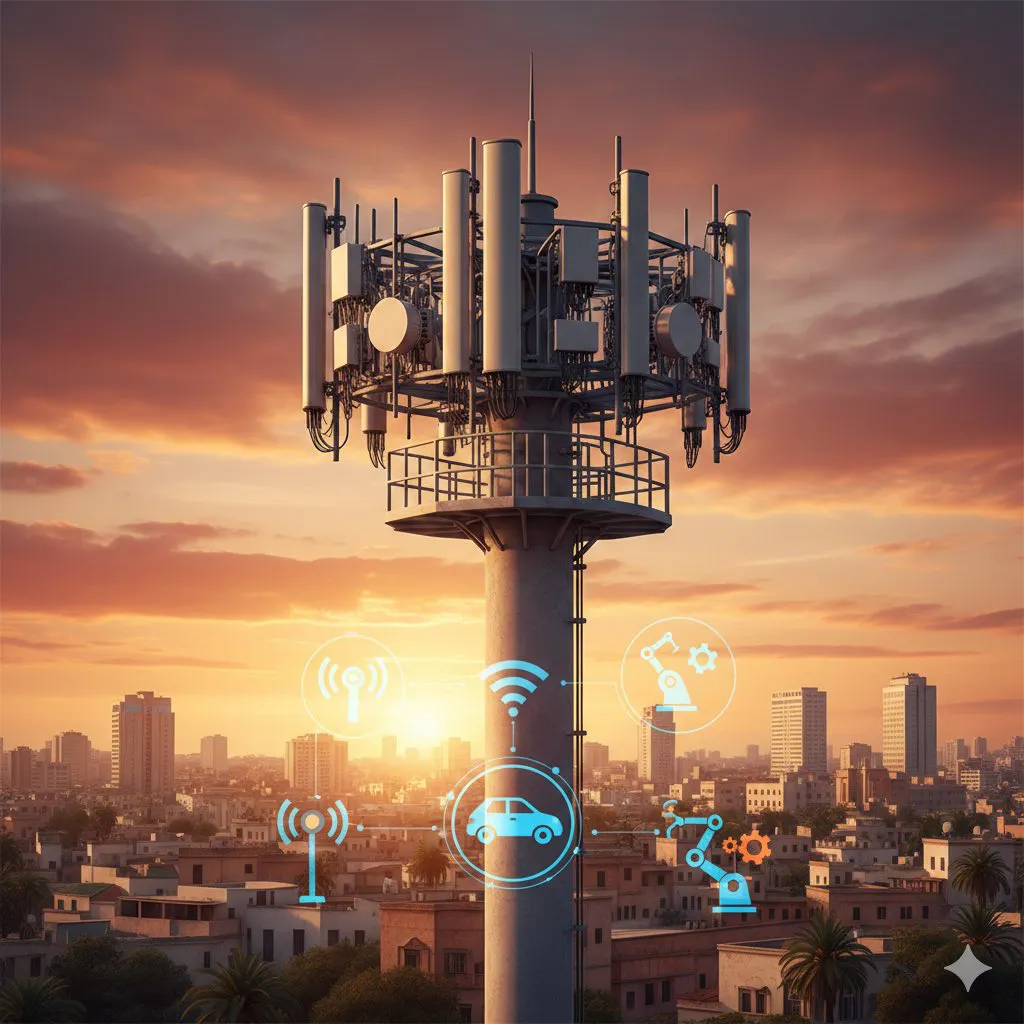
5G enables wireless sensor networks for predictive maintenance, autonomous guided vehicles requiring millisecond-level responsiveness, and computer-vision quality control on production lines. In January 2026, Ooredoo and ZTE hosted a 5G Vertical Industry Summit in Algiers demonstrating robot-assisted automation and smart manufacturing applications — a signal that operators are targeting enterprise revenue, not just consumer data plans.
Agriculture and Supply Chain
Algeria’s agricultural territories — from the Mitidja plain to the Saharan date palm oases — have been connectivity-constrained. 5G-connected IoT sensors can monitor soil moisture, temperature, and nutrients in real time, feeding cloud AI platforms that generate irrigation recommendations. Drone fleet coordination over large fields and real-time GPS tracking of produce from field to market can target the 30-40% post-harvest losses that currently plague the country’s vegetable production.
Healthcare
Algeria’s healthcare system suffers from severe geographic imbalance, with specialists concentrated in the northern cities. 5G-quality video and low latency make remote diagnostics viable: a patient in Tamanrasset consulting a cardiologist in Algiers with near-in-person quality. Remote patient monitoring via wearables becomes practical at scale.
Advertisement
The Cloud-5G Nexus: Why They Are Inseparable
Here is the core thesis for Algerian tech leaders: 5G without cloud is infrastructure without a brain.
A manufacturing plant with 10,000 connected sensors generates gigabytes of data per hour. That data has zero value on a local server — it has value when processed by AI models running on cloud platforms that identify patterns, predict failures, and trigger automated responses.
5G also enables edge computing — processing data close to where it is generated rather than in a centralized data center. Each of Algeria’s three operators will need to deploy edge computing nodes within their 5G base station infrastructure, creating a new market for cloud-at-the-edge services. Globally, the edge computing market enabled by 5G is projected to reach $232 billion by 2030.
Critically, no major hyperscaler (AWS, Azure, Google Cloud) currently operates a data center in Algeria. Combined with Law 18-07, which requires local data hosting for citizen and transaction data, this creates both a constraint and an opportunity. Local and regional cloud providers have a window to capture demand before international players establish in-country presence.
Challenges: An Honest Assessment
Coverage timeline. 5G currently covers a small fraction of Algeria’s territory. The Saharan south — 85% of national landmass — will not see 5G for years. For oil and gas operations, Saharan agriculture, and southern tourism, satellite connectivity may remain the only viable option. International studies estimate full national coverage at $3-8 billion in infrastructure investment.
Device affordability. Entry-level 5G smartphones start at roughly 24,500 DZD (~$150) based on February 2026 market prices, with mid-range devices around 42,000-78,000 DZD. With GDP per capita at approximately $4,400, mass consumer adoption will be slow. 4G will remain dominant for most consumer applications through at least 2028-2029.
Operator fragmentation. Three competing 5G networks mean each covers less territory than a consolidated approach would allow. Network roaming agreements between operators are still being negotiated and are not yet operational.
What Businesses Should Do Now
- Pilot 5G use cases in high-value operations. Factory floor connectivity, field service management, and supply chain visibility offer the highest initial ROI. The Ooredoo-ZTE summit demonstrated tangible industrial applications — this is not theoretical.
- Assess cloud architecture for 5G readiness. If your applications cannot deliver value over mobile networks or your data architecture is not designed for real-time sensor streaming, 5G investment will not pay off.
- Engage operator enterprise teams. Mobilis, Djezzy, and Ooredoo all offer enterprise sales units with 5G private network options for industrial customers. Negotiate now while operators are hungry for flagship enterprise accounts.
- Plan for data sovereignty. Law 18-07 requires local hosting. Bank of Algeria Instruction 02-2025 sets the framework for digital banking. If your 5G-enabled application handles personal or financial data, your cloud infrastructure must be in-country.
- Watch the edge computing market. As operators deploy edge nodes in 5G base stations, new service models will emerge. Early movers who build for edge-native architectures will have a structural advantage.
Frequently Asked Questions
How will 5G change Algeria’s tech landscape?
5G enables sub-10ms latency and speeds above 1 Gbps, unlocking real-time IoT applications, edge computing, cloud gaming, and telemedicine that 4G cannot support. For Algerian businesses, it means cloud-first architectures become viable even in areas where fixed broadband is limited.
When will 5G be widely available across Algeria?
Initial 5G rollout covers major cities — Algiers, Oran, Constantine — with commercial availability expanding through 2026-2027. Full national coverage will take 3-5 years, with rural areas likely served last.
What business opportunities does 5G create in Algeria?
Smart manufacturing, precision agriculture with real-time sensor networks, autonomous logistics, telemedicine in underserved areas, and immersive education/training platforms. Companies building 5G-native applications now will have first-mover advantage.