From Demo Stage to Assembly Line
For years, humanoid robots were a conference-stage spectacle — a company would show a robot walking, folding laundry, or doing a backflip, and the applause would be followed by years of silence about actual deployment. That pattern broke in 2026. Figure AI’s CEO Brett Adcock announced on July 23, 2026 that the company’s BotQ facility had manufactured its 1,000th Figure 03 humanoid robot, commemorating the milestone with a golden-finished unit built alongside the standard charcoal-grey fleet.
The number matters less than the curve behind it. Figure had reported roughly 350 units produced as of late April 2026, meaning the company added roughly 650 more units in about three months — a pace built on hitting one robot manufactured per hour at BotQ by late April, according to the same report. That acceleration follows a brutal 2025: Forbes reported that Figure shipped only about 150 units in all of 2025, per an Omdia research estimate, before the company doubled its shipment volume in each of three consecutive months in early 2026. Figure’s own announcement of the BotQ facility states that its first-generation manufacturing line is capable of producing up to 12,000 humanoids per year, giving Figure enormous headroom above its current run rate.
Atlas Goes to Work at Hyundai and DeepMind
While Figure scaled its own factory, Boston Dynamics took a different route: shipping its flagship humanoid directly into a car plant. Boston Dynamics unveiled the production version of its fully electric Atlas robot on January 5, 2026, during Hyundai’s global media day presentation at CES in Las Vegas. Hyundai Motor Group — Boston Dynamics’ majority shareholder — has committed to deploying “tens of thousands” of the company’s robots across its manufacturing facilities, backed by a $26 billion investment in U.S. operations that includes a dedicated robotics factory capable of producing 30,000 units annually.
The entire first production run is already spoken for. Every Atlas unit built in 2026 is committed to two destinations: Hyundai’s Robotics Metaplant Application Center (RMAC), where the robots will work directly on assembly-line tasks, and Google DeepMind, which is using its allocation for research and to train foundation models on a top-tier physical robotics platform. Boston Dynamics confirmed that a newly announced partnership with Google DeepMind aims to integrate DeepMind’s foundation models into Atlas to expand the robot’s cognitive capabilities for handling varied industrial tasks — pairing Boston Dynamics’ hardware with DeepMind’s foundation-model research. Additional commercial customers beyond Hyundai and DeepMind won’t receive units until early 2027, according to the company’s own announcement. Hyundai Mobis, the group’s parts subsidiary, will supply the actuators for Atlas and is working with Boston Dynamics to build out a reliable component supply chain as production accelerates.
Two Manufacturing Philosophies, One Market
Figure and Boston Dynamics represent two distinct bets on how humanoid robotics scales. Figure is optimizing for raw manufacturing throughput — a dedicated factory line pushing toward a rated capacity of 12,000 robots a year, aimed broadly at logistics and warehouse tasks. Boston Dynamics, by contrast, is starting with a single deep-pocketed anchor customer that also happens to own a controlling stake in the company, using Hyundai’s automotive assembly lines as the proving ground before expanding to a wider commercial customer base in 2027. Both approaches sidestep the traditional venture-backed hardware trap — years of pilot programs with no committed buyer — by locking in a production customer before scaling manufacturing capacity.
The component cost curve is also moving fast enough to matter. Figure’s newer Figure 03 model achieved a 90% component cost reduction compared to its Figure 02 predecessor, according to the company’s own product materials reported by Forbes — the kind of cost compression that turns humanoid robots from a research curiosity into an equipment-budget line item a factory manager can actually justify. The same generation of hardware also carries meaningfully upgraded sensing: Figure 03 ships with an improved camera system and fingertip tactile sensors capable of detecting forces as light as 3 grams, according to the company’s product specifications reported by Forbes — precise enough to distinguish a firm grip from a bruising one, which matters directly for tasks like handling fragile parts on a logistics line.
Advertisement
The Wider Market Context
Figure and Boston Dynamics aren’t operating in isolation — they’re racing inside a market that is still tiny relative to its own five-year forecast. Technology.org’s July 2026 industry roundup notes that humanoid robots are now logging real hours on factory floors, hospital corridors, and warehouse operations rather than sitting in prototype status, with automotive manufacturing standing out as the clearest early success story — automakers are deploying humanoids for constrained-space component installation, quality inspection, and materials handling, the exact task categories Hyundai has earmarked for its RMAC-bound Atlas fleet. That framing matters for anyone trying to size the opportunity: the current production numbers from Figure and Boston Dynamics, impressive as the growth curve looks, are still a rounding error against the multi-million-unit annual shipment volumes that analysts project for the next decade — meaning the manufacturing capacity being built today (BotQ’s 12,000-unit rating, Hyundai’s 30,000-unit robotics factory) is itself only a fraction of what forecasters expect the market to eventually need.
What This Means for Manufacturers Evaluating Humanoid Robots
1. Treat 2026-2027 as the pilot-to-production inflection, not the starting line
Manufacturers still waiting for “humanoid robots to mature” are watching that maturation happen in real time at Figure’s BotQ and Hyundai’s RMAC. Budget planning for 2027 procurement should assume unit costs and lead times both improve materially from where they sit today, given the 90% component cost drop already recorded between Figure’s second and third generation models.
2. Expect single-anchor-customer deployment models, not open marketplaces
Both Figure and Boston Dynamics are prioritizing committed, large-volume customers over broad marketplace availability in 2026. A manufacturer hoping to buy a handful of humanoid robots off a general order sheet this year will likely be disappointed — the near-term market favors companies willing to commit to fleet-scale deployment or strategic partnership, as Hyundai and Google DeepMind have done with Atlas.
3. Separate the hardware bet from the foundation-model bet
The Boston Dynamics–Google DeepMind partnership signals that the physical robot and the AI model driving it are increasingly built by different specialists and integrated afterward, rather than developed in-house end to end by a single company. Procurement teams should evaluate a humanoid robot vendor’s foundation-model partnerships as carefully as its actuator specs — the cognitive layer is where task flexibility, not raw mobility, will differentiate deployments.
The Manufacturing Test Humanoid Robotics Just Passed
The real headline from 2026 isn’t that a robot can walk or manipulate objects — that bar was cleared years ago in demo videos. It’s that two very different companies proved they could build humanoids at a rate measured in robots per hour rather than robots per year, and that one of the world’s largest automakers was willing to commit tens of thousands of units and billions of dollars in factory investment on the strength of that production curve. The next test isn’t technical — it’s economic: whether Figure’s 12,000-unit BotQ capacity and Hyundai’s 30,000-unit robotics factory can find enough paying industrial customers by 2028 to justify the capital already committed. For now, the pilot phase that defined humanoid robotics for a decade is visibly over.
Frequently Asked Questions
How many Figure 03 humanoid robots has Figure AI built?
Figure AI manufactured its 1,000th Figure 03 humanoid robot on July 23, 2026, according to CEO Brett Adcock. That is up from roughly 350 units reported in late April 2026, reflecting a production ramp that reached one robot manufactured per hour at the company’s BotQ facility, which is rated for up to 12,000 units annually.
Where is Boston Dynamics shipping its electric Atlas robots in 2026?
Every Atlas unit produced in 2026 is committed to two destinations: Hyundai’s Robotics Metaplant Application Center (RMAC), where the robots perform assembly-line tasks, and Google DeepMind, which is using its units for robotics research and foundation-model training. Additional commercial customers will not receive Atlas units until early 2027.
Why is Hyundai investing so heavily in Boston Dynamics’ robots?
Hyundai Motor Group is Boston Dynamics’ majority shareholder and has committed to deploying tens of thousands of the company’s robots across its manufacturing operations, backed by a $26 billion U.S. investment that includes a robotics factory designed to produce 30,000 units annually by 2028. The bet reflects Hyundai’s strategy of vertically integrating humanoid robotics into its own automotive manufacturing rather than relying solely on external suppliers.
Sources & Further Reading
- BotQ: A High-Volume Manufacturing Facility for Humanoid Robots — Figure
- Boston Dynamics Unveils New Atlas Robot to Revolutionize Industry — Boston Dynamics
- A Golden Milestone: Figure Manufactures Its 1,000th Figure 03 Humanoid — Humanoids Daily
- This Humanoid Robot Maker Is Doubling Deliveries Every Month — Forbes
- Humanoid Robots in 2026: What Is Actually Deployed — Technology.org
🔗 Related Intelligence
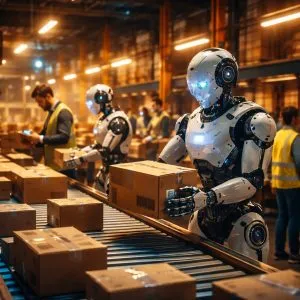
Humanoid Robotics Gold Rush: $14 Billion and the Race to Automate Warehouses
The Humanoid Robot Race: How AI Is Powering the Next Generation of Physical Automation
Humanoid Raises $152M Series A at $1.35B, Becomes Europe’s First Pure-Play Robotics Unicorn
Robotics Foundation Models: The Real Breakthrough Is Software, Not Hardware