A New Mediterranean Backbone
Medusa is the most ambitious submarine cable project in the Mediterranean in a decade. Operated by AFR-IX Telecom as a neutral and independent infrastructure operator, the system spans more than 8,700 km of subsea cable with 24 fibre pairs, each carrying 20 Tbps, for a total design capacity of 480 Tbps. The €342 million (~$400 million) project is co-funded by AFR-IX, Orange and EU programmes including the Connecting Europe Facility (CEF) – Digital, NextGenerationEU and DG NEAR, giving it uncommon financial and political weight.
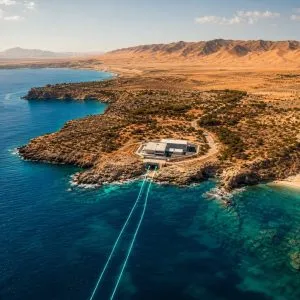
Landings have been announced in rapid succession: Marseille (France) in October 2025, Bizerte (Tunisia) in November 2025, and Nador (Morocco) in December 2025. Algeria is listed among the 21 confirmed landing points, alongside Portugal, Spain, Morocco, Tunisia, Malta, Libya, Greece, Cyprus, Egypt and Jordan. Additional landings continue through 2026 per the operator's published roadmap.
What 480 Tbps Actually Buys Algeria
Algeria's international connectivity has historically leaned on a handful of older Mediterranean systems (SEA-ME-WE 4, ORVAL, Algérie Télécom's legacy routes). Medusa is an order-of-magnitude upgrade in both headline capacity and route diversity. The design-life of 25 years means the cable is meant to be a backbone asset well into the 2040s.
For Algerian ISPs and enterprises, three concrete things change. First, wholesale IP transit prices in the Mediterranean basin should fall over the next 24 months as Medusa capacity comes online — the standard pattern after any new system lights up. Second, latency to European interconnects and public cloud regions improves: a direct fibre-pair from an Algerian landing to Marseille puts enterprise traffic two or three hops from most of western Europe's internet exchanges. Third, route diversity reduces the single-system risk that has repeatedly hit North African connectivity (anchor strikes, repair delays) when traffic piles up on one or two aging cables.
Advertisement
The Open-Access Model Matters
Medusa is structured as an open-access, neutral infrastructure — AFR-IX sells capacity as full or half fibre-pair services rather than operating as a vertically integrated carrier. This matters for Algeria specifically. Open-access capacity is easier for competitive ISPs and independent cloud providers to buy than capacity controlled by a single incumbent. The result, in other markets where Medusa-style models have been used, is denser peering, more local content hosting, and lower prices for end-customers.
This doesn't happen automatically. It depends on ARPCE and Algérie Télécom allowing non-incumbent buyers (private ISPs, local cloud providers, international CDNs) to acquire and terminate Medusa capacity on fair terms. The next 12-18 months will show whether the backbone upgrade actually translates into retail and wholesale price reductions.
What Algerian Decision-Makers Should Do
Enterprise IT leaders should revisit international-connectivity contracts that are up for renewal in 2026. Ask current carriers explicitly whether their transit path leverages Medusa capacity and request price benchmarks against new-build providers using Medusa. Cloud architects should re-evaluate whether to keep primary workloads in European regions now that latency and bandwidth costs to Frankfurt, Marseille or Madrid should improve. And domestic data-center operators should consider Medusa a material input to their value proposition — the same cable that makes European cloud cheaper also makes Algerian hosting more attractive for customers serving European users.
Frequently Asked Questions
What is the Medusa cable and why does it matter for Algeria?
Medusa is an 8,760 km submarine cable system spanning the Mediterranean, designed with 24 fibre pairs at 20 Tbps each for 480 Tbps total capacity. Algeria is one of 21 confirmed landing countries, alongside Spain, France, Italy, Portugal, Morocco, Tunisia, Egypt and others. It is operated by AFR-IX Telecom as a neutral, open-access infrastructure — meaning any carrier or ISP can buy capacity. For Algeria, it is the biggest bandwidth upgrade in more than a decade.
When does Algerian capacity come online?
Marseille was lit in October 2025, Bizerte in November 2025, and Nador in December 2025. Additional landings are scheduled through 2026. The system is built for a 25-year operational life and is funded by a €342 million (~$400 million) partnership including AFR-IX Telecom, Orange and EU programmes such as Connecting Europe Facility – Digital and NextGenerationEU.
Will Algerian internet prices drop because of Medusa?
Probably yes at the wholesale level over the next 12-24 months — new subsea capacity historically drives transit prices down in the affected basin. But whether those savings reach Algerian retail customers depends on ARPCE's rules around open access and Algérie Télécom's pricing decisions. Enterprise buyers who negotiate transit contracts in 2026 should explicitly ask carriers to price Medusa-enabled paths.