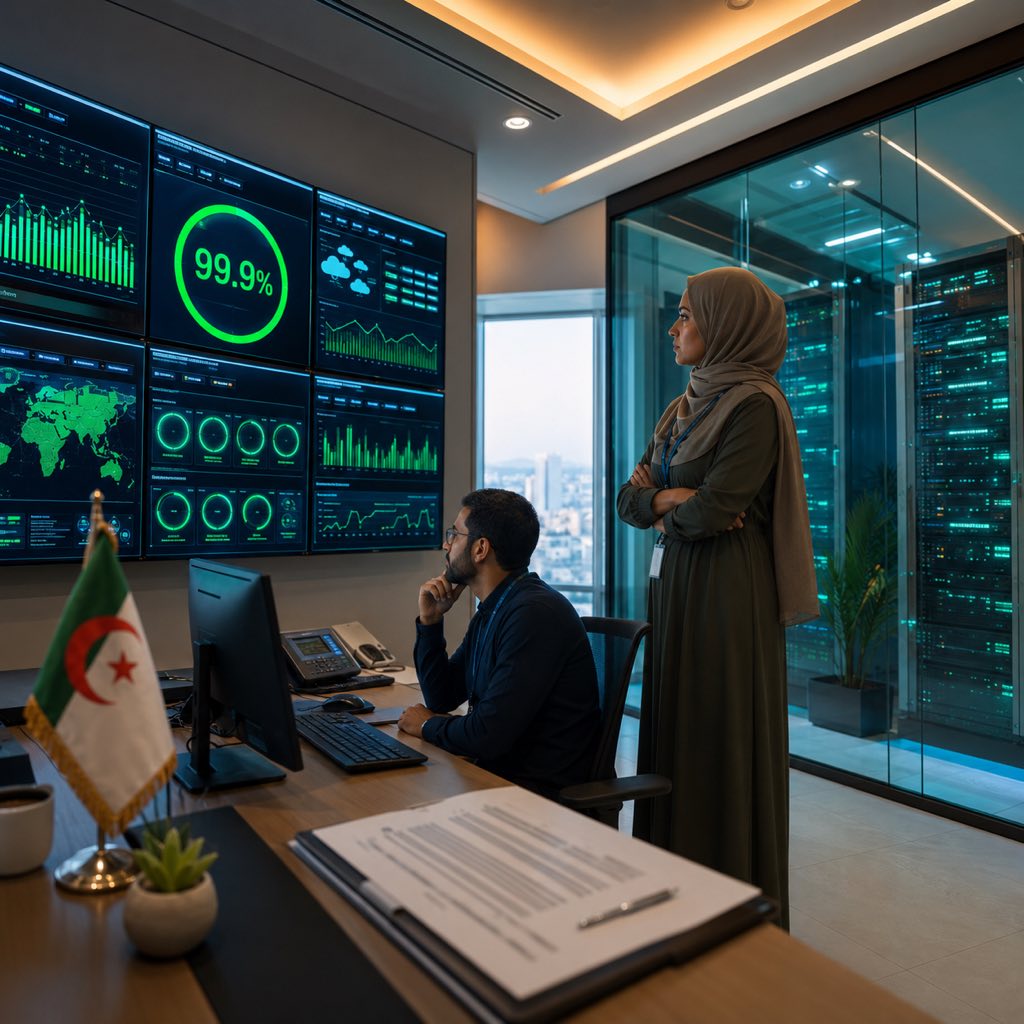
The Gap Between “99.9%” on the Brochure and Hours Offline in Reality
Algerian enterprises are migrating workloads to the cloud faster than ever. National fibre coverage reached 3 million households connected to fibre-to-the-home in February 2026, and the regulator’s award of 5G licences to three operators for nearly $492 million in late 2025 signals a connectivity base that finally supports serious cloud adoption. Sovereign providers such as Ayrade — which hosts more than 1,000 companies from its Rahmania data centre in Algiers and entered the Algiers Stock Exchange in 2026 — sit alongside AT Cloud and AventureCloudz, while the hyperscalers AWS, Microsoft Azure and Google Cloud court the same enterprise budgets.
But the marketing number — “99.9% uptime!” — hides the real exposure. A Service Level Agreement (SLA) is a contract, not a promise of perfection, and the difference between two adjacent “nines” is the difference between a tolerable inconvenience and a day-long outage. Most procurement teams sign without translating the percentage into hours, and without checking what they are actually owed when the provider misses it.
What Each “Nine” Actually Costs You in Downtime
The arithmetic is unforgiving and worth memorising before any negotiation:
- 99.9% (“three nines”) allows about 8.76 hours of downtime per year — roughly 43 minutes a month.
- 99.95% allows about 4.38 hours per year.
- 99.99% (“four nines”) allows about 52.6 minutes per year — only 4.32 minutes per month.
- 99.999% (“five nines”) allows about 5.26 minutes per year — rare and expensive.
Each extra nine costs disproportionately more to engineer and to buy. The crucial point Algerian buyers miss: as analysts note, hyperscaler SLAs are per-service, not per-provider, and the headline 99.99% figure usually applies only when you deploy across two or more availability zones. A single-instance virtual machine often carries a weaker SLA — sometimes 99.5% or none at all — so the “four nines” you think you bought may not cover the architecture you actually run.
Service Credits: A Refund of the Bill, Not the Loss
Here is the clause that surprises first-time enterprise buyers. When a provider breaches its SLA, the remedy is almost always a service credit — a percentage of that month’s bill for the affected service, applied against future invoices. Across AWS, Azure and Google Cloud, these credits typically range from 10% to 100% of the monthly fee, tiered by how badly the target was missed.
Consider the gap. If an Algerian e-commerce firm pays 200,000 DZD a month for compute and suffers a six-hour outage during a peak sales window, the service credit might return 10–25% of that monthly fee — perhaps 20,000–50,000 DZD. The lost transactions, abandoned carts, and reputational damage could be many multiples of that. The credit is real, but it is a refund of part of what you paid the provider, never compensation for what the downtime cost your business. Worse, credits are rarely automatic — most providers require the customer to file a claim within a fixed window, often 30 days, with their own monitoring logs as evidence.
Advertisement
Local Sovereign Cloud vs Global Hyperscaler: A Practical Trade-Off
The choice is not simply “local is patriotic, global is powerful.” Each path carries distinct SLA implications for an Algerian enterprise.
Sovereign providers keep data physically inside Algeria — Ayrade’s leadership frames data sovereignty as the core of the value proposition, which matters for organisations bound by data-residency expectations and for latency to Algerian users. Their backbone often connects directly to Algérie Télécom’s international PoP. The trade-off is that a single-region domestic provider cannot offer the multi-region failover that underpins a hyperscaler’s 99.99% guarantee, so resilience depends more heavily on its backup power and redundancy — a real consideration given that energy reliability is the central operational challenge across African data centres, where the continent runs about 360 MW of operational capacity with 238 MW more under construction.
Hyperscalers offer multi-zone and multi-region architectures and mature credit ladders, but the nearest regions sit outside Algeria, adding latency and raising data-residency questions. Their SLAs are also conditional: you only earn the 99.99% number if you build to their reference architecture, which costs more.
What Algerian Enterprise IT Leaders Should Do
1. Translate every SLA percentage into annual downtime hours before comparing quotes
Do not let “99.9%” and “99.95%” sit on a comparison sheet as raw percentages — convert them to 8.76 hours/year vs 4.38 hours/year and map that against your tolerance for your most critical workload. A back-office reporting system may live happily at three nines; a payment gateway or a customer-facing storefront during peak season should target 99.95% or better. Decide the tier per workload, not one blanket number for the whole estate, and put the hour figures directly into your procurement scorecard.
2. Read the service-credit ladder and the claim mechanics, not just the headline number
Ask three questions of every provider: what percentage of the bill is credited at each breach tier, what is the claim window (often 30 days), and does the customer or the provider bear the burden of proof? Insist that the contract names the monitoring source of truth — your data or theirs — so a disputed outage does not become a he-said-she-said. Where possible, negotiate automatic credits triggered by the provider’s own status dashboard rather than a manual claim you might forget to file.
3. Negotiate failover, data residency, and escalation clauses explicitly
For sovereign providers, ask what happens during a regional power event and whether a secondary site or hot standby is available. For hyperscalers, confirm in writing which architecture (single-AZ, multi-AZ, multi-region) earns which SLA, and specify the data-residency region. In every contract, add an escalation clause: named technical contacts, a maximum response time for severity-1 incidents, and a defined path to a human engineer — not a ticket queue — when production is down.
4. Build your own monitoring so you can prove a breach
The credit you are owed is only collectable if you can evidence the outage. Deploy independent uptime monitoring (synthetic checks from outside the provider) and retain logs. This converts a vague “we were down for hours” into a timestamped claim the provider must honour, and it gives your board an objective availability record independent of any vendor’s marketing.
The Bigger Picture for Algeria’s Cloud Decade
Algeria is entering a genuine cloud-adoption phase, with fibre and 5G removing the connectivity bottleneck that long held enterprises back, and a maturing field of sovereign and global providers competing for the same workloads. That competition is healthy — it gives buyers leverage they did not have five years ago. The opportunity now is to build enterprise procurement discipline to match: treating the SLA as a negotiable risk-management instrument rather than fine print to skim past. The organisations that learn to read uptime tiers, model service credits against real revenue, and write their own failover and escalation clauses will extract far more value from the cloud than those who sign on the headline number. As regional analysts note, enterprise cloud adoption across the continent moves through long sales cycles shaped by data sovereignty and risk governance — Algerian firms that invest in SLA literacy today will be the ones negotiating from strength tomorrow.
Frequently Asked Questions
What is the real difference between 99.9% and 99.99% cloud uptime?
99.9% (“three nines”) permits about 8.76 hours of downtime per year, while 99.99% (“four nines”) caps it near 52.6 minutes per year — roughly 4.32 minutes per month. The extra nine costs significantly more to engineer and usually requires deploying across multiple availability zones, so confirm your architecture qualifies for the tier you are paying for.
Do cloud service credits compensate for revenue lost during an outage?
No. Service credits refund a percentage (typically 10–100%) of the affected service’s monthly bill, applied against future invoices — not the revenue, transactions, or reputation lost during the outage. Credits are also usually claim-based, requiring the customer to file within a window (often 30 days) with their own monitoring evidence.
Should an Algerian enterprise choose a local sovereign cloud or a global hyperscaler?
It depends on the workload. Sovereign providers like Ayrade keep data inside Algeria and offer low latency to local users, which suits data-residency-sensitive workloads, but a single domestic region cannot match a hyperscaler’s multi-region failover. Hyperscalers offer stronger resilience architectures and mature credit ladders but host data outside Algeria. Many enterprises adopt a hybrid split by workload sensitivity.
Sources & Further Reading
- Algeria Reaches Milestone as 3 Million Households Connect to Fibre Broadband — Tech Africa News
- Algeria Awards 5G Licenses to Three Operators for Nearly $492 Million — Ecofin Agency
- Africa Data Centre Market 2026: Structural Growth, Energy Constraints and Long-Term Investment Strategy — Zawya
- Cloud SLAs Compared: What AWS, Azure & GCP Actually Guarantee — Webalert
- 99.9% Uptime: What Your Cloud Provider Isn’t Telling You — Siliceum
- SLA Uptime Calculator: What is a Good Uptime Percentage? — Notifier
- Lamine Belbachir, PDG d’Ayrade, sur la souveraineté numérique — TSA Algérie
🔗 Related Intelligence

Algeria’s Licensed Cloud Providers in 2026: ARPCE, ISAAL, Ayrade, eBS and ADEX — Who Hosts What

Algeria’s Cloud Infrastructure Market: AYRADE IPO, New Players, and Enterprise Strategy

Cloud Engineering Careers in Algeria: Where Enterprise Demand Is Accelerating in 2026

ARPCE Cloud Directives: A Compliance Map for Algerian SaaS and Hosting Providers