The 25x Power Density Jump That Changes Everything
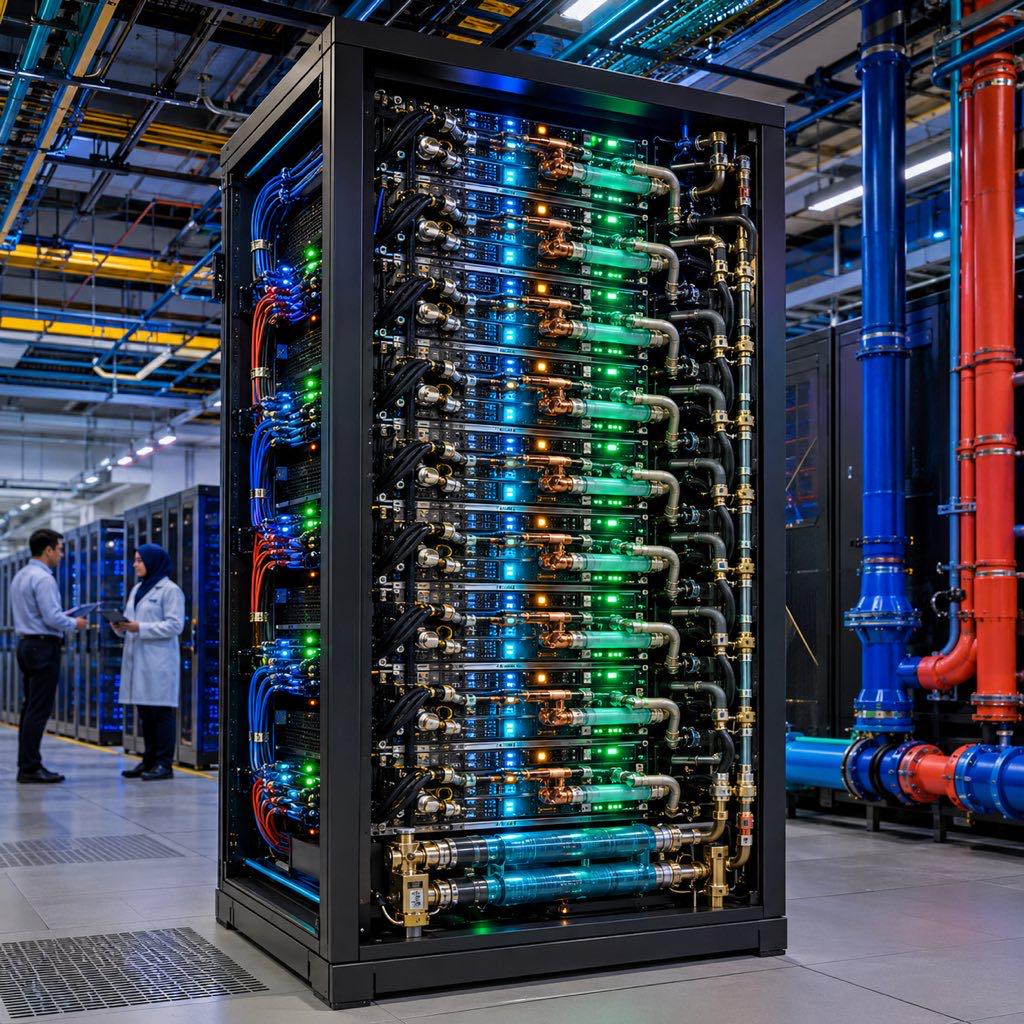
Traditional high-performance computing racks run at 30-40 kilowatts. Well-designed HPC clusters from five years ago operated at 50-80 kW per rack. AI training infrastructure is now being designed to approach 1,000 kilowatts — 1 megawatt — per rack. That is not an incremental improvement; it is a category change.
The shift was confirmed at Data Center World 2026. Varun Sakalkar from Google stated plainly: “We’re not designing a rack anymore — we’re designing a system.” Ram Nagappan from Oracle Cloud Infrastructure described the design constraint: “You have to take both into account when you build the data center” — referring to the divergent requirements of training clusters (tightly coupled GPUs, latency-optimized) and inference systems (distributed availability, user-responsiveness optimized). Sean James from Nvidia acknowledged the power challenge: “Behind-the-meter power is a good stopgap — not the preferred long-term solution.”
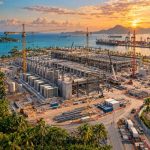
These are not theoretical observations. Oracle Project Jupiter in New Mexico is specifically transitioning from gas turbines to fuel-cell microgrids to handle high-density AI workloads. The Aligned Data Centers Project Caprock in Texas is a 540 MW campus, 313 acres, six facilities, $5 billion economic impact, designed around AI-era power requirements. These projects represent the new normal in hyperscaler construction, not edge cases.
What the old design envelope looked like: a raised-floor computer room with precision air conditioning, 30-40 kW per rack, uniform aisle hot/cold separation, and a power usage effectiveness (PUE) target of 1.4 or below. What the new design envelope requires is fundamentally different.
Liquid Cooling: From Optional to Mandatory
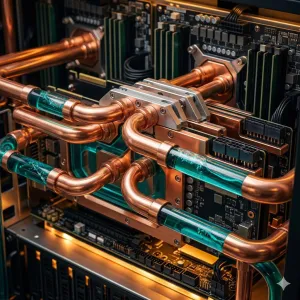
The reason for the paradigm shift is thermodynamic. Air simply cannot remove heat fast enough from a 1 MW rack. A kilogram of air has a specific heat capacity of approximately 1 kJ/kg·°C; a kilogram of water has a specific heat capacity of approximately 4.2 kJ/kg·°C. Water removes heat four times more efficiently than air at the same mass flow rate. At megawatt rack densities, air cooling is physically incapable of keeping GPU junction temperatures within specification.
At Data Center World 2026, the consensus was clear: liquid cooling is now mandatory for high-density AI systems, not optional. The industry focus has shifted from debating whether to use liquid cooling to standardizing which type and how to manage coexistence with legacy air-cooled infrastructure.
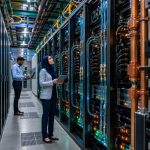
The practical challenge is hybrid management. Most real data centers are not greenfield AI training facilities — they are existing facilities that also run traditional enterprise workloads on air-cooled equipment. Managing the coexistence of liquid-cooled AI clusters and air-cooled legacy servers in the same building requires careful pressure management, separate cooling circuits, and meticulous separation of hot/cold aisles from liquid distribution manifolds. Organizations that try to add liquid-cooled AI racks to existing air-cooled rooms without structural planning typically create hot spots, corrosion risks from condensation, and maintenance access problems.
The water challenge also scales in unexpected ways. Evaporative cooling — the dominant technology in large-scale air-cooled data centers — uses significant volumes of water for heat rejection. As racks grow denser and facilities scale, operators are actively trying to “engineer out water where they can,” as described by attendees at Data Center World 2026. Direct liquid cooling (direct-to-chip or immersion) actually uses less water than evaporative air-cooled systems at equivalent load levels — a counterintuitive result that is driving adoption beyond pure thermal performance.
Advertisement
What Infrastructure and Engineering Leaders Should Do
1. Reclassify Your Data Center Capacity in Megawatts per Cabinet, Not Square Feet
The square-foot metric for data center capacity is obsolete for AI workloads. A 10,000 square foot traditional computer room might house 200 racks at 30 kW each for 6 MW total. An equivalent 10,000 square feet designed for AI workloads might house 20 racks at 300 kW each for the same 6 MW — or 10 liquid-cooled racks at 600 kW each for the same footprint at double the capacity. The implication: your current colocation or data center agreement is written in square feet, but your AI workload needs are measured in kilowatts per cabinet. Before signing any new colocation contract or data center lease, convert the capacity specification to kW-per-rack and verify the facility’s power infrastructure, cooling circuit capacity, and backup generation can actually deliver the rated kilowatts at your target rack density. Do not assume a “10 MW facility” means 10 MW delivered to your racks at high density — verify the distribution architecture.
2. Plan Liquid Cooling Infrastructure as a Capital Project, Not a Retrofit
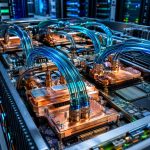
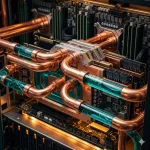
Liquid cooling infrastructure — chilled water distribution, in-row cooling units, direct-to-chip manifolds, or immersion tanks — requires building-level planning. It cannot be retrofit into a raised-floor air-cooled computer room without structural modifications, additional MEP work, and often floor load recalculation. If your organization will deploy GPU clusters of more than 50 kW per rack within the next 24 months, start the liquid cooling capital project now. The lead time for purpose-built liquid cooling infrastructure in new construction is 12-18 months; in retrofit scenarios, it is 18-30 months due to permitting, structural assessment, and MEP contractor availability. Waiting until you have the GPU purchase order in hand means a 2-year deployment delay. Plan the infrastructure before you need it.
3. Separate Training and Inference Workloads at the Design Stage
Oracle, Google, and Nvidia all articulated the same design principle at Data Center World 2026: AI training clusters and AI inference systems have divergent infrastructure requirements, and designing a facility that tries to optimize for both simultaneously produces a facility that is excellent at neither. Training clusters need: tightly coupled GPU interconnects (InfiniBand or NVLink fabric), ultra-low-latency storage (NVMe over fabric), and power stability (training jobs that fail mid-run due to a power event waste weeks of GPU time). Inference systems need: distributed CDN-like availability, user-facing latency optimization, high redundancy, and the ability to scale out horizontally. These are different buildings, or at minimum different floors with different power and cooling circuits. Organizations that run mixed training-inference facilities today should evaluate whether the operational complexity penalty (different maintenance windows, different network architectures, different SLA requirements) justifies the co-location savings.
The Structural Lesson: Data Centers Are Now Buildings That Compute
The megawatt-rack transition reflects a deeper structural change: data centers are no longer passive buildings that house computing equipment — they are integrated systems where the building and the compute are co-designed. Varun Sakalkar’s statement at Data Center World 2026 that “we’re not designing a rack anymore — we’re designing a system” points to the logical conclusion: the facility, the power infrastructure, the cooling architecture, and the compute stack are a single engineering product.
This mirrors the evolution of semiconductor fabrication, where the cleanroom and the fab equipment became inseparable co-designed systems decades ago. Data centers are following the same trajectory, and the pace is accelerating: projects like Aligned Data Centers’ 540 MW Texas campus and Oracle Project Jupiter are already designed around this integrated philosophy.
For infrastructure leaders outside the hyperscaler tier — enterprise data center managers, regional colocation operators, university HPC center directors — the structural lesson is that the talent and tooling required to manage data centers has permanently changed. Electrical engineers managing megawatt-class power delivery, mechanical engineers designing liquid cooling circuits, and systems engineers coordinating training-inference workload topology are now baseline requirements, not specialties. Organizations that plan their infrastructure team for the legacy 40 kW-per-rack world will be unable to operate the infrastructure they need for AI within three to five years.
Frequently Asked Questions
What is driving the shift from 40 kW to megawatt-class rack power densities?
The primary driver is GPU-based AI training workloads. Modern AI accelerators (Nvidia H100, H200, and successor chips) draw 700W-1000W each, and AI training requires hundreds to thousands of GPUs in tightly coupled clusters. A 100-GPU rack running H100s draws approximately 70-100 kW; a 256-GPU DGX SuperPOD equivalent can approach 350-500 kW per rack. As GPU counts per rack increase with next-generation interconnect architectures, densities approach 1 MW per rack. This is physically impossible to cool with air at standard data center air velocities — hence the mandatory shift to liquid cooling.
What are the main liquid cooling technologies being deployed in AI data centers?
The three primary approaches are: direct-to-chip (cold plate) cooling, where chilled liquid runs through plates mounted directly on processors; in-row liquid cooling, where rear-door heat exchangers capture hot air before recirculation; and full immersion cooling, where servers are submerged in dielectric fluid. Direct-to-chip is the most widely deployed in production AI clusters because it achieves high heat transfer efficiency while maintaining access to servers for maintenance. Immersion cooling delivers the highest heat removal efficiency but complicates server maintenance and has higher initial capex.
How should enterprises that are not building hyperscaler-scale facilities respond to these trends?
Enterprises planning any data center investment or colocation contract renewal should take three steps: first, convert their capacity requirements from square feet to kilowatts per cabinet and verify vendor infrastructure can deliver at their target density; second, evaluate whether their planned GPU workloads in the next 3 years require liquid cooling and begin planning the capital project or colocation RFP accordingly; third, separate AI training infrastructure requirements from inference requirements in their architectural planning — these have divergent needs that lead to different facility designs and different vendor choices.
Sources & Further Reading
🔗 Related Intelligence
AI Data Centers: How They Work and Why They Matter
Modular Data Centers: The 6-Month Build Strategy Disrupting AI Infrastructure
The $700B Hyperscaler Bet: Why Power and Cooling Are Now the AI Infrastructure Ceiling
Two-Phase Direct-to-Chip Cooling: How Data Centers Tame 250kW AI Racks in 2026