What $112 Billion in One Quarter Actually Means
The numbers from Q1 2026 hyperscaler earnings require context to be understood. AWS, Azure, and Google Cloud did not choose to spend $112 billion in a single quarter on infrastructure out of excess caution — they spent it because their customers are committing to AI infrastructure faster than the providers can build it.
Google stated it is “compute constrained in the near term” despite committing to $180-190 billion in full-year 2026 capex. Its backlog — representing signed contracts for future cloud services — exceeded $460 billion in Q1, nearly doubling quarter-over-quarter. Google’s Gemini AI service is processing 16 billion tokens per minute via direct API access, growing 60% quarter-over-quarter. 330 of Google’s customers each processed over 1 trillion tokens in a single quarter — a number that corresponds to sustained, high-volume AI production deployments, not experimentation.
Microsoft Azure grew cloud revenue 40% year-over-year on an estimated 2026 capex trajectory of approximately $120 billion. Amazon Web Services grew revenue 28% year-over-year while its year-over-year capex surged to $59.3 billion — the company shipped 2.1 million AI chip units over the preceding 12 months and raised approximately $54 billion in debt in March 2026 to fund continued expansion.
The combined picture is a simultaneous bet across three of the world’s largest companies that AI inference and training will become the dominant enterprise compute workload within 2-3 years. The $112 billion quarterly spend is not infrastructure for current demand — it is infrastructure for projected demand 18-36 months ahead.
The Three Structural Shifts Behind the Numbers
Understanding why hyperscalers are spending at this pace requires examining three structural shifts that make the investment rational rather than speculative.
First, inference has overtaken training as the primary compute demand driver. AI training — building and refining models — was the initial GPU demand driver from 2022 through 2024. By 2026, inference — serving AI model outputs to end users at scale — consumes the majority of AI compute. An enterprise that deploys a single GPT-4-class model for customer support across 10,000 agents generates continuous, 24/7 inference demand. Multiply this by thousands of enterprise customers, and the aggregate inference compute requirement grows faster than any previous enterprise software category.
Second, the economic model has shifted from software margins to infrastructure margins. Traditional enterprise software businesses earn 70-80% gross margins by selling licenses or subscriptions with near-zero marginal cost per additional customer. AI cloud services have a fundamentally different cost structure: every incremental inference request costs compute. The hyperscalers are betting that volume — at the scale of trillions of tokens per quarter — will generate sufficient aggregate margin despite the lower per-unit margins of compute-intensive AI services.
Third, the competitive consequence of underbuilding is permanent market share loss. In traditional enterprise software markets, a vendor that underinvests in product development loses customers over 2-3 years as competitors build better features. In AI cloud, a vendor that underbuilds infrastructure loses customers in weeks — a customer whose AI workloads cannot scale because GPU capacity is unavailable will migrate to a competitor that has capacity. The $112 billion quarterly spend is partly driven by the existential fear of being the provider that says “no capacity available” at the moment a major enterprise customer wants to scale.
Advertisement
What the Numbers Tell Us About Data Center Design
The $112 billion quarterly capex is not evenly distributed across conventional data center construction. The investment is concentrated in three specific infrastructure categories that define AI-era data center design:
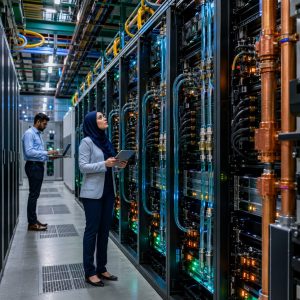
Liquid cooling at GPU density. Training and inference clusters require 10-100x more power density per rack than traditional server deployments. Standard air cooling cannot dissipate the heat generated by 8-GPU DGX H100 servers running at full load. Google, Microsoft, and Amazon are all deploying direct liquid cooling in new AI data center facilities — a technology shift that requires redesigned facility infrastructure from the floor up.
Custom silicon for AI workloads. All three hyperscalers have developed or are developing custom AI accelerators: Google’s TPUs (Tensor Processing Units), AWS’s Trainium and Inferentia chips, and Microsoft’s Maia AI accelerator. The $112 billion includes significant investment in these custom silicon programs, which are designed to deliver better performance-per-dollar for specific AI workloads than NVIDIA GPUs. Amazon’s 2.1 million chip shipments include its custom silicon alongside NVIDIA hardware.
Power procurement at unprecedented scale. A 200-megawatt AI data center consumes as much electricity as a mid-sized city. IREN’s Sweetwater campus — a neocloud competitor — has 2 gigawatts of capacity. The hyperscalers are investing in long-term power purchase agreements, nuclear power deals, and renewable energy contracts at a scale that did not exist in the enterprise technology industry three years ago.
What Enterprise Cloud Buyers Should Take Away
The $112 billion hyperscaler capex sprint has direct implications for enterprise cloud strategy, particularly for organizations making multi-year cloud commitments.
1. Negotiate Capacity Commitments Now, Not at Peak Demand
Google’s public statement that it is “compute constrained in the near term” — despite historic infrastructure investment — confirms that AI GPU capacity is a rationed resource. Enterprise customers who negotiate capacity commitments at the time of contract renewal are in a stronger position than those who request GPU capacity on-demand when a project scales unexpectedly. Capacity reservation contracts, reserved instance discounts, and committed use agreements are all more favorable today than they will be when AI workloads compete for the same GPU pools.
2. Diversify Across Hyperscalers and Neoclouds
The simultaneous scale of all three major hyperscaler investments creates a temporary window where all three providers are competing aggressively for enterprise AI commitments. This competitive dynamic produces pricing concessions, service level enhancements, and support commitments that will narrow once market positions stabilize. Enterprise cloud architects who evaluate both hyperscalers and neoclouds (IREN, CoreWeave, Lambda Labs) in the same RFP process extract better commercial terms than those who default to incumbent providers.
3. Build Cost Governance Before Scaling AI Inference
The State of FinOps 2026 report found that 98% of organizations now formally manage AI spend — up from 31% two years ago. The reason is simple: AI inference costs scale non-linearly with usage. An enterprise that deploys an AI assistant for internal use and sees adoption grow from 100 to 1,000 daily users faces a 10x compute cost increase without any corresponding change in the business value equation. Enterprise cloud architects scaling AI workloads on hyperscaler infrastructure should implement cost tagging, budget alerts, and autoscaling limits before usage scales — not after the first surprise invoice.
The Correction Scenario
The $112 billion quarterly capex pace creates a scenario risk that enterprise cloud buyers should factor into long-term planning: a demand correction. If enterprise AI adoption slows — due to economic headwinds, regulatory restrictions on AI deployment, or a wave of enterprises discovering that AI projects deliver less value than projected — the hyperscalers will have massively overbuilt infrastructure relative to demand.
The consequence for enterprise buyers in a correction scenario would be price competition, as excess capacity gets monetized at reduced rates. Bank of America’s forecast of $175 billion in hyperscaler debt issuance for 2026 — over 6 times the prior five-year average — means the three providers have taken on significant leverage against the AI demand thesis. If that thesis proves correct, the infrastructure investments create compounding competitive advantages. If it proves premature, the debt service pressure could force pricing changes that benefit enterprise buyers in the short term but destabilize the market in the medium term.
Enterprise cloud strategy should hedge against both scenarios: negotiate multi-year commitments that lock in current pricing for predictable workloads, while maintaining flexibility on variable workloads to capture potential price corrections.
Frequently Asked Questions
Why are hyperscalers spending $112 billion in a single quarter when AI adoption is still early?
The hyperscalers are building infrastructure now because data centers take 18-36 months to design, permit, and construct. Building for current demand means having no capacity for projected demand in 2027-2028 — and AI inference demand is growing 60%+ quarter-over-quarter at providers like Google Cloud. Google’s $460 billion backlog of signed customer contracts further validates that enterprise AI demand is not hypothetical: customers have already committed to the spend, and hyperscalers are racing to build the infrastructure to fulfill those commitments before competitors do.
How does the hyperscaler capex race affect cloud pricing for enterprise customers?
In the near term, competition for enterprise AI contracts is driving pricing concessions, capacity guarantees, and support enhancements. In the medium term (2026-2027), as new data center capacity comes online, GPU availability constraints will ease and per-token inference pricing will continue declining. Bank of America forecasts that hyperscaler debt issuance will reach $175 billion in 2026 — significantly above historical averages — creating financial pressure that, in an overcapacity scenario, could accelerate price competition. Enterprise buyers are best positioned when they negotiate multi-year commitments during the current competitive window.
What is the difference between AI training compute and AI inference compute, and why does it matter for cloud spending?
AI training is the process of building and refining a model — it is compute-intensive but happens once per model version (or periodically for fine-tuning). AI inference is serving the trained model to users — it runs continuously for every query, document, or customer interaction. By 2026, inference has overtaken training as the primary AI compute demand driver because enterprise AI deployments are in production at scale, generating continuous query traffic. This shift matters for cloud spending because inference demand is continuous, predictable, and grows with enterprise user adoption — making it the primary driver of the $112 billion quarterly infrastructure investment.
—
Sources & Further Reading
- The $112 Billion Quarter: Hyperscalers Bet the Farm on AI — Tom Tunguz
- Google Cloud vs AWS vs Azure: Q1 2026 AI Infrastructure Race — MindStudio
- AI CapEx 2026: The $690B Infrastructure Sprint — Futurum Group
- Big Tech Hyperscalers Will Spend $700 Billion on AI Infrastructure This Year — Fortune
- State of FinOps 2026 Report — FinOps Foundation