Why Kenya’s Model Stalled — and What It Reveals About the Right Template
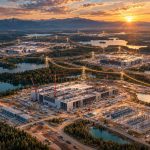
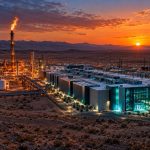
The Microsoft-G42 geothermal data center project in Kenya was announced with genuine ambition: a $1 billion facility powered by KenGen’s Olkaria geothermal fields near Naivasha, targeting 100 MW of IT capacity by May 2026. Kenya’s government suspended the project in May 2026 after it became clear that the data center’s power requirement — approximately 1 GW including cooling and overhead — represented roughly one-third of Kenya’s entire 3 GW installed national grid capacity. President William Ruto stated the problem directly: “To switch on that one data centre, we would need to shut off power for half the country.”
Beyond raw power math, secondary complications included Microsoft and G42’s request for guaranteed annual payment commitments from the Kenyan government for reserved capacity — a financial structure that Kenya’s National Treasury declined to approve.
The Kenya case is instructive not as a failure story but as a diagnostic tool. It reveals precisely what hyperscalers require for a large-scale African data center commitment: renewable energy at meaningful scale, grid capacity that absorbs the facility without dominating it, and a government counterparty willing to provide bankable infrastructure guarantees. Algeria’s current energy trajectory addresses the first two criteria in ways Kenya could not.
Algeria’s Solar Build: The Numbers That Matter
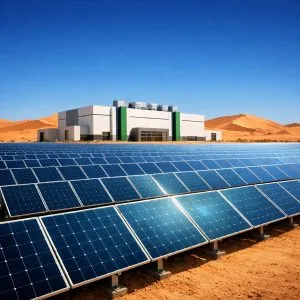
Algeria plans to commission nine new photovoltaic power plants totaling 1,480 MW of capacity by August 2026. According to ESI Africa, this is part of Algeria’s national energy transition programme, drawing on the Sahara’s exceptional solar irradiance — consistently among the highest in the world at over 3,000 hours of sunshine per year.
This matters in data center context for two specific reasons. First, 1,480 MW is additive new capacity on a national grid that already has adequate generation for domestic demand — unlike Kenya’s 3 GW total capacity, Algeria’s grid can absorb a major data center without supply crisis. A 100 MW data center campus on Algerian soil represents less than 7 percent of the new solar capacity being commissioned this year alone. Second, photovoltaic generation in the Sahara corridor produces at high capacity factors during daylight hours with predictable seasonal curves, making power purchase agreement (PPA) structuring straightforward for international investors who need revenue certainty in project finance models.
The Africa & Middle East data center colocation market, growing at 22.8% annually to reach $11.1 billion by 2030, is driven significantly by hyperscalers that have published net-zero carbon commitments. A solar-backed Algerian facility directly addresses the ESG procurement criteria that now govern hyperscaler infrastructure decisions.
Advertisement
What Algerian Policymakers and Infrastructure Partners Should Do
1. Structure a Dedicated Renewable Energy Zone for Data Center Development Near the Southern Grid
Algeria’s solar plants are concentrated in the south and Hauts Plateaux, where irradiance is highest. The practical model is to designate a Renewable Energy Data Center Zone — a defined geographic area with grid connection, fiber backhaul to the Algerian national network, and pre-approved land rights — that international data center developers can access through a single administrative window. Singapore’s Jurong Innovation District and Rwanda’s Kigali Innovation City used this model to accelerate hyperscaler commitments: the zone pre-solves the permitting, connectivity, and energy questions so that investor due diligence focuses on commercial terms, not regulatory navigation. For Algeria, a zone anchored to the Ghardaïa or Biskra corridor — connected to the coastal fiber network and within the 1,480 MW solar capacity build — would provide the “one-stop” infrastructure profile that hyperscalers require for initial site evaluation.
2. Develop a Bankable PPA Framework Between Sonelgaz and International Data Center Investors
Kenya’s data center stalled in part because the Kenyan government could not structure a bankable energy commitment. Algeria must avoid the same failure mode by preparing Sonelgaz’s renewable division to offer a standardized power purchase agreement template for data center developers: fixed-price solar electricity supply, denominated in a stable currency, with force majeure provisions and minimum supply guarantees over a 10 to 15 year term. International data center project finance requires energy cost certainty over the loan amortization period — typically 12 to 15 years. A Sonelgaz PPA template that satisfies this requirement, reviewed by international legal counsel and approved by the Ministry of Energy, converts Algeria’s solar surplus from a national asset into a commercially deployable product for foreign infrastructure investment.
3. Commission a Feasibility Study for a Pilot Green Data Center at 10-20 MW Scale
Before pursuing hyperscale ambitions, Algeria should commission a public-private feasibility study for a pilot green data center at 10 to 20 MW IT load — large enough to attract tier-two cloud providers as anchor tenants, small enough to be built within 24 to 36 months without grid strain. The Africa Data Centers Association’s 2026 economic report identifies 10 to 20 MW facilities as the optimal entry point for markets developing initial hyperscaler relationships, because they match the minimum capacity threshold at which global cloud providers evaluate regional colocation partnerships. The feasibility study should cover: grid connection costs, PPA pricing from Sonelgaz, fiber backhaul to Algeria’s Mediterranean cable landing stations, cooling technology options suited to the Algerian climate, and water consumption modeling (a critical consideration in the Sahara where water is scarce — dry-side economizer cooling or liquid immersion cooling should be evaluated over water-cooled towers).
4. Package Algeria’s Green Data Center Offer Through AfDB and IFC Partnership Channels
The African Development Bank and the International Finance Corporation both have active data center and digital infrastructure investment mandates. Algeria’s sovereign-grade creditworthiness and renewable energy profile qualify it for concessional co-financing structures that reduce the cost of capital for private data center developers below commercial rates — typically 200 to 400 basis points cheaper than pure commercial debt in frontier markets. This cost-of-capital advantage is what allows African nations to price colocation competitively against established Mediterranean hubs like Marseille. The Ministry of Finance and Algérie Télécom should jointly develop a data center investment prospectus — following the template used by Rwanda for its Kigali Innovation City data center cluster — and present it through AfDB’s digital infrastructure desk and IFC’s sector team.
The Structural Lesson from Kenya
The fundamental lesson of the Kenya-Microsoft episode is not that Africa is not ready for hyperscale data centers. It is that energy infrastructure sequencing matters: the grid must be able to absorb the facility before the facility is announced. Kenya announced first and discovered the power math second.
Algeria’s approach — commissioning solar capacity at national scale before structuring data center partnerships — is the correct sequence. The NewLines Institute’s analysis notes that Algeria’s geographic position between Europe and sub-Saharan Africa, combined with its energy resources, creates the conditions for a regional digital infrastructure anchor that is structurally different from the capacity-constrained markets that have dominated Africa’s data center narrative so far.
The window is not permanent. Morocco is actively developing its Atlantic and Mediterranean coastal data center presence. Egypt’s hyperscaler relationships are deepening. If Algeria moves in the next 24 months — with a designated zone, a bankable PPA framework, and a pilot facility — it establishes a reference anchor that attracts the second and third hyperscaler commitments through demonstrated execution. If it waits, the regional data flow will route around it just as reliably as internet packets find alternate paths.
Frequently Asked Questions
Why did Microsoft’s Kenya data center fail despite Kenya’s geothermal energy advantage?
The fundamental problem was scale mismatch: the proposed data center required approximately 1 GW of power from a national grid with only 3 GW total capacity. Geothermal energy is Kenya’s most reliable renewable resource, but even geothermal cannot supply one-third of a nation’s total grid capacity to a single facility. A secondary issue was the payment guarantee structure — Microsoft and G42 wanted Kenya to commit to paying for reserved capacity even if unused, which Kenya’s National Treasury declined. The combination of physical infrastructure constraints and financing structure incompatibility made the project unviable in its original form.
How does Algeria’s climate affect data center cooling — a key operational cost?
Algeria’s Sahara climate presents both opportunities and challenges for data center cooling. High ambient temperatures (40°C+ in summer in the south) rule out traditional air-side economizer cooling during summer months, which works well in cooler climates. However, the low humidity in the Sahara corridor makes certain direct evaporative cooling approaches viable with modest water consumption. Modern liquid immersion cooling or rear-door heat exchanger systems are effective in high-ambient-temperature environments and should be evaluated as the primary cooling architecture for Algerian facilities. Water consumption modeling is essential: a 20 MW data center using water-cooled towers in a Sahara location could consume 100,000+ liters per day — a meaningful load in a water-scarce environment.
What role does the Africa Data Centers Association play in supporting new markets?
The Africa Data Centers Association (Africa DCA) serves as the industry body for data center operators across the continent, publishing economic reports, standard-setting guidance, and advocacy with African governments on regulatory frameworks for data center investment. Its 2026 economic report identifies North Africa as an underserved sub-region relative to its energy and connectivity assets, specifically calling out the gap between North Africa’s solar resources and its data center investment. Algeria becoming a member and engaging with Africa DCA’s investment facilitation program would provide access to the broker and hyperscaler networks that route new facility commitments.
Sources & Further Reading
- Energy Shortfall Scuppers Kenya’s $1B Microsoft Data Center — Semafor
- Africa & Middle East Data Center Colocation Data Report 2026 — GlobeNewswire
- Algeria to Commission 1.48 GW of Solar Capacity by August — ESI Africa
- Why Algeria Is Positioned to Become North Africa’s AI Leader — New Lines Institute
- Data Centres in Africa 2026: The Economic Report — Africa DCA
- Microsoft and G42 to Build Geothermal-Powered Data Center in Kenya — Data Center Dynamics
🔗 Related Intelligence

African Digital Summit: Algeria’s Infrastructure Bet

ICT Africa Summit in Algiers: Algeria’s Bid to Lead Continental Digital Infrastructure
Algeria’s 500 Digital Projects: Infrastructure Build-Out Powering National Cloud Demand
Pairing Saharan Green Hydrogen with Data Centers: A Playbook for Algeria’s Next Digital Infrastructure Wave