From Capital Sprint to Physics Problem
The AI infrastructure buildout of 2026 has crossed a threshold that no amount of financial commitment can simply overcome. According to Futurumgroup and Yahoo Finance analysis, hyperscalers have committed $700 billion in combined 2026 capex — the largest single-year technology capital deployment in history. The individual commitments are staggering: Amazon at a $200 billion annualized run rate, Alphabet at $175-185 billion, Meta at $115-135 billion, Microsoft at approximately $120 billion, and Oracle at $50 billion.
But a detailed read of what is actually blocking deployment reveals a pattern that financial analysts have rarely confronted in technology coverage: the limiting factor is physical infrastructure at the grid level, not software, not semiconductors, not even GPU supply. Analysis by Introl.com documents that Microsoft is sitting on an $80 billion unfulfilled Azure customer backlog — orders it has received but cannot service because the data centers to run those workloads lack available electrical connection. The grid connection, not the server rack, is the delivery constraint.
The macroeconomic signal is equally striking: for the first time in the industry’s history, hyperscalers collectively hold more debt than cash. The Big Five issued $121 billion in bonds in 2025 alone. Alphabet’s February 2026 bond issuance included a 100-year sterling instrument — a century bond, the instrument of last resort for organizations expecting very long payback horizons. JP Morgan and Morgan Stanley project the technology sector may need $1.5 trillion in new debt financing to complete the AI infrastructure build.
Three Hard Limits That Capital Cannot Simply Solve
1. Grid Interconnection Queues: The Seven-Year Wait
In Northern Virginia — the single densest concentration of data center capacity on Earth — the queue to connect a new large-scale facility to the power grid now extends approximately seven years. In Texas’s ERCOT territory, requests for large-load grid connections surged 700% between 2023 and 2024, from 1 gigawatt to 8 gigawatts of pending applications. These are not administrative delays; they are physical capacity constraints in transmission lines, substations, and the electrical switching infrastructure that routes power from generation to consumption.
The transformer shortage compounds the problem. High-voltage transformer lead times have risen to 128 weeks — more than double the pre-2020 baseline — and prices have increased 77% since 2019. Transformer demand has grown 116% over the same period, driven simultaneously by data center expansion, electrical vehicle charging infrastructure, and renewable energy interconnection needs. A hyperscaler that finalizes a data center site today and immediately orders transformers will receive them in late 2028 at the earliest.
The consequence is that data center construction timelines have decoupled from equipment delivery timelines. Building a “warm shell” — a structurally complete building ready to receive equipment — requires 18-24 months. Grid connection requires 4+ years in constrained markets. The gap between a ready building and a connected building is the operational bottleneck that no capex increase resolves.
2. Liquid Cooling: The New Infrastructure Standard That Isn’t Yet Standard
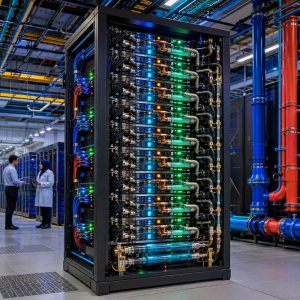
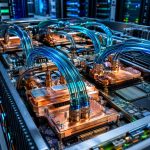
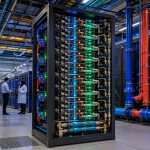
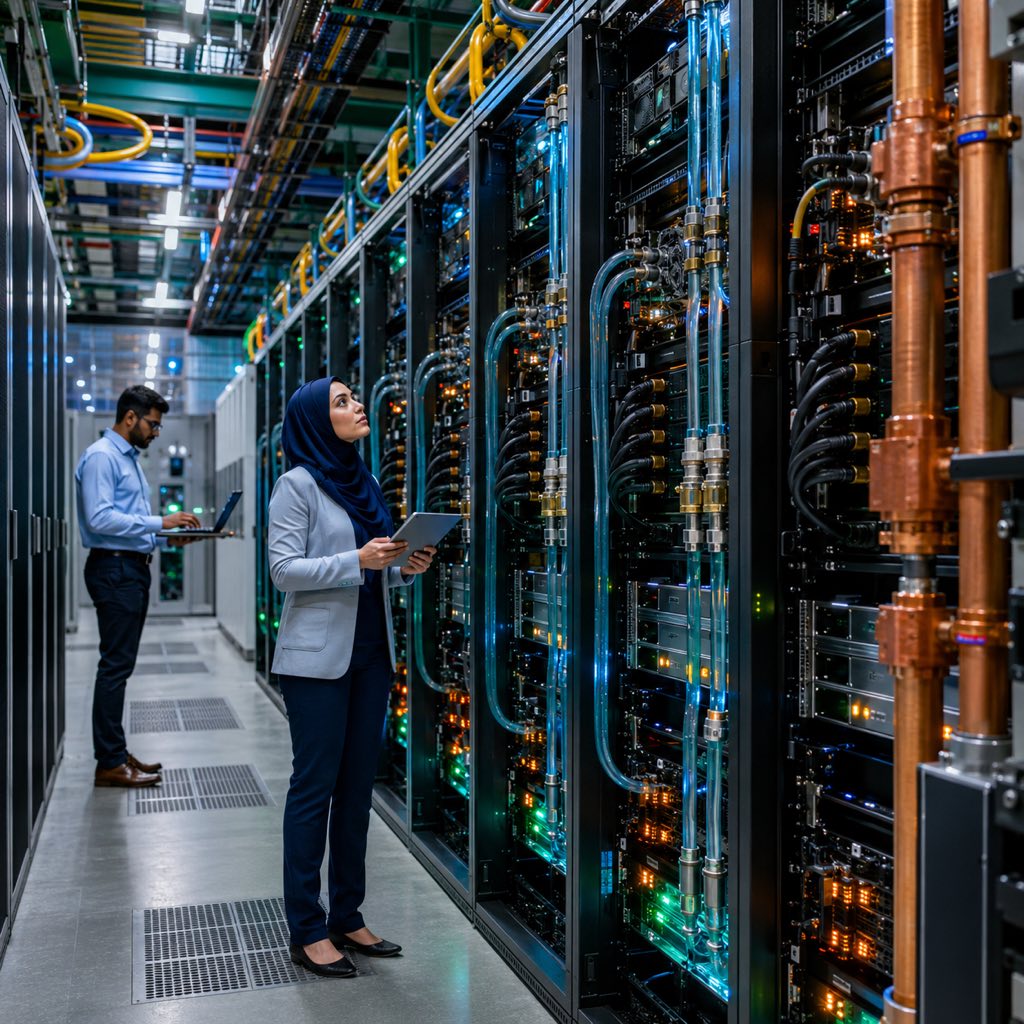
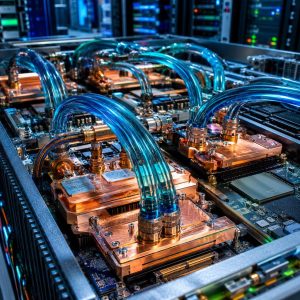
AI accelerators — NVIDIA H100 and H200 GPUs, Google TPUs, custom Microsoft Maia chips — generate heat densities that traditional air cooling cannot handle at modern rack densities. A rack populated with AI accelerators may draw 100 kilowatts or more; air cooling is economically viable only to approximately 15-20 kilowatts per rack. The industry is now mid-transition from air cooling to liquid cooling, but the liquid cooling supply chain is itself capacity-constrained.
The GlobeNewsWire report on hyperscaler capacity growth projects active IT load growing from 24.37 GW in 2025 to 147.13 GW by 2035 — a sixfold increase — with advanced cooling technologies identified as a prerequisite for the AI inference infrastructure segment. But the liquid cooling transition is not simply a technology selection decision; it requires retrofitting or replacing existing cooling distribution infrastructure, training facility operations teams, and managing the water supply and treatment requirements that direct liquid cooling introduces.
Equinix, the world’s largest data center colocation operator, reported that approximately 60% of its major Q4 2025 deals were AI-driven, and that customers specifically seeking liquid cooling-capable facilities were willing to pay premium rates and accept longer lead times. This creates a two-tier market: legacy air-cooled capacity that AI workloads cannot fully utilize, and premium liquid-cooled capacity with long wait lists.
3. Free Cash Flow Collapse: The Financial Signal That Something Must Give
The financial model underlying hyperscaler expansion in 2026 is structurally unprecedented. Hyperscaler capex now consumes nearly 100% of operating cash flows — against a ten-year historical average of 40%. The consequences are visible in the free cash flow projections: Amazon’s trailing free cash flow declined 95% to $1.2 billion; Alphabet’s projected 2026 free cash flow is approximately $8.2 billion against a 2025 actual of $73.3 billion; Meta’s projected free cash flow falls to approximately $4.4 billion from $43.6 billion in 2025.
Evercore ISI analysts have warned that sector-wide free cash flow has fallen below “yellow flag” levels and is approaching “red flag” territory. The mathematical constraint is that pure-play AI vendors are projected to generate only approximately $35 billion in 2026 AI service revenue — representing roughly 5% of the $660-700 billion in infrastructure being installed to serve them. The industry is operating on a 20:1 investment-to-current-revenue ratio, relying on an aggressive projection of future AI adoption to validate the capital deployment.
Advertisement
What CIOs and Infrastructure Leaders Should Do About It
1. Treat Power as a Procurement Criterion, Not an Assumption
Enterprise infrastructure decisions — particularly colocation site selection — have historically evaluated power as an input cost rather than an availability constraint. That framework is now broken. CIOs selecting colocation partners should explicitly evaluate power commitments as a contract term: guaranteed megawatt availability, interconnect queue position for expansion capacity, and fuel source diversity (a single-source power agreement in a grid-constrained market is a business continuity risk). In markets where grid constraints are most acute (Northern Virginia, Phoenix, Dublin), the premium for pre-secured power capacity is real and rising — enterprises willing to commit multi-year contracts are gaining access to capacity that spot-market buyers cannot reach.
2. Reassess Your AI Workload Colocation Strategy Against Cooling Availability
AI inference workloads cannot run efficiently in facilities without liquid cooling capability. CIOs planning to colocate AI inference infrastructure should audit their current and prospective colocation partners’ liquid cooling roadmaps — not just their current liquid cooling availability, but their committed upgrade timelines and their cooling capacity per rack in liquid-cooled zones. Facilities that offer liquid cooling only as a premium add-on with a 12-18 month lead time for provisioning are effectively imposing a delay tax on AI workload deployment. Negotiate cooling availability as a binding SLA term, not a feature to be requested later.
3. Model Your Cloud Spend Against Hyperscaler Backlog Risk
Microsoft’s $80 billion Azure unfulfilled backlog is a data point that every large enterprise Azure customer should incorporate into infrastructure planning. If a hyperscaler is capacity-constrained in its ability to provision new services, enterprises with growing AI workloads may face provisioning delays, regional availability gaps, or service tier limitations that are not reflected in current pricing or availability guarantees. Distribute workloads across at least two hyperscaler providers for AI-critical applications, not as a cost optimization strategy but as a provisioning redundancy strategy. The same risk applies to any hyperscaler with rapidly growing demand relative to available capacity.
The Structural Lesson: Infrastructure Investment Precedes Revenue
The deeper message from the 2026 hyperscaler capex sprint is about the mechanics of platform transitions. The hyperscalers are making a calculated bet — spending $700 billion to build infrastructure capacity for AI workloads that will generate far more than $700 billion in cumulative revenue over the next decade, if AI adoption follows the trajectory they project. The bet may prove correct; it may prove premature. But the physics constraints — power grid timelines, cooling supply chains, transformer shortages — are outside their control regardless of the financial commitment.
According to Archdesk’s global data center construction analysis, 2026 is seeing the largest single-year surge in data center construction in history, with over 30% of projects facing delays tied to power and cooling supply chain constraints. For enterprises watching this unfold, the structural lesson is that the hyperscalers’ infrastructure build is simultaneously the prerequisite for your AI capability and a constraint on your access to it. The organizations that will capture the most value from AI in 2027-2028 are the ones working now to secure power-committed colocation capacity, liquid cooling-capable facilities, and multi-hyperscaler provisioning agreements — before the backlog pressure that is currently visible in Northern Virginia and Dublin spreads to every major cloud region. The bottleneck is real, the timeline is known, and the preparation window is 2026.
Frequently Asked Questions
Why are hyperscalers spending so much more in 2026 than in prior years?
The acceleration is driven by AI model serving infrastructure: running large language models and AI agents at enterprise scale requires orders of magnitude more GPU compute than traditional cloud workloads. Hyperscalers are racing to build the GPU cluster and cooling infrastructure capable of serving this demand before competitors do. The $700 billion figure in 2026 compares to approximately $443 billion in 2025 — a 55% increase in a single year, driven entirely by AI infrastructure demand.
What is the practical impact on enterprise cloud customers if hyperscalers are capacity-constrained?
The most visible impact is provisioning delays for specific services and regions — particularly for GPU-based AI services and for deployments in heavily congested regions like Northern Virginia, Ireland, and Singapore. Enterprises may find that reserved instance commitments do not guarantee immediate service availability for AI workloads, and that new region deployments face longer lead times than historical norms. Multi-cloud and colocation strategies provide the most effective hedge against this provisioning risk.
Is liquid cooling safe and practical for enterprise data center operations?
Liquid cooling has been used in supercomputing and specialized environments for decades and is technically mature. The enterprise data center transition is primarily an operational and capital question, not a safety question. Direct liquid cooling (where coolant contacts server components) requires more careful maintenance protocols than air cooling, but modern systems are designed for enterprise operations teams. The more significant consideration is facility modification cost — retrofitting an existing air-cooled facility to support high-density liquid cooling typically costs $1-3 million per zone, which is why purpose-built liquid-cooled facilities command premium pricing.
Sources & Further Reading
- Hyperscalers Hit $700 Billion in 2026 — Yahoo Finance
- Hyperscaler CapEx $690B: Microsoft Azure Power Bottleneck 2026 — Introl
- Hyperscaler Data Center Capacity to Surge More Than 6x by 2035 — GlobeNewsWire
- AI CapEx 2026: The $690B Infrastructure Sprint — Futurum Group
- Global AI Data Center Construction 2026 — Archdesk
🔗 Related Intelligence
AI Data Centers: How They Work and Why They Matter

The $112 Billion Quarter: Inside the Q1 2026 Hyperscaler AI Infrastructure Sprint
Two-Phase Direct-to-Chip Cooling: How Data Centers Tame 250kW AI Racks in 2026
Power Before Chips: The $80B Azure Backlog That Reveals Hyperscalers’ Real Constraint