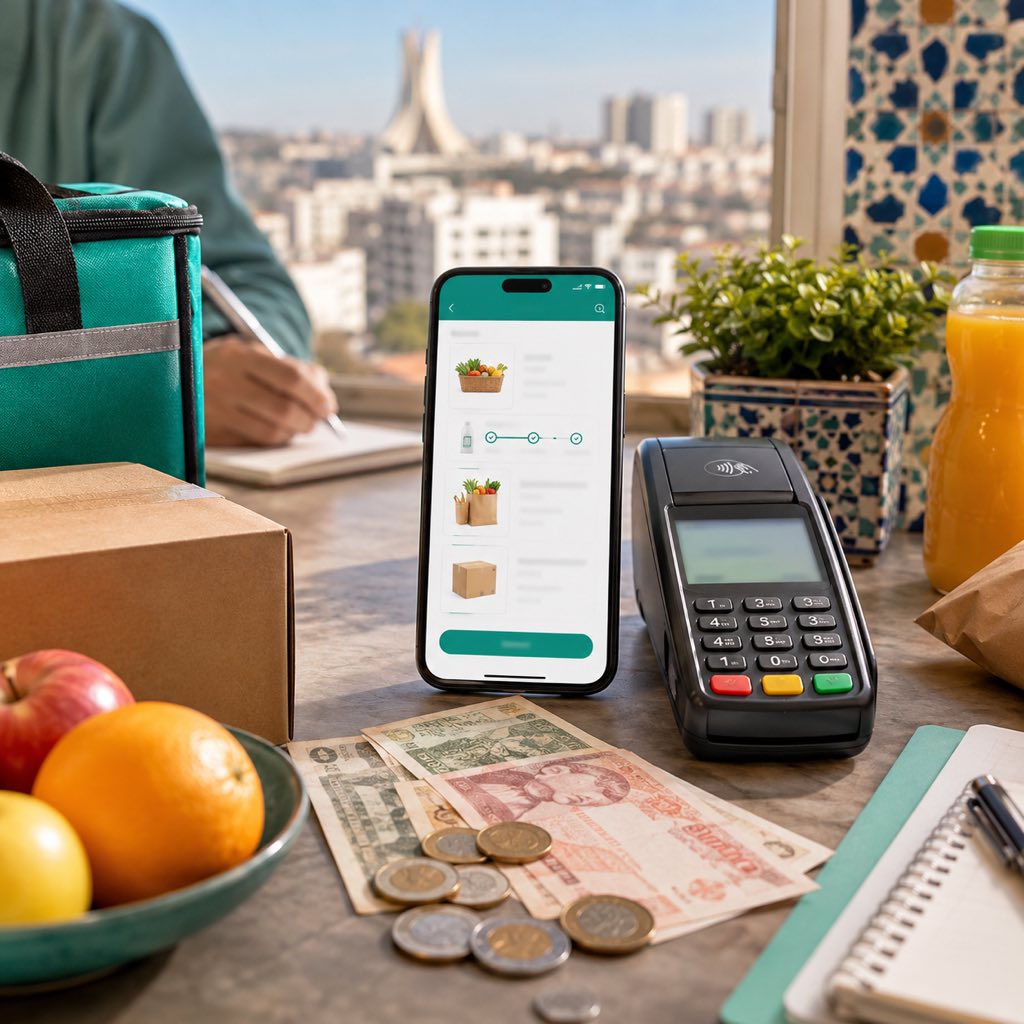
A Market That Defies Its Own Growth Numbers
Algeria’s e-commerce sector has one of the most paradoxical growth stories in the MENA region. According to EasySell’s 2026 Algeria e-commerce market analysis, the market has expanded at a 92% compound annual rate since 2020 and is projected to reach $2 billion by 2029. Meanwhile, electronic payments surged 46% in 2025 to 939 billion DZD, with online transactions alone hitting 145 billion DZD across 27 million operations — a 179% year-on-year increase. Internet penetration has crossed 77%, and there are 45 million potential consumers with a median age of 28.
By every metric, the addressable market is large and growing fast. And yet 95% of e-commerce orders in Algeria are still completed with cash paid to a delivery driver at the door — a rate that exceeds comparable markets including Saudi Arabia (60% COD) and Pakistan (75% COD).
This is not simply a technology-adoption lag. It reflects a set of structural trust mechanisms that digital payment infrastructure has not yet addressed: consumers who cannot inspect goods before payment, merchants who lack reliable dispute mechanisms, and a broader cultural comfort with cash that took decades to build and will not dissolve in response to a mobile wallet marketing campaign.
Understanding why COD persists — and what is actually moving the needle — is more useful for merchants and investors than the growth headline alone.
Why COD Persists Despite Infrastructure Improvements
The electronic payment infrastructure in Algeria has expanded significantly. Algeria’s 2025 digital payment data shows 78,774 POS terminals across the country (a 15.6% increase from 2024), 4,679 ATM machines, and QR code transactions reaching 69.3 million operations worth 57.3 billion DZD. BaridiMob, CIB cards, and Edahabia provide functional digital payment rails. The infrastructure argument — that COD dominates because there is no alternative — is no longer accurate.
The persistence of COD is better explained by three interlinked factors. First, return-to-sender rates in major cities run 15-20%, and exceed 30% in southern provinces, according to EasySell’s market data. For consumers who have experienced waiting 5-10 days for a delivery that arrives damaged or different from the listing, COD is rational risk management — they pay only when satisfied. Second, the merchant side lacks robust dispute resolution mechanisms that would give consumers recourse after digital payment. Third, average order values of 2,500-6,000 DZD ($18-$44 USD) are low enough that consumers do not consider it worth the effort of setting up a digital payment credential they rarely use.
The 179% growth in online payments is real, but it is concentrated in sectors where the product cannot be delivered physically — telecommunications top-ups (12+ million transactions), administrative service fees (7.6 million), and utility payments. These are not COD-competing sectors. The e-commerce transaction itself — physical goods ordered online and delivered to a door — remains overwhelmingly cash-settled.
Advertisement
Yassir’s Hybrid Model: Physical Trust as the On-Ramp
The most strategically significant development in Algeria’s e-commerce landscape in 2026 is not a payment app launch or a fintech regulatory update. It is Yassir’s acquisition of the Uno retail chain from Cevital Group and the subsequent rebranding of those stores as Yassir Market — with the flagship location opening at Bab Ezzouar Shopping Center in Algiers.
According to WORLDEF’s coverage of the expansion, the acquisition integrates physical retail with Yassir’s digital services. Stores carry groceries, consumer goods, cosmetics, and food while simultaneously serving as fulfillment centers for online orders and delivery services. Customers can shop in-store or online, with payments running through Yassir Cash — the company’s payment system backed by thousands of agents nationwide — and loyalty points accumulating through the Yassir+ program across all services.
The strategic logic is sound. Yassir’s acquisition fills the retail gap left by Jumia’s exit from Algeria, while doing something a pure-play digital merchant cannot: establishing physical trust infrastructure where consumers can see, touch, and return products without the friction of a postal dispute process. The same consumer who will not pay digitally for an online order from an unfamiliar merchant is willing to use Yassir Cash in-store, because the physical store provides the inspection-before-payment assurance that COD provides in delivery.
Over time, the in-store digital payment habit becomes the bridge. A consumer who regularly pays with Yassir Cash at a Yassir Market location is far more likely to complete an online order digitally than one who has only ever used BaridiMob for a telecom top-up. This is the COD transition model that the market has been waiting for — not a digital-only push, but a physical-digital hybrid that meets consumers where trust currently lives.
What Algerian Merchants and Operators Should Do Now
1. Build COD Management into Your Unit Economics Before Optimizing for Digital Conversion
The merchants most vulnerable in Algeria’s current e-commerce environment are those who priced their operations on the assumption that COD return rates would normalize toward MENA averages. With RTO rates at 15-30% depending on governorate, and COD requiring logistics infrastructure that delivers, collects cash, and reconciles daily, the cost of COD is often underestimated at business launch.
Before investing in digital payment conversion campaigns, calculate your actual COD economics: delivery cost per order, return-to-sender rate by wilaya, cash reconciliation overhead, and the working capital impact of having cash in transit across a 58-wilaya delivery network. For many merchants, optimizing logistics to reduce RTO rates — better product photography, size guides, pre-delivery confirmation calls — delivers more margin improvement than a 5-point shift from COD to digital payment.
2. Integrate with Yassir Market’s Fulfillment Infrastructure Before the Network Scales
The Yassir Market network is in its early expansion phase. Merchants who establish wholesale supply relationships with Yassir Market now — before the network reaches scale — are positioned to gain shelf placement and digital catalog inclusion under more favorable terms than will be available once the retail footprint is established. The WORLDEF report confirms Yassir is also building B2B logistics infrastructure for wholesale and institutional clients, which represents a distinct channel from consumer e-commerce and carries lower RTO risk.
Separately, Yassir’s agent network for Yassir Cash represents a COD collection alternative. Rather than maintaining your own cash-collection logistics, integrating with Yassir Cash’s agent network for last-mile collection can reduce per-order cash-handling costs while capturing transaction data that builds toward a digital payment profile for returning customers.
3. Target the Payment Conversion Opportunity in Telecoms and Recurring Services
The 12 million digital transactions in the telecommunications sector — the largest category by volume — demonstrate that Algerian consumers will pay digitally when the product is intangible and the risk of a bad delivery is zero. Merchants who sell digital goods, subscription services, or top-up products should treat digital payment as the default and not offer COD at all. The consumer trust barrier to digital payment is product-category-specific, not universal.
For physical goods merchants, the practical conversion lever is loyalty: offering Yassir+ points, BaridiMob cashback, or merchant-specific discount codes exclusively for digital payments creates a concrete financial incentive for the consumer to incur the one-time friction of setting up digital payment credentials. The 2025 surge in average transaction values — from 1,180 DZD in 2020 to 5,400 DZD in 2025 — suggests Algerian consumers are increasingly comfortable with higher-value digital transactions once trust is established through initial low-risk purchases.
Where This Fits in Algeria’s 2026 Digital Commerce Landscape
Algeria’s e-commerce market is not waiting for COD to disappear — it is evolving around COD. The merchants, platforms, and logistics operators that understand this will build businesses with sustainable unit economics. Those that treat COD as a temporary anomaly to be legislated or campaigned away will consistently underperform their growth projections.
The Yassir Market acquisition is the most credible attempt to date to build the physical-digital bridge that the market requires. Whether it succeeds at scale depends on execution — store operations quality, supply chain depth, Yassir Cash adoption incentives — but the strategic direction is more sophisticated than any purely digital alternative that has been attempted in this market.
For the broader ecosystem, the 179% growth in online payment volumes in 2025 is genuine signal, not noise. The consumers who completed 27 million digital payment transactions last year are building the payment habits that reduce COD dependence from the bottom up. The market is moving — but on a timeline set by consumer trust accumulation, not investor expectations.
Frequently Asked Questions
Why does Algeria have such a high COD rate compared to other MENA markets?
Algeria’s 95% COD rate exceeds comparable markets because the combination of high return-to-sender rates (15-30%), limited consumer recourse for digital payment disputes on physical goods, and low average order values makes COD the rational choice for most consumers. Digital payment infrastructure exists — BaridiMob, CIB, Edahabia — but infrastructure availability does not automatically create trust in the purchase-then-pay model for physical goods.
What is Yassir doing with the Uno retail acquisition?
Yassir acquired the Uno retail chain from Cevital Group and is rebranding stores as Yassir Market, opening the flagship at Bab Ezzouar Shopping Center in Algiers. The stores function both as physical retail locations and as fulfillment centers for online orders, with transactions run through Yassir Cash. The model uses physical store presence to build the consumer trust that enables digital payment adoption — addressing the core COD problem through hybrid commerce rather than pure digital push.
Is the 179% growth in online payments in Algeria a sign that COD is declining?
The 179% growth in online payment transactions in 2025 (reaching 145 billion DZD) is real but concentrated in intangible categories: telecom top-ups, administrative services, and utility payments. These sectors do not compete with COD because no physical delivery is involved. COD dominance in the physical goods e-commerce sector remains at approximately 95% and reflects product-category-specific trust dynamics that are shifting gradually, not in response to the overall payment volume growth.
Sources & Further Reading
- Algeria E-Commerce COD Market Entry Guide 2026 — EasySell
- Electronic Payments in Algeria Surge 46% in 2025 — DzairTube
- Network Growth After Yassir’s Uno Retail Chain Acquisition — WORLDEF
- Algerian Super-App Yassir Buys Uno Hypermarkets — Launch Base Africa
- Algeria’s Fintech Ecosystem in 2026 — The Fintech Times
🔗 Related Intelligence
Algeria’s E-Commerce Pivot: From COD Dominance to Digital Payment Adoption

The COD Trap: How Cash on Delivery Is Strangling Algeria’s E-Commerce

Algeria’s E-Commerce Platform Ecosystem: Tools for Online Merchants in 2026

Algeria’s $1.7B E-Commerce Market After Jumia: Local Merchants Race to Fill the Gap