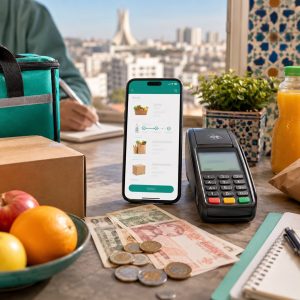
A $7 Billion Market Running on Courier Bags and Instagram DMs
Algeria’s online retail sector crossed a critical threshold in 2025: according to CODRocket’s Algeria E-Commerce COD Guide, the market is estimated at $7 billion and growing at 25% annually, with over 30 million internet users active on social and shopping platforms. The country has 3,679 live Shopify stores, up 34% year-over-year, and a new wave of small merchants is moving from informal Facebook and Instagram selling toward structured storefronts.
But underneath this growth lies a structural fragility. Ecommaps’ 2026 research on Algerian e-commerce documents what practitioners already know: over 85% of transactions still run on Cash on Delivery (COD), the country has no mature fulfillment hub network, and the logistics infrastructure covering all 58 wilayas relies almost entirely on a handful of courier companies — Yalidine Express, ZR Express, Maystro, and EcoTrack — operating without unified software integration.
The consequence is an economy where merchant capital is constantly frozen in transit: parcels sitting in courier depots, COD cash held for J+3 to J+14 before remittance, and return-to-sender (RTS) rates that quietly consume 5–9% of gross merchant revenue per order cycle. Algeria is not alone in this predicament — COD dominance characterizes most MENA markets — but it is uniquely exposed because leading MENA markets are already building the infrastructure layer that transforms COD friction into profitable quick commerce. Algeria’s fulfillment infrastructure is entering its next phase.
Why Fulfillment Infrastructure Is the Unlock
In advanced e-commerce markets, “fulfillment infrastructure” means dark stores, micro-fulfillment centers, and merchant warehousing hubs positioned close to population density. A dark store is a retail space repurposed as a mini-warehouse, stocking fast-moving SKUs within a 3–5 km radius of the customer, enabling sub-30-minute delivery without the cost of a physical storefront.
Algeria does not yet have a functioning dark store ecosystem. What it does have is a first-generation logistics layer built for parcel delivery, not inventory proximity. This distinction matters enormously for merchants.
When a COD order is refused at the door — return rates reach 25–40% in some product categories according to the MENA COD State of the Market 2026 report from eGrow — the parcel makes a full round trip. The merchant pays for both legs of delivery. The product is tied up for 5–10 days in transit and depot handling. The cash never materializes. In a business running on 25–35% gross margins (typical for Algerian fashion or electronics merchants), a 30% return rate on 35% of orders is not a fulfillment problem — it is a solvency event in slow motion.
The solution is not to eliminate COD — that battle will be won over years, not months, as digital payment penetration climbs. The solution is to shrink the cost of each failed delivery by bringing inventory closer to the customer, shortening delivery windows, and building operational intelligence that flags high-risk orders before dispatch.
Advertisement
What Algerian Merchants Should Build Now
1. Treat a Wilaya Storage Node as a Capital Investment, Not an Overhead Line
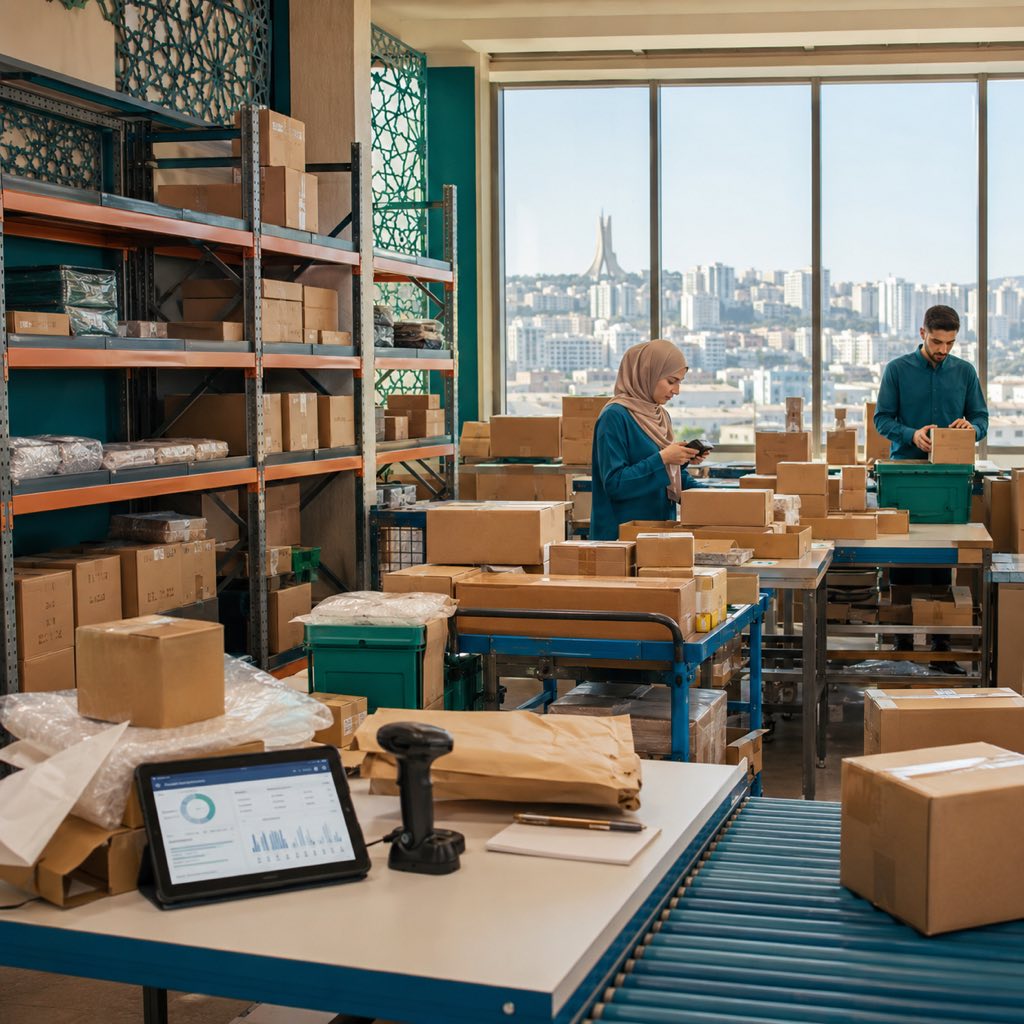
The most actionable step for a merchant doing 50+ daily orders is to establish a storage node — not a full warehouse, but a 50–200 m² depot space — in the wilaya that generates the most volume. For most Algerian online sellers, this is Algiers, then Oran, then Constantine.
A wilaya node serves three functions: it allows same-day or next-day delivery within the wilaya (cutting the RTS window from 5–7 days to 1–2 days); it reduces courier pick-up costs because the courier collects from a fixed point rather than a residential address; and it gives the merchant a physical location to verify high-value orders before dispatch, which directly suppresses fraudulent COD attempts.
The capital requirement is modest. A 100 m² storage lease in Bab Ezzouar or Cheraga typically costs 50,000–80,000 DZD per month. A merchant moving 100 parcels per day who reduces their RTS rate by 10 percentage points will recover that rent cost within a single billing cycle in saved re-delivery fees alone.
2. Negotiate COD Remittance Schedules Upfront — and Use Float Productively
The standard COD remittance window across Algerian logistics providers runs from J+3 (Yalidine’s best-tier offer for high-volume merchants) to J+14 (the default for small merchants on basic plans). This float is not merely inconvenient — it is a structural liquidity risk for businesses that need to reorder inventory weekly.
Merchants who negotiate a J+3 or J+5 remittance schedule by demonstrating volume consistency can unlock working capital that peers are losing to logistics float. Concretely: a merchant doing 3,000 DZD average order value at 80 orders per day with a J+14 remittance is floating ~3.36 million DZD in outstanding cash at any given moment. Moving to J+5 recaptures roughly 2.16 million DZD in accessible working capital — enough to fund a month’s restock without credit.
The negotiation leverage is order volume and RTS rate. Logistics providers offer better remittance terms to merchants who maintain RTS rates below 20% because low-RTS merchants reduce their own operational load (fewer re-delivery attempts, less depot storage of refused parcels).
3. Integrate Blacklist and Order-Scoring Logic Before Building Anything Else
Before investing in storage nodes or renegotiating logistics contracts, every Algerian COD merchant should implement order-scoring: a lightweight system that assigns a risk score to each incoming order based on phone number history, address delivery density, product category, and order value.
Ecommaps’ platform documentation describes how shared blacklist networks — where multiple merchants flag fraudulent phone numbers and addresses — can suppress RTS rates by 8–15 percentage points versus merchants operating in isolation. In the Algerian market, where a single fraudulent address can generate 20–30 returned orders from different sellers before being flagged, shared intelligence is a collective public good that no individual merchant can produce alone.
The practical implementation requires no custom software. The three main Algerian e-commerce SaaS platforms — Ecommaps, Lexi, and Shopify Algeria integrations via EcoTrack’s API — all offer order history lookups and basic blacklist matching. A merchant who enables this filtering before dispatch will prevent more RTS events than they can recover from after the fact.
The Dark Store Opportunity: First Movers Have a 3-Year Window
Algeria is approximately where Egypt’s Breadfast was in 2021: a high-COD market with fast-growing consumer demand, no dominant quick-commerce operator, and logistics infrastructure too thin to support 30-minute delivery at scale. Breadfast spent 2021–2024 building the vertically integrated dark store model that turned it into Egypt’s dominant quick-commerce player before raising $10 million from EBRD in 2025.
The equivalent opportunity in Algeria is real but fragmented. According to Globe Newswire’s Africa and Middle East Quick Commerce Report 2026, the Africa and Middle East quick-commerce market was valued at $3.2 billion in 2024 and is projected to reach $4.9 billion by 2029 at an 8.9% CAGR. North Africa’s trajectory is following MENA’s established growth arc, with Algeria well-positioned for the dark store rollout.
The first Algerian operator to build a network of 5–10 dark stores in Algiers (Bab Ezzouar, Kouba, Dar el Beïda, Annaba) will inherit the same structural advantage Breadfast holds in Cairo: density begets speed, speed begets loyalty, loyalty begets the data that makes the model defensible. The window for first-mover positioning is approximately 2026–2028.
Where This Fits in Algeria’s 2026 E-Commerce Ecosystem
Algeria’s e-commerce sector is at an inflection point that is well-understood in retrospect but poorly visible in real time. The formal e-commerce registration regime introduced under Law 18-05 is forcing the informal seller economy toward structured platforms. The government’s 2030 digital economy target of 20% GDP contribution creates policy tailwinds for logistics investment. And the COD-heavy market dynamic, while often framed as a problem, is actually a structural protection for domestic logistics operators against foreign platform entry — no international quick-commerce giant has found the Algerian market attractive enough to compete directly with local couriers.
The merchant who treats fulfillment infrastructure as a strategic asset — not an operating cost — will be positioned to benefit from the next phase: the partial shift from COD to Baridi Pay, CCP-linked QR payments, and eventually card-on-file checkout that is slowly expanding through formal merchant registration. Each percentage point of digital payment penetration directly improves fulfillment economics, because a failed digital payment is a cancelled order, not a returned parcel with two delivery fees attached.
The gap is wide. The window is open. The merchant who builds first will not need to compete on price — they will compete on reliability, which in Algeria’s current market is the scarcest commodity of all.
Frequently Asked Questions
What is a dark store and does Algeria have any?
A dark store is a retail space repurposed as a mini-warehouse, stocking fast-moving products close to urban population centers to enable 30-minute delivery. Algeria does not yet have a functioning dark store network — the country’s quick-commerce infrastructure remains in its first generation, dominated by parcel courier services rather than proximity-stocking models. The MENA dark store market is projected to reach $12.1 billion by 2030, Algeria’s dark store ecosystem is in an early growth stage with significant expansion ahead.
Why do COD return rates in Algeria reach 25–40%?
High COD return rates stem from several converging factors: low digital payment trust leading buyers to order speculatively, limited address verification (many deliveries go to informal addresses without GPS coordinates), and the absence of order-scoring systems that flag high-risk buyers before dispatch. Product categories like fashion and electronics see the highest return rates due to size/fit uncertainty and buyer’s remorse. Merchants who implement phone number blacklists and address scoring can reduce their RTS rate by 8–15 percentage points.
How can a small merchant start improving fulfillment without large capital?
The most accessible first step is enabling order-scoring through existing e-commerce platforms — Ecommaps, Lexi, and EcoTrack’s API integration all offer basic blacklist matching at low cost. The second step is negotiating a J+5 COD remittance schedule with Yalidine or ZR Express by demonstrating volume consistency and a sub-20% RTS rate. A wilaya storage node requires 50,000–80,000 DZD/month in lease cost and is viable for merchants at 50+ daily orders — significantly below the threshold most merchants assume before they model the return on saved re-delivery fees.
Sources & Further Reading
- Algeria E-Commerce COD Complete Guide 2026 — CODRocket
- The Digitization of E-Commerce in Algeria — Ecommaps
- The State of COD E-Commerce in MENA 2026 — eGrow
- Africa and Middle East Quick Commerce Report 2026 — Globe Newswire
- Algeria eCommerce Market Forecast — Statista
- E-commerce in Algeria 2026: Laws and Commercial Register — Ecommaps
🔗 Related Intelligence

Algeria’s $1.7B E-Commerce Market After Jumia: Local Merchants Race to Fill the Gap

Algeria’s E-Commerce Boom: 92% Annual Growth and What Comes Next for Digital Merchants
Algeria E-Commerce Logistics: API Unification Cuts Merchant Friction in a $7B COD Market

AfCFTA Digital Trade: How Algerian E-Commerce Merchants Can Reach African Markets