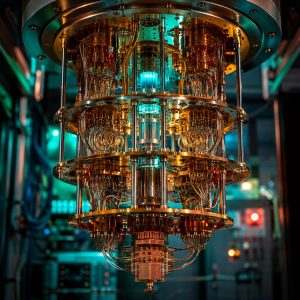
The 30-Year Problem That Willow Just Solved
Since Peter Shor introduced quantum error correction in 1995, physicists have chased a seemingly paradoxical goal: adding more qubits to a quantum system while making it less error-prone rather than more. For three decades, every attempt to scale up quantum processors increased noise faster than error correction could suppress it. In December 2024, Google’s Quantum AI team announced in Nature that their 105-qubit Willow processor had finally broken through that barrier.
The breakthrough is called “below threshold” error correction. Google tested surface code arrays at increasing sizes — 3×3, 5×5, and 7×7 grids of qubits — and demonstrated that each step up in grid size cut the encoded error rate by a factor of 2.14. The trend is exponential: double the grid, halve the errors. That is the fundamental requirement for building a fault-tolerant quantum computer, and no one had achieved it in a superconducting system before Willow.
What the Benchmark Actually Means
Google’s headline number is dramatic: Willow completed a Random Circuit Sampling (RCS) benchmark in under five minutes that would take the world’s fastest supercomputer 10 septillion (10^25) years — a duration vastly exceeding the age of the universe. The number is real, verified, and published in Nature.
But context matters. RCS is a benchmark specifically designed to be exponentially hard for classical computers. It does not solve any known practical problem. It proves that quantum hardware can outperform classical hardware on at least one task — an important scientific milestone, but not the same as useful quantum computing. Google itself has been transparent about this distinction, positioning Willow as milestone two on a six-milestone roadmap toward commercial quantum applications.
Advertisement
Beyond Breakeven: Why Logical Qubits Matter
The more consequential achievement is what Google calls “beyond breakeven.” Willow’s logical qubit — the error-corrected unit that encodes information across multiple physical qubits — achieved a lifetime more than twice that of its best constituent physical qubit. This means the error correction system is actually improving the hardware’s performance, not merely compensating for it.
The system ran for up to one million error correction cycles over several hours while decoding errors in real time and maintaining performance. That sustained operation demonstrates engineering maturity, not just a one-shot physics experiment.
In October 2025, Google followed up by demonstrating quantum advantage in portfolio optimization — solving financial optimization problems 13,000 times faster than classical supercomputers — the first real-world application where Willow showed practical value beyond benchmarks.
The Race Is On: IBM, Microsoft, and the Road to Fault Tolerance
Willow does not exist in a vacuum. IBM is targeting verified quantum advantage by the end of 2026 using its 120-qubit Nighthawk processor and already deploys 433-qubit Condor systems for research. Microsoft has unveiled topological qubits, an entirely different physical approach that trades current qubit counts for potentially better error resilience at scale.
The common bottleneck is the same: fault-tolerant quantum computing will likely require millions of physical qubits, not hundreds. Willow’s 105 qubits are a proof of concept, not a production system. Google has opened a Willow Early Access Program (proposals due May 15, 2026) for external researchers, signaling that the next phase is collaborative experimentation, not commercial deployment.
What This Changes for the Industry
Willow’s error correction breakthrough shifts the quantum computing conversation from “if” to “when.” Before Willow, the field’s central question was whether quantum error correction could work at all in superconducting hardware at meaningful scale. That question is now answered. The remaining questions — how to scale from 105 to millions of qubits, how to reduce costs, and which applications will reach commercial viability first — are engineering problems, not physics puzzles.
For enterprises, the practical timeline remains long. Most experts project commercially useful fault-tolerant quantum computers are at least a decade away. But the industries that will benefit first — drug discovery, materials science, financial optimization, and cryptography — should be tracking these milestones closely. The gap between “laboratory curiosity” and “strategic planning concern” just narrowed substantially.
Frequently Asked Questions
What did Google’s Willow quantum chip actually achieve?
Willow is a 105-qubit superconducting quantum processor that demonstrated below-threshold quantum error correction for the first time. As surface code arrays scaled from 3×3 to 5×5 to 7×7 grids, the error rate halved at each step — proving that adding more qubits makes the system more reliable, not less. It also completed a benchmark computation in under 5 minutes that would take the fastest supercomputer 10 septillion years.
Is quantum computing now ready for practical business applications?
Not yet. Willow’s benchmark (Random Circuit Sampling) does not solve any real-world problem. While Google demonstrated quantum advantage in portfolio optimization in October 2025, fault-tolerant quantum computers capable of general commercial applications will likely require millions of physical qubits. Most experts estimate this is at least a decade away. The industries most likely to benefit first are drug discovery, materials science, and financial optimization.
How does Willow compare to IBM’s quantum computing efforts?
Google’s Willow (105 qubits) focused on error correction quality, becoming the first to demonstrate below-threshold performance. IBM is pursuing scale, with 433-qubit Condor processors deployed and a target of verified quantum advantage by end of 2026 using its 120-qubit Nighthawk. Microsoft is taking a third approach with topological qubits. All three face the same challenge: scaling from hundreds to millions of qubits for fault tolerance.
Sources & Further Reading
- Meet Willow, Our State-of-the-Art Quantum Chip — Google Blog
- Quantum Error Correction Below the Surface Code Threshold — Nature
- Making Quantum Error Correction Work — Google Research
- Google Debuts New Quantum Chip and Roadmap Details — HPCwire
- Google Opens Early Access to Willow Quantum Processor — The Quantum Insider